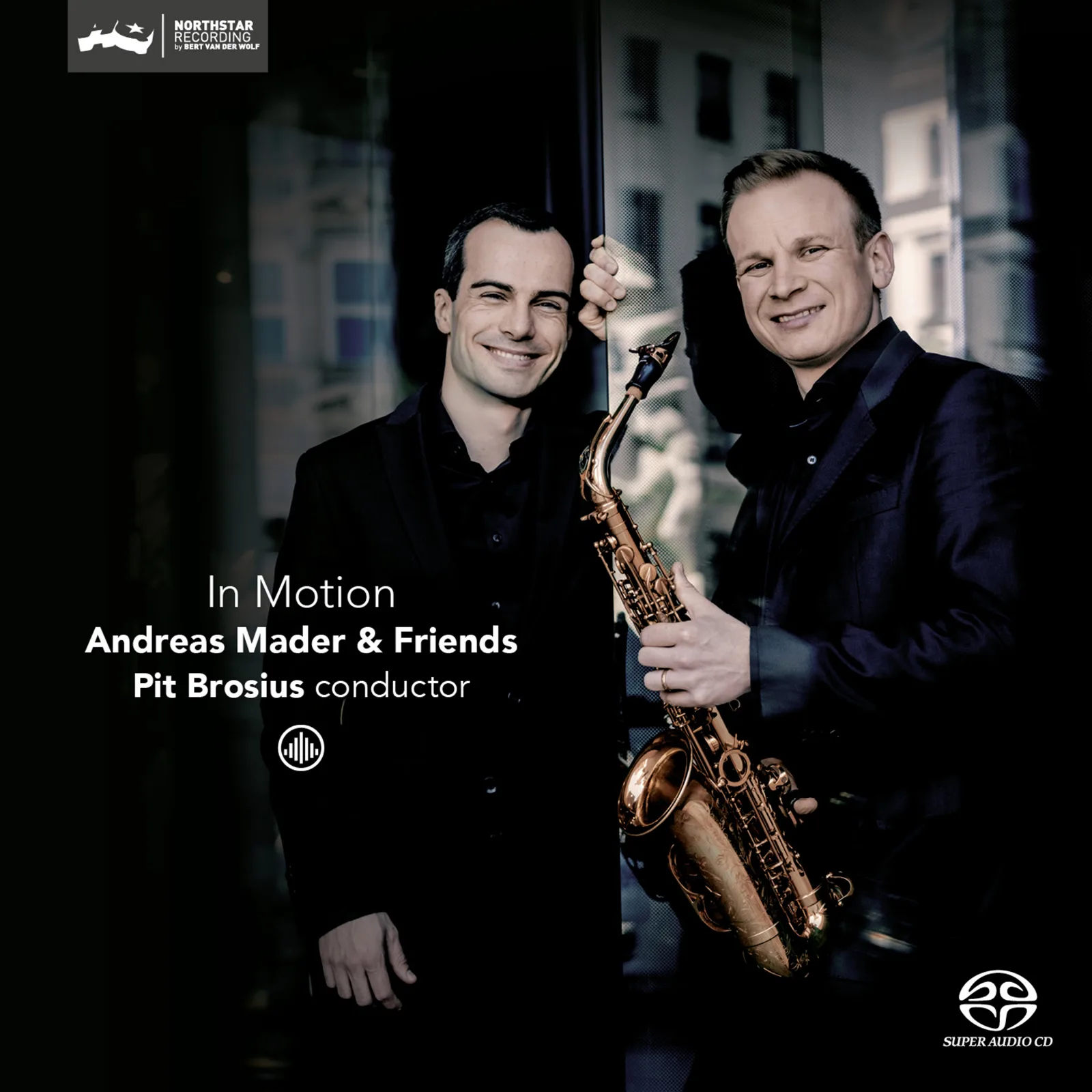
Motion as a guiding principle: that is the starting point of In Motion, the new album by Austrian saxophonist Andreas Mader, recorded with a select ensemble of eleven musicians under the direction of conductor Pit Brosius. The programme is skillfully assembled around the theme of time and motion, and offers a surprisingly coherent journey through nearly a century of chamber music, from neoclassicism to contemporary American music.
The album opens with the Concertino da camera by Jacques Ibert (1890-1962), a staple in the saxophone repertoire. Mader approaches the piece with precision and spirit; especially the second movement – considered by Ibert himself to be his best work – receives here a beautiful, restrained interpretation of touching melancholy. The outer sections, by contrast, burst with rhythmic playfulness: the ensemble responds alertly to every turn, effortlessly captures every tonal colour and follows Mader in every emotional nuance. It is music that simply brings joy, especially when played with such vitality and mutual understanding.
Next comes the Sonatine-Tango by Pierre-Max Dubois (1930-1995), originally written for bassoon and piano, here arranged by Brosius himself. It is an eccentric, breathless four-part work full of character, in which the dance rhythms that recur throughout the album come to the fore nicely. The arrangement for saxophone is skillfully executed and fits seamlessly with the spirit of the original; here too the ensemble supports the sax admirably, with a fine sense of timing and timbre. Various facets of the tango – now fierce and driven, then restrained and lyrical – thus come into their own beautifully.
With Its Motion Keeps by Caroline Shaw (°1982) we enter a different world. The piece was originally written for choir with viola or cello, and is based on an American shape-note hymn – a simple form of communal singing popular in the nineteenth century, where the notes were not notated with ordinary staves but with recognizable shapes, so that untrained singers could easily read from it. Here it has been arranged by Hy-Khang Dang for violist Nikita Gerkusov and ensemble. A constantly repeating viola motif runs through it, like the ticking of a clock, while strings and winds continually alternate with each other, like two choirs thoughtfully responding to one another, so that it almost sounds like Renaissance music. At just over eight minutes, it is immediately the longest piece on the album: a breathing space between the more virtuosic sections, one that invites reflection.
The Fantasia para Saxophone is the only work by Heitor Villa-Lobos (1887-1959) with saxophone as a solo instrument. Here it sounds in a revised version in which Brosius enriched the original string apparatus with additional woodwinds and reduced the number of horns from three to one. The result is a surprisingly transparent, colourful interpretation that brings out the Brazilian folk influences and the almost impressionistic compositional style of the composer. Different moods alternate with each other, and Mader succeeds in portraying them one by one with a fine sense of rhythm, the right tone and breathing space. Once again the ensemble supports him with precision, especially when the tension builds in the final section Très animé.
From the Second Violin Sonata by Maurice Ravel (1875-1937) only the middle section is presented, Blues – here reworked by Hy-Khang Dang into a dialogue between violin and saxophone, with ensemble. It is immediately one of the most remarkable moments on the album: it sounds as if you are briefly transported to a smoky café where a small jazz band from Ravel's own time is playing. Violin and saxophone complement each other beautifully, and the ensemble gives the whole the finishing touch. A daring arrangement that completely convinces.
The cd concludes with a suite from El amor brujo by Manuel de Falla (1876-1946), arranged for the full ensemble by Hy-Khang Dang. Those familiar with the lavish orchestral version need to take a moment to adjust, but the excellent musicians make that comparison quickly fade away. The famous Ritual Fire Dance receives the expected fierceness and punch, but what stays with me most is how that raw, earthy energy permeates every section of the suite – one could not wish for a better conclusion to this richly textured and varied album.
Throughout the entire hour, the quality of the eleven-member ensemble stands out. It plays with much attentiveness and sense of atmosphere, exactly what this varied programme requires. Mader himself switches effortlessly between alto, tenor and soprano saxophone and displays technical fluency and great expressive power in each register. The recording, made at the Trifolion in Echternach by Bert van der Wolf (Northstar Recording), is of high quality: spatial, natural and rich in detail. Especially in surround, the sound places the listener right in the middle of the ensemble, with a tangible sense of depth between the different instrumental groups.
In Motion is a thoughtfully and freshly programmed album that looks beyond the usual saxophone repertoire. By allowing compositions from different eras and traditions to speak to each other on the theme of time and motion, it creates a listening experience that is both intellectually stimulating and purely musically enjoyable. For lovers of chamber music with saxophone – and for those curious about how diverse composers as Ibert, Shaw and De Falla can approach the same theme – this is a recommendation.