

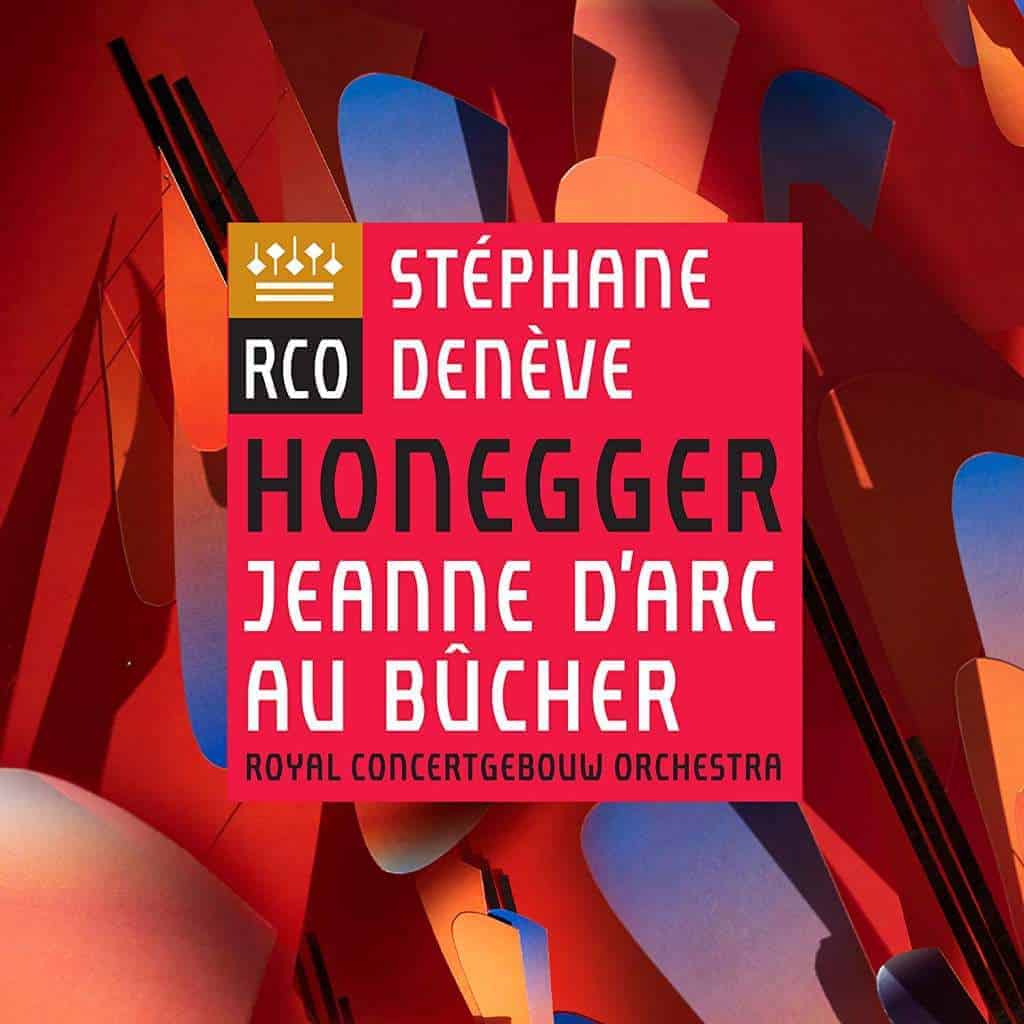
**** This dramatic oratorio is rarely programmed. At the moment it is receiving considerable attention in our cultural world through the production presented by the Münch theater under the direction of the provocative director Romeo Castellucci. That production is discussed elsewhere on these pages. Those who want to get acquainted with the work or hear it again afterwards have an ideal opportunity with the recent recording that the Koninklijk Concertgebouworkst releases of a concert performance in Amsterdam with the excellent chief conductor of the Brussels Philharmonic Orchestra, Stéphane Denève.
Arthur Honegger was born in France in 1892 and died of a heart attack in Paris in 1955. His parents were Swiss. Honegger studied first in Zürich, but from 1911 he came to Paris. Although his education was mainly French-oriented, he had great admiration for Johann Sebastian Bach. He was part of Le Groupe des Six which was founded in 1920. His breakthrough came with the oratorio Le Roi David. He stood out with his symphonic poem Pacific 231, which evoked the then modern fast locomotive. His oeuvre is very extensive with orchestral works, chamber music, ballets, film music, operas and oratorios. Towards the end of his life he tends towards a religious outlook on life, which is reflected in his dramatic oratorio Jeanne d'Arc au bûcher (1935) and later in La danse des Morts (cantate sacrée) – also on text by Paul Claudel - and the Symphonie liturgique (1946).
Jeanne in men's clothes
Jeanne d'Arc lives on as the legendary, simple girl who lived during the Hundred Years' War between England and France and claimed that at thirteen she heard heavenly voices urging her to fulfill a historical mission. In 1429 she went into battle with the dauphin against the English and led his army, with which the occupied Orléans was liberated. She convinced him to have himself crowned King of united France as Charles VII in Reims. In Compiègne she was captured and sold to the English. They handed her over to the Bishop of Beauvais, Pierre Cauchon. He brought a trial against her, whereupon she was condemned as a heretic, whore and witch. On May 30, 1431 she died on the stake. One of the accusations of the ecclesiastical court that contributed to the verdict was that she – contrary to biblical precepts - wore men's clothes. Something she did for protection against rape. In 1456 that judgment was overturned and she was restored to honor. In 1920 she was canonized. Paul Claudel (1868-1955), the Catholic author and librettist of Honegger described her as follows: "This is the immortal Jeanne d'Arc who at the threshold of modern times was recognized as the patroness of our national unity."
Dramatic musical fresco
Honegger composed a very versatile and diversified work. He strives to convey the religious and lyrical impact of the piece as sharply as possible and for this purpose resorts to the sharpest contrasts, ranging from simple unison of children's songs to the most polyphonic richness of modern orchestral language. The piece is like a musical fresco that in a cinematic way lets the life of Jeanne pass by, whose martyrdom was meant to serve the liberation of the French people in the Christian tradition. In flashback she relives the final moments of her life. The contemplative passages are text fragments that are spoken. The smaller sung parts tell the story, sometimes from a heavenly perspective, sometimes banal and earthly. Gregorian tones alternate with realistic sounds or dance rhythms, here and there mixed with electronics. Rather than an 'opera' the piece resembles a medieval mystery play, as a mirror of a contemporary experience. Choir and orchestra are the connecting element of the drama, which is divided into eleven scenes and to which Honegger, almost ten years after its creation, added a prologue in which the choir calls upon Jeanne to unite the land, which lies in deep darkness.
For the work both speaking voices and singers are required, in addition to a choir, children's choir and orchestra. The recording discussed here was made live in the Concertgebouw in Amsterdam on September 27 and 28, 2018.
Stunning command of sound
As expected, the Royal Concertgebouw Orchestra is outstanding in applying the rich instrumental palette in these eleven scenes plus prologue in which Jeanne sees the film of her short life pass by. The prologue begins very quietly – almost inaudibly – as a moment of concentration upon which the choir then enters and the ondes martenot immediately create a mystery and otherworldliness. The orchestra is stunning in the rich and emotionally charged passages that evoke so many changing expressions of fear, mystery, satire (Jeanne livrée aux bêtes), and abandonment. The dog's yelping, the playful music during the political card game (scene VI) or the nightingale's song: everything is laid down in a highly evocative manner. A magnificent performance by choir and orchestra, a tour de force of concentration and musical mastery by conductor Stéphane Denève. The conversations between Frère Dominique and Jeanne are thoughtful and resigned or hallucinatory depending on the scene (part V). Both actors, Jean-Claude Drouot and Judith Chemla, are extremely convincing. Chemla brings varying nuances to her voice from scene to scene: poetic, ecstatic, youthful, fearful, bewildering as in a dream. Moving is the final scene in which she relives her mission as 'daughter of God'. The small vocal parts of La Vierge (Claire de Sévigné) and Marguerite (Christine Goerke) are excellently performed. The choir gives moving responses, the basses at the end of scene VI with the verdict Qu'elle meure par le feu is spine-chilling. The choir culminates in the final scene in a kind of dialogue with Jeanne, where the orchestra also reaches an impressive apotheosis.
The luxurious booklet accompanying the recording is very carefully produced and contains an interesting explanatory text – also in Dutch. Each scene is briefly described, which is certainly a help for a work that does require some effort when listening. An ideal recording, therefore, to get to know this masterpiece of twentieth-century repertoire. A dramatic oratorio that moves, but in its layering also confuses and requires a fascinating performance such as this to continue to captivate. Certainly a work that will appeal even more with the added benefit of a visual performance, which the Munt is currently offering…
- WHAT: Jeanne d'Arc au bûcher – Arthur Honegger (1892-1955)
- WHO: Royal Concertgebouw Orchestra, Rotterdam Symphony Chorus and Netherlands Children's Choir conducted by Stéphane Denève
- VOICES: Judith Chemla (Jeanne), Jean-Claude Drouot (Frère Dominique), ...
- RELEASE: RCO 19001