

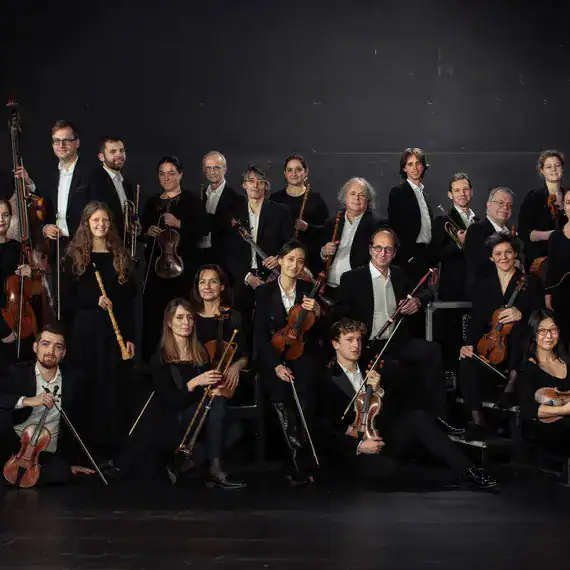
On Saturday, June 7, the Vlaams Radio Koor and Il Gardellino, with a selection of soloists (Ida Falk Winland, soprano, Ambroisine Bré, alto, Nick Pritchard, tenor, and André Morsch, bass) under the direction of Bart Van Reyn, presented an impressive tribute to the Haydn brothers at Flagey.
The programme featured the rarely performed Requiem (1771) by Michael Haydn (1737-1806), alongside the widely known Nelsonmesse (1798) by Joseph Haydn (1732-1809). A bold combination that turned out wonderfully, for how often do you hear works by Michael alongside those of his famous brother Joseph in a single concert?
In times of fear and need, music can be a particularly powerful, comforting companion. This remains as true and urgently relevant today as it was during the lifetime of the Haydn brothers in the eighteenth century.
Requiem, Michael Haydn
If Michael Haydn's works are performed at all, they tend to be his lighter compositions. This is strange, because during his lifetime he was lauded by the Mozarts and by Schubert for his religious works, which they regarded as highly as the religious works of his older brother Joseph. Joseph, incidentally, found his little brother's masses more beautiful than his own, and upon hearing Michael's Requiem, you might almost agree with him. The Requiem we heard this evening is one of his most imaginative works that deserves a place alongside other great works from that period.
Van Reyn provided an introduction to the context of this Requiem. Michael composed the work in a mere two weeks, in December 1771, following the death of Prince-Bishop Sigismund Count Schrattenbach, his patron. But behind the official occasion lay a personal tragedy: a few months earlier, his only daughter, Aloisia Josepha, had died before her first birthday. It is quite possible that Mozart – then still young – participated in the premiere of the work in Salzburg (violin or organ), and that he recalled it when writing his own Requiem, twenty years later. What we would now call 'plagiarism' was then regarded as tribute: musical quotation was a form of respect. Van Reyn pointed out that Mozart's references were probably unconscious, but all the more striking as homage to his friend.
If you are familiar with Robert King's more measured recording, you might have been startled by the infectious dynamism that emanated from this interpretation, but Van Reyn's fervor was perfectly fitting. It was as if the dead were summoned to rise from their graves dancing.
The Vlaams Radio Koor sang, as always, with natural phrasing, flexible and clear, restrained yet fiery. The soloists – initially deployed as a kind of semi-chorus – gradually opened up and gained increasing presence. Il Gardellino played with infectious fire: lively, precise, and as a perfectly coordinated ensemble. Soloists, chorus, and orchestra brought forth the full emotional spectrum of the work, and reminded us that there are still many musical forgotten pearls waiting to be rediscovered.
Nelsonmesse, Joseph Haydn
This was followed by the confrontation with Joseph Haydn. In his introduction, Van Reyn explained his choice of the Nelsonmesse. Both works share a smaller instrumentation – without woodwinds and with similar orchestration – a consequence of wartime economies at the court of Haydn's employer. Although Haydn later allowed his publisher Breitkopf to add extra parts, we heard the original version this evening.
Joseph Haydn composed his Missa in angustiis – the 'Mass in Times of Need' – during the turbulent Napoleonic years. Later, the work became known as the Nelsonmesse, because Admiral Horatio Nelson is said to have attended the mass in Eisenstadt, following his victory over the French at the Battle of the Nile.
Anyone who thought that only Mozart's Requiem brought somber minor tones into the idealized world of Viennese classical music learned otherwise this evening after listening to this Mass. The "Kyrie" and "Benedictus" – both Van Reyn's favorite sections of this composition – and the "Sanctus," which unexpectedly begins pianissimo, are among Haydn's most poignant compositions. If you listen carefully, you can even recognize the beginning of Beethoven's Fate Symphony in the Benedictus, Van Reyn pointed out. The mass did not end in a conventionally meditative setting of the "Dona Nobis Pacem," but in joyful excitement. The threat of war had (temporarily) receded …
The performance under Van Reyn's direction conveyed vividly how fervently Haydn appeals to his God for help. Both chorus and orchestra showed themselves at their most expressive, dramatically charged, and homogeneous. The soloists performed their parts with great intensity. The ensemble sounded forceful and combative where needed, sometimes rebellious, but was equally capable of becoming hushed and moving, as in the "Qui tollis" (Gloria) or the "Et incarnatus" (Credo), where time seemed to stand still. Van Reyn's tempo brought the score into sharp focus and kept the listener on the edge of his seat from beginning to end.
During this performance, Haydn's minor-key composition received a stunning rendition that penetrated musically into the dark sides of life, only to then celebrate the triumph of Life in radiant tones.
We may rightly be proud of the quality of our own classical ensembles. The Vlaams Radio Koor remains a jewel: musically precise, emotionally apt and with crystal-clear diction. Il Gardellino impressed with playfulness and finesse, light-footed and communicative – with a smile on their faces – even in the most demanding passages.
Both works were recorded over the past few days. It promises to be a promising CD release that we can rightly look forward to after this concert.