

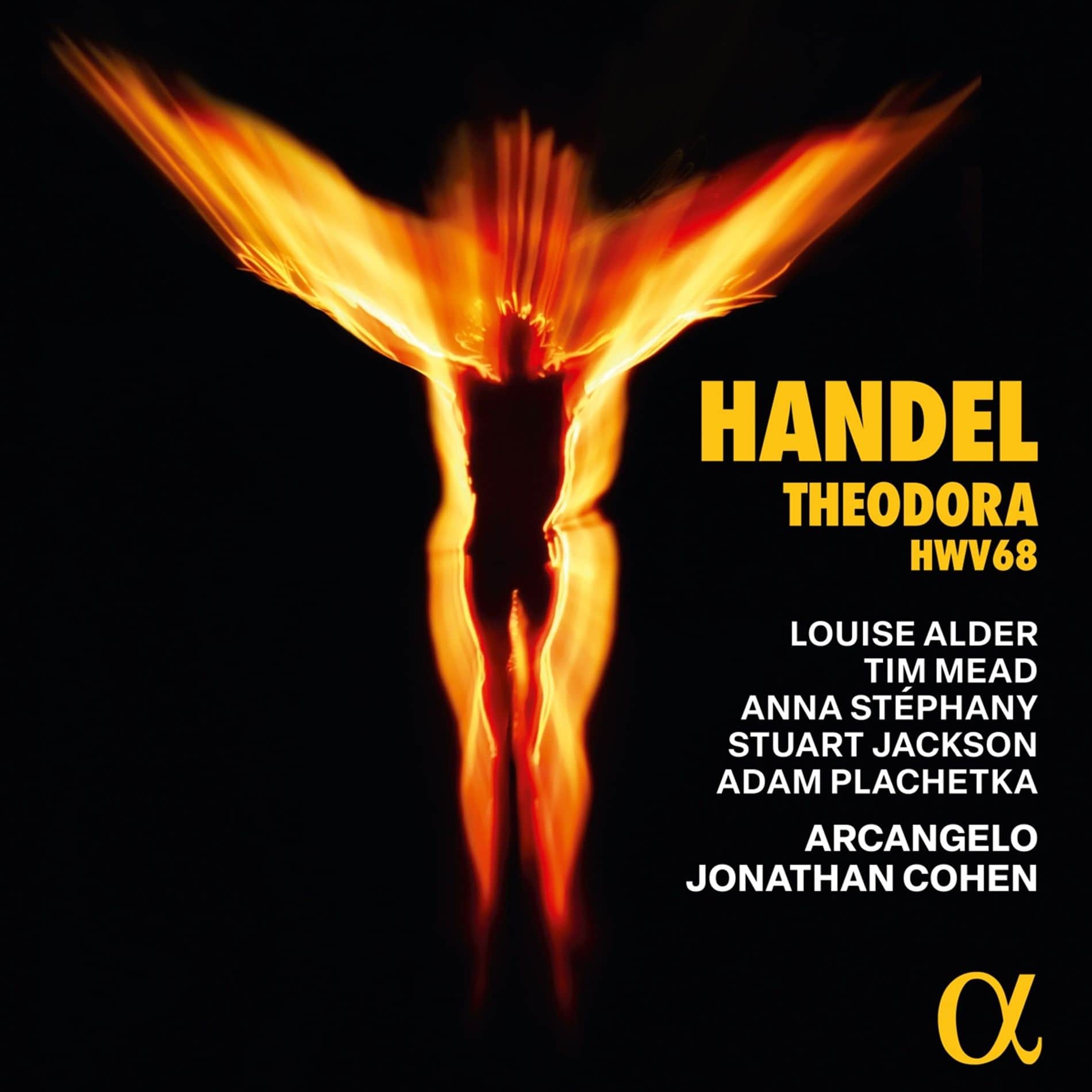
The oratorio Theodora discussed here, conducted by Maxim Emelyanychev on the Erato label, is a true jewel, but I also had high expectations of this new performance under Jonathan Cohen. However, that was quite disappointing, I even turned pale at it. But more about that later, because first a few things about the opera itself and what preceded it.
Händel's popularity as an opera composer had declined considerably in London around 1740, while at the same time he had responsibility for a theater company that had grown quite large. So he tried to turn the unfavorable tide not only for him by improvising on the theater organ during (sometimes numerous) scene changes, although that hardly helped: his popularity continued to decline.
Deeply disappointed, he seriously considered leaving the British capital and testing his talents in Dublin. However, this plan came to nothing, because contrary to expectations, his brand new oratorio Messiah proved to be a real blockbuster, which was further boosted by the success of a new prestigious series of concerts (with subscriptions!). Händel decided to remain in London and there surprise his audience with his oratoria and subscription concerts. As if he had seen the light anew: public taste had changed, opera was clearly 'out', the oratorio 'in'. Within a period of barely ten years they flowed from his industrious pen: Belshazzar, Hercules, Joseph, Judas Maccabeus, Semele, Jeptha and...Theodora.
Händel, now 64 years old, began Theodora in June 1749, his penultimate oratorio. Only Jeptha would follow, which he completed on 17 February 1751 not without emotion with 'Reached here on 13 February 1751, unable to go on owing to weakening of the sight of my left eye.'
Theodora had all the qualities that made the oratorio meet the expectations of the affluent class: a Christian subject, a gripping narrative and also performed in the English language (so that everyone could easily follow the action). Yet there was an important downside: the deep tragedy that pervades the piece and so also ends it. His good friend Thomas Morell (1703-1784) had again provided the libretto, which was based on a work by Robert Boyle (1627-1691): The Martyrdom of Theodora and of Didymus, published in 1687. Boyle in turn had heavily borrowed from Théodore, Vierge et Martyre by Pierre Corneille (1606-1684). No one was concerned about plagiarism back then, or what looked very much like it...
Within a couple of months Händel had already completed the oratorio, after which it premiered on 16 March 1750 in the well-known theater in London's Covent Garden. There was undoubtedly some applause after the performance, but not much, as it turned out to be a complete flop. After three performances the work was withdrawn from the repertoire, never to return (the last time was in 1755).
From a historical perspective, two causes have been put forward for years. First, the fact that the London public had little interest in the persecution, condemnation, martyrdom and death of a Saint (Theodora as a Christian martyr, in love with the Roman Didymus who had converted to Christianity: according to legend both were beheaded) and second the earthquake that, a week before the premiere, caused many lovers (including some of the middle class as well as numerous patrons and wealthy nobles) to flee the city. But there is a third reason: the extremely somber character of the oratorio, further reinforced by the associated slow tempi in the various parts. According to London music historian Charles Burney (1726-1814), public interest was so poor that Händel was forced to hand out free tickets to 'scholars' (connaisseurs) so that the hall could at least be reasonably filled. But it helped little, as so few people showed up that according to Burney the empty space in the hall could even be danced in, with the chairs pushed to the side... And Händel exclaiming to his friends, who had come and found themselves facing an almost empty hall: "It doesn't matter, the music will sound all the better for it!"
One may perhaps wonder how little public acclaim the work received at the time in London, for whoever hears the oratorio now can hardly fail to conclude that it is among the best that Händel has produced in this genre. But if it is not performed accordingly, the listener is left with a hangover. And that is clearly the case with this new recording.
The misery begins already in the three-part overture which in fact, as far as Cohen's direction is concerned, sets the tone: that of sluggish tempi and unnecessary emphasis on melodic and harmonic details, alongside peculiar tempo changes, dynamic exaggerations and phrases wrenched out of context. Of course, a straightforward interpretation is not to be expected, but this is certainly no exemplary model of text visualization as should also be expressed in the instrumental parts and is disrupted by mannerisms. Even then the best vocal acting cannot save this oratorio. But even that is not the case, for why engage vocalists who stylistically have far too little experience with this (Baroque) repertoire and who have traded clarity for sloppy diction and truly unpalatable vibrato? The latter so pronounced that I often had no idea whatsoever what was actually being sung; unless the libretto was consulted.
Fortunately there are exceptions, such as the crystal-clear soprano voice of Louse Alder as Theodora, the always reliable countertenor Tim Mead as Didymus and the Czech bass-baritone Adam Plachetka as Valens who is well aware of his role, while the choral contribution (Christians and Heathens) certainly exudes considerable authority, but with that the positive aspects are unfortunately exhausted. And who thought of including the lute part in the continuo and giving it such a dominant auditory role??