

The table of contents can be found here
Scarcely any composer developed a distinctive style from the very beginning, and Claude Achille Debussy (1862-1918) was no exception to this rule, though some nuance is certainly in order here.
Around his twentieth year, he stood as a tone poet and pianist amid what was then considered popular and cultural entertainment in France, particularly in Paris: the composing and playing of melodious pieces, mostly miniatures, in an admittedly entertaining but also quite predictable style, specifically intended for home music-making by more advanced amateurs. Although there were certainly also pieces whose virtuosic character marked a sharp dividing line between amateur and professional. Among the composers who engaged with the genre were Georges Bizet, Camille Saint-Saëns, Jules Massenet and Eduard Lalo.
One might thus think that Debussy steeped his piano works in such a style during that period, but this is only sporadically the case. Not only because they are not markedly virtuosic, but also because the joie de vivre so rooted in the music of that era (although often with a hidden depth) is conspicuously absent as a stereotype. Examples of this are also to be found on this album, foremost among them the Suite bergamasque, the Deux Arabesques still under the influence of Edvard Grieg (ca. 1890) and the Nocturne reminiscent of Chopin (1892). The Tarantelle styrene (1890, rev. 1903), by contrast, is virtuosic, has a scherzo character and was created in the same period as the Suite bergamasque. Although stylistic elegance predominates in the majority of these pieces, they already contain elements as precursors of Debussy's later, mature style.
Pour le Piano (1894, rev. 1901) is one of the first piano works in which the mature style already announces itself convincingly. The piece is not free from the exoticism that was also popular at the time (the Javanese gong sounds in the Prélude speak the language of the mysterious East), undoubtedly inspired by the World's Fair in Paris in 1889 where, among many exotic instruments, the gamelan could also be seen and heard. The entire piece breathes a rare, blended atmosphere of old and new, with its distinctive, sustained harmonic effects (the sophisticated use of the pedal plays an important role), the far from ordinary fusion of legato and non-legato, the many dissonant chords that refuse to resolve into consonants, and furthermore the diatonic-governed, triumphant cadence.
Though the piece may allude stylistically to baroque dance forms, it is above all its ambiguous character that expresses itself in the cheerful appearance of simplicity in the rhythmic nature of the Sarabande and the metric ambivalence in the concluding Toccata (in which the spirit of Domenico Scarlatti hovers).
The appearance of simplicity in the Sarabande? Yes, for it is deceptive. While the outer sections still fall under what might be called traditional writing (although the Prélude is no longer supported by classical proportions and a new harmonic 'language' is already recognizable in the Toccata, albeit in a way that its swollen ending represents more of a genuflection to Romanticism), the Sarabande, by contrast, stands out through the new tonal relations we already find in the Sarabande (Souvenir du Louvre) from the Images oubliées, as a reference to a painting in the Louvre - in the far from ambiguous key of C-sharp minor from the same period (1894). It is a tonal language that can dispense with full-fledged chords and optimally conveys the 'light-footed sadness' that hangs over the piece.
In Estampes (1903), it is again the characteristics of the gamelan that draw attention, but the Javanese mood is determined above all by the ingeniously developed pentatonicism, the series of five tones (not a scale) which here – unlike Grieg's equally pentatonic Morgenstimmung - creates a distinctly oriental atmosphere.
While it may seem somewhat fashionable, especially in light of the World's Fair, the fact remains that Debussy succeeded at that time as no other in unfolding an entirely new sonic world, keeping his distance from an orientalist-oriented musical 'travel guide'. In the CD booklet, the pianist explains it as follows:
'Javanese 'mood', inescapably orientalist to twenty-first century minds, is enhanced by the remarkably non-Western melodic marking 'délicatement et presque sans nuances'. Java had neither chords nor pagodas, but Debussy was fashioning a new world in sound, not a travel guide. Melodies and harmonies float, 'normal' rules suspended; Lisztian filigree stands still; stasis supersedes development. Fourths, fifths, seconds, and unisons, their merging of vertical and horizontal bringing Debussy closer to Schoenberg than either might imagine, create a world unmistakeably 'other', though necessarily anchored in Debussy's own.'
It is tempting to view Debussy's music at least in part in the light of impressionism from the perspective of the then fashionable visual arts (Cézanne, Renoir, Degas and others), of which the two sets Images (which incidentally have nothing to do with the Images pour orchestre) would then serve as an explicit example. The composer did not comment on this. However, he wrote to his music publisher Durand about the first set: 'Without false pride, I feel that these three pieces are fine works and will find their place in piano literature to the left of Schumann or to the right of Chopin.'
The first set was created between 1901 and 1905, the second in 1907. Both groups of three pieces each are similar in their design.
The opening section of the first triptych is intimately naturalistic in coloring. Reflets dans l'eau, the musically masterfully worked out suggestion of reflections in the water, certainly recalls Liszt's equally enchanting Les jeux d'eau à la Villa d'Este. La Mer as a reflection of an infinite and rough sea is far removed here.
The second section is intended as a tribute to Rameau (in Debussy's words: 'dans le style d'une Sarabande mais sans
rigueur'). Without 'strictness' then, which in this case means that only the basic tempo, in the form of a stately, baroque dance, recalls earlier times, because the music seems more akin to the introductory measures of Wagner's Parsifal!
The third section, Mouvement (Movement) is that in the most literal sense: very moving indeed, although this only applies to the underlying rhythm. The piece already foreshadows the later Études but also connects easily with a sonata by Domenico Scarlatti (for whom Debussy must have harbored great admiration).
The opening section of the second triptych, Cloches à travers les feuilles, (Bells ringing through the leaves), is dominated by - it has become an eloquent formula - the indefinite, constructed in a polyphonic world from the whole-tone scale, gradually transitioning into the bright and sunny E major. Along the way, tonality is suggested rather than confirmed. Alfred Cortot recalled Debussy's painting as that of barely perceptible leaf rustling with the distant echo of gamelan sounds in the distance.
The second section, Et la lune descend sur le temple qui fus (And the moon shines on a former temple), was dedicated by Debussy to his friend, the sinologist Louis Laloy, who is said to have given him the title. Once again we hear the sound of the gamelan, and just as clearly as in Pagodes. It is pure musical imagination, of a landscape at rest, illuminated by soft moonlight and so melodically strongly constructed that this little piece could have managed even without harmonic support. It is, like the other sections not discussed here, a textbook example of what a Debussyesque 'image' can achieve.
The exuberant, extroverted and virtuosic L'isle joyeuse (1904) is unthinkable without the French singer Emma Bardac, with whom the composer maintained an intense, extramarital love affair. What preceded it?
Like many wealthy Parisian women around the fin-de-siècle, Madame Bardac regularly held musical soirées in her salon, where many artists of all kinds made their appearance, including Gabriel Fauré. In 1877, his fiancée, a Parisian singer, had abandoned him, which nearly drove the already troubled composer to despair and subsequently plunged him into a loveless and soon completely embittered marriage; as a result, he indulged in numerous extramarital escapades. One of these involved Emma Bardac, a beauty seventeen years his junior who responded to his advances. The Dolly Suite was the almost direct result of this, for Fauré composed in the period 1893-1896 this collection for piano four-hands especially for Emma's daughter Régina Hélène, or Dolly. Fauré thoughtfully provided each section with a title that related in some way to events or interesting facts about the Bardac family. Emma herself was - how could it be otherwise - a source of inspiration, as evidenced by the song cycle La bonne chanson, completed by Fauré in 1894. That she was his muse for a considerable time is thus quite obvious, even though the relationship did not endure.
In October 1903, Fauré made way for a new 'lover', Debussy, then 41 years old and only a few weeks younger than Emma. Like Fauré, Debussy had stayed 'close to home' for some time by giving piano lessons to Raoul, Emma's son. And like his predecessor, Debussy too fell for the extremely charming, attractive, worldly and not unmusical Emma. Whether Lilly was aware of this love triangle from an early stage is certainly likely, but certainly not at first, when she still accompanied her husband to the soirées. It is possible she did get wind of it, for soon after, Debussy began to visit alone. Emma's world was in any case not that of Lilly, whom she found far too cosmopolitan and furthermore had little appreciation for Emma's refined charms. This must have suited Debussy perfectly, for it cleared the way for what would become a passionate love affair.
By this time, Debussy had tired of Lilly. In July 1904, he even sent her to her parents, only to go on a secret vacation with Emma shortly after. The destination the couple had chosen for this undoubtedly intense rendezvous was the island of Jersey, where Debussy brought the love-filled L'isle joyeuse (The joyful island) to manuscript paper. Only to revise the work substantially immediately upon returning to Paris. A different, more familiar setting resulted in different, equally more familiar insights, it seems.
Lilly, on the other hand, saw only a dark future. After Debussy had made it clear to her that their marriage was over, she took a pistol, went to the Place de la Concorde and attempted suicide. After Debussy learned from her doctor that Lilly had survived, he moved in with Emma anyway. In Parisian society circles, stories and rumors were rife, and a scandal seemed inevitable. Debussy's heartless conduct was especially resented, and it didn't help that he refused to pay Lilly's medical bills. And because he refused to budge, musicians and other artists organized a collection for the impoverished wife abandoned by her husband. Things didn't go smoothly for Debussy either, and it must have been particularly painful for him that so many friends and acquaintances wanted nothing more to do with him. The newlywed couple saw fit to leave and departed for England to wait out the storm raging over their heads until it had at least subsided somewhat.
The blissful L'isle joyeuse is part of the well-known Trois pièces of 1904 (the title does not come from the composer), which also include Masques and D'un cahier d'esquisses. Bringing them together under this common title was not such a strange idea, for apart from the year of their creation, there are certainly resemblances to be found between these three pieces. All three are not set up contrapuntally and lack the characteristic quality of the etude. This is not to say they are simple pieces: the amateur will find them quite challenging and the professional may scratch his head too. Both musician and listener find themselves confronted with the ambiguous tonality that emerges here and there in an atmosphere of evocative and chiseled suggestion. The titles perfectly match the musical content: Masques is a masquerade wrapped in dancing color richness, D'un cahier d'esquisses is intended as music from some sketchbook whose correct direction has not yet been found, and is therefore quickly brought to a conclusion (the more dreamlike piece takes less than five minutes).
The last piece of this triptych, L'isle joyeuse, is anything but dreamy, but rather bright, sunny and euphoric. According to experts, it is also partly based on a painting by Jean Antoine Watteau (1684-1721): L'embarquement pour Cythère, depicting a group of notables dressed in festive attire embarking with the Greek island of Kythira as their destination, the birthplace of Aphrodite, who according to mythology was born from the foam of the waves surrounding the island, after the genitals of Uranus were cut off by his son Saturn and fell upon her. Aphrodite, the goddess of love but also of beauty, sexuality and fertility. She was (her nickname was not without reason Kythereia) worshipped in ancient Greece as the goddess Urania. On the island, the ancient Greeks built a temple in her honor.
Debussy employed an exceptionally refined pen for many of his creations, his musical imagination based on movements, events, circumstances, natural elements, landscapes. The dynamics are deliberately often limited, as there is also that magical suggestion of silence and peace, often inspired by the purity of creative perception. Music that through its illustrative character possesses an almost hypnotic beauty, and through this is pure and inviolable. The expressive gradations seem virtually endless.
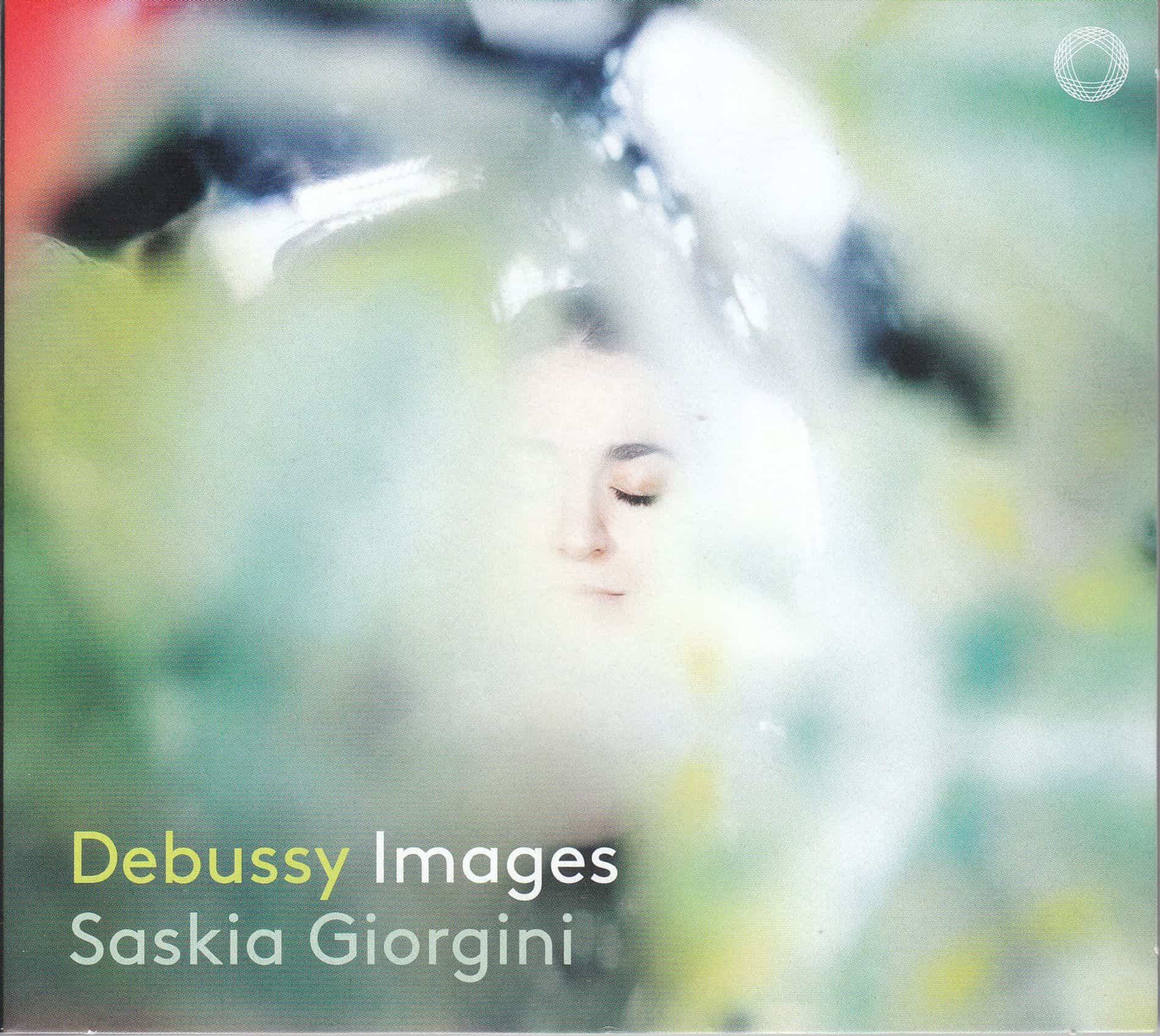
That brings me to the playing of Italian-Dutch pianist Saskia Giorgini, which strongly reminds me of that of her French colleague Pierre-Laurent Aimard (or going much further back, Dutch pianist Hans Henkemans), through its adventurous character, the impression as if these were brand-new compositions. But also through that very special combination of precision and adventure. These are interpretations that from beginning to end evoke the much-desired magic that ensures a unique listening experience. Giorgini, and fortunately as time progresses she is not alone (the list of brilliant interpreters only grows longer), rightly chose optimal clarity in the voicing, the articulation is phenomenal, and the enchanting element in both the melodic and harmonic progression does not stem from the imposed mistiness, the vagueness, that is so often equated with French impressionism. There is at the same time much charm in her playing, but like Aimard it remains far removed from the ethereal or affected. Stylistically there is a considerable gap between their playing and that of, for example, Arturo Benedetti Michelangeli, for many still the touchstone regarding a more personal (not necessarily better, but different) approach to this very specific idiom. Giorgini proves herself in these pieces to be 'modern' and thus completely free from historically acquired baggage. The sonorous yet clear recording helps considerably in this regard. The Bösendorfer perfectly intonated and tuned by Siebren van Hoog is as magnificently captured as the exemplary piano playing of Saskia Giorgini.