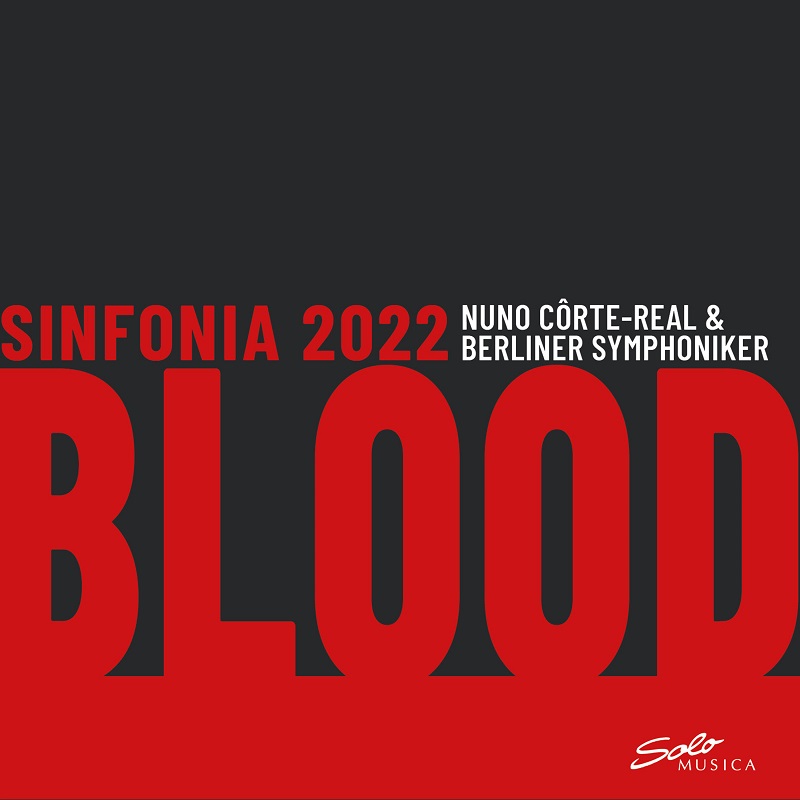
When this CD arrived at the editorial office, I was immediately intrigued. War and finance, that seemed like an interesting angle to me. Nuno Côrte-Real (°1971) brings them together on one CD and recognizes the same logic of power, greed and destruction in both: the visible catastrophe of war in the Sinfonia 2022, the less visible but equally destructive forces of financial power and corruption in the Banksters Suite – two works that are separated by more than a decade in creation time, but here sound surprisingly strongly as two expressions of the same contemporary issue. The result is music that wants to communicate emphatically without reducing itself to a simple programme – only that doesn't always work equally well.
A world out of joint
The Sinfonia 2022, op. 70, was written on commission from the Teatro Nacional de São Carlos in Lisbon and premiered there on 13 January 2023, with the Orquestra Sinfónica Portuguesa under the direction of the composer. After a revision, the current version sounded on 13 April 2025 in the Berliner Philharmonie, with the Berliner Symphoniker under the direction of Côrte-Real, and was recorded immediately afterwards for this CD. You should not look for programmatic illustration music in it: Côrte-Real does not prescribe images, but builds tension fields in which the listener can create meaning themselves. Yet the whole sounds anything but abstract.
In Search of Darkness immediately draws the listener into a feverish, rousing whirlpool of sound full of threatening brass outbursts. The deliberately monotonous drum part at times adds a bitter feeling: from the start there hangs an oppression, fuelled by a fearful obsessive theme. Then comes a surprising moment of stillness – a sacred-tinged organ intermezzo with a beautiful solo of woodwind and xylophone, while the ominous brass sometimes slinks through underneath – before the penetrating opening material returns, announced by drum rolls. A remarkable experience, this first part: even though you are far from the horrors of war, this accessible music brings it uncomfortably close nonetheless.
Song of Death is initially more subtle: from an alto saxophone solo, Côrte-Real builds a refined chamber music texture that gradually culminates in a waltz with something furtive and spectral – a danse macabre from which no one seems to escape. The Mahlerian resonances are clearly audible without Côrte-Real falling into being an epigone, and it is precisely here that his feeling for orchestral colour shows itself most strongly. Yet the part lacks Mahler's restless variation drive: Côrte-Real lingers too long in the same tension zone, as a result of which the music loses its grip over time. Yet the build-up to the climax still convinces, although the ending is unnecessarily drawn out for my taste.
In contrast to this stands Nuclear Marching Band, a grotesque march full of derailed rhythms, shrill brass fanfares and organ, which depicts the madness of displays of power and destruction. The comparison with Shostakovich is obvious, although Côrte-Real is more direct and less subtle: where Shostakovich could evoke a world of irony with a single gesture, Côrte-Real too often opts for the grand gesture. That makes his music immediately accessible, but causes attention to slacken over time.
And then comes the ending – not a pathetic rush of victory, but a gradually built-up, simple melody that invites contemplation. I know not what tomorrow will bring takes its title from the last words Fernando Pessoa wrote down on 29 November 1935, the day before his death. Côrte-Real withdraws here from the violence of the preceding parts: the music becomes light, but never reassuring – rather a metaphysical suspension than a solution. The orchestration is beautiful, the recurring melody and the creeping undertone come together perfectly, sometimes on the edge of the explicit, but it works. At the moment when I thought this symphony had lost me, this finale gripped me after all.
The direct communicative power of this symphony is at once its strongest and most vulnerable quality. Côrte-Real possesses an exceptional feeling for orchestral colour and knows how to make tension immediately perceptible, but in the middle sections he remains too long within the same tension zone. With less of it, there could have been more to it. The Berliner Symphoniker meanwhile give themselves completely: the orchestra plays superbly and gives this work the full force. That the finale removes the doubt after all underscores the power of that final section – it could itself form a moving, independent work that poignantly expresses the feeling that many experience with every senseless war.
Violence without gunfire
The six-part Banksters Suite, op. 75, leads to another form of disorder. It is distilled from the eponymous opera from 2011 about the downfall of financier Santiago Malpago – the title immediately reveals the programme: bankers and gangsters are combined into one word. It is not Côrte-Real's concern to present a realistic portrait of the financial world, but to present an allegory of a society in which materialism, power and appearance are intertwined with each other.
Diabolic Vision and Fight opens aggressively and unstably, immediately captures your attention and keeps you in suspense. Musically well-crafted, but here too the material sometimes spins in the same groove for too long. Mimi Kitsch offers a more transparent, lyrical sound image, while in Angelino Rigoletto a dark undertone creeps in. Santiago Malpago sounds fragmented and threatening. The ultra-short The Murder, by contrast, works like a sudden violent explosion.
Besides the opener, Redemption is the strongest part: cello, bassoon and English horn receive an elegiac melody, while double bass, bass clarinet and horn give the music a dark, withdrawn shine. Malpago's last words – "take my soul to safe harbour" – take on an ambiguous meaning here: redemption as insight, not as acquittal. It is precisely in this section that Côrte-Real proves what he is capable of when he deploys his familiar effects less emphatically: rock background, film music experience and romantic orchestral idiom melt together into his own, distinctive language.
The sharp orchestral outbursts and the electric guitar work well as contrast, but the surprise effect is quickly exhausted. Côrte-Real himself says he wants to be free from aesthetic currents and circles; in Diabolic Vision and Fight and especially in Redemption you can really hear that independence. It's a pity that the rest of the suite doesn't always reach that level.
Much asked for, not always delivered
The Berliner Symphoniker prove themselves particularly well-equipped to handle this stylistic mixture. Côrte-Real conducts with a clear sense of where the tension points lie and does not constantly seek maximum impact – the moments of restraint also get space. This way the contrast between lyrical strings, dark woodwinds, sharp brass and the sometimes almost rock-like percussion comes across convincingly. The recording, made from 15 to 17 April 2025 in the Teldex Studios in Berlin, sounds clear and spacious, with sufficient depth and without smoothing away the sharp edges of brass and percussion – precisely what this repertoire needs.
BLOOD is not an easy comfort album, but neither is it an accusation that imposes its meaning on the listener. Côrte-Real possesses a distinctive musical language of his own, in which Mahler and Shostakovich, film music and rock meet each other. When he doses his means, that yields powerful and sometimes moving music. In particular I know not what tomorrow will bring and Redemption show how much potential lies in his compositional imagination. The performance by the Berliner Symphoniker also lifts the less convincing passages above themselves.