

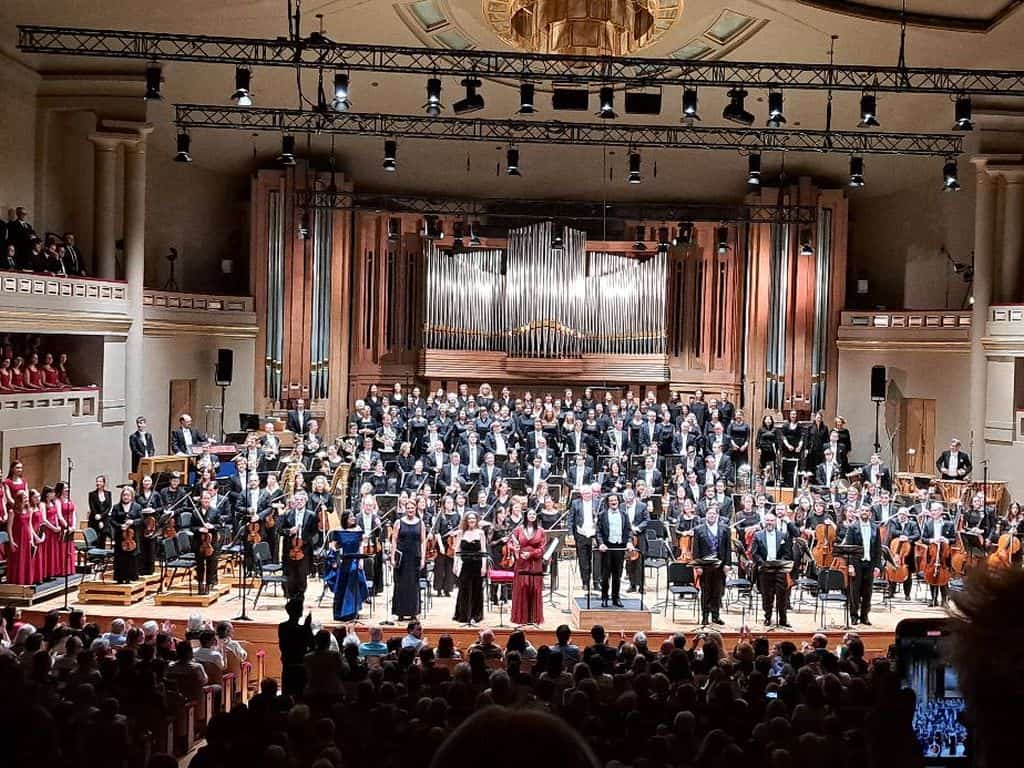
That number 8 is truly special. Without a doubt a sung symphony. Mahler had already introduced voices and choirs into his symphonic work before, but now the voices receive treatment as if they were instruments. For, Mahler thought, isn't the voice also the most beautiful human instrument?
He considered his 8th symphony his best work to date, composed in 1906. He was proven right at the premiere in 1910. It was a brilliant success. No classical four-movement structure this time, two movements sufficed, very different but both equally impressive. And when you saw all those musicians on stage and even in the boxes, that was indeed impressive. His publisher christened the work the "Symphonie Der Tausend". At BOZAR there were somewhat fewer, but still enough to justify that term.
Three federal institutions joined forces for this: BOZAR, the orchestra and choir of De Munt (including choir academy, children's and youth choir), the Belgian National Orchestra, 8 soloists and in addition, the Vlaams Radiokoor. Number of instruments? Not only strings, woodwinds, percussion, but also a harmonium, piano, celesta, electric organ, (not the one at BOZAR, still recovering from the fire…) even a mandolin. You've never heard so many together and so overwhelming at the opening of a symphonic work.
It sounded truly deafening. Whether it also sounded good to the refined ear of Alma Mahler is questionable. Did he have to please his wife with this to win her back into the family fold? But this masterful work was in any case a compositional tour de force. And yes, there were also lyrical passages in which soloists and choirs, but also the orchestras could shine, culminating in a delicately soft Sylvia Huang violin solo. But everything built back up to a climax where the audience from the royal box was almost blown away by blaring trumpets and trombones.
"Nicht diese Töne", Beethoven would say now for the completely different second movement. No longer based on the Gregorian Whitsun hymn "Veni Creator Spiritus", but this time on the closing text of Goethe's romantic Faust tale. All those performing artists, for that's what you can call all those musicians and singers, artists, pull us fully into that story. Sometimes muttering and then again exuberantly. Because Mahler wrote as if singers were instruments, their voices sometimes immerse themselves in Mahler's real instrumentation, the jubilant orchestra. That carried us to higher spheres, to an ending that must radiate redemption, away from earthly troubles and sorrows and spurred on by shrill trombone blasts, once again from the royal box.
Love triumphs in Faust, so Mahler also hopes to save his marriage. What we experienced was in any case a triumph for the three federal institutions, triumph for all the musicians and above all, triumph for conductor – standing ovation – Alain Altinoglu.