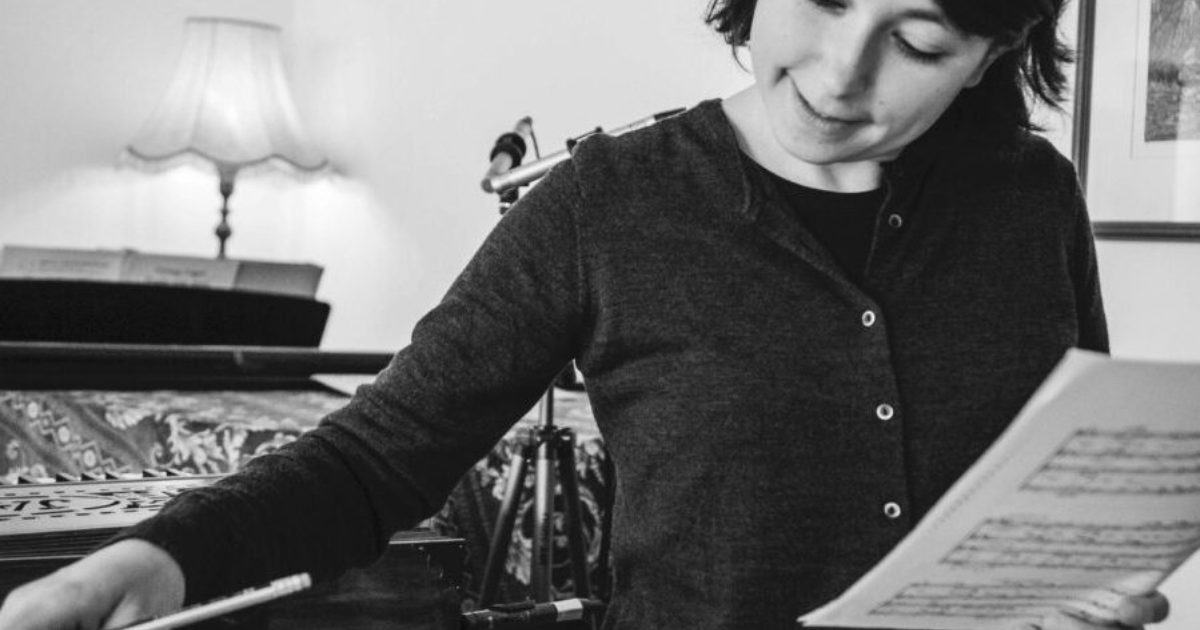
On the occasion of the world premiere of Sci-Volo Palla on Saturday, June 20 during the Tectonics Festival at Flagey, Werner De Smet spoke with composer Maya Verlaak for Klassiek Centraal about her investigative compositional practice, in which calculation, musical relations, technology, and uncertainty converge in a system that only takes full shape in performance.
Composition as Contextual Research
Maya Verlaak doesn't start her work from sound alone, but from the full context of a compositional commission. Every new work begins for her with a critical analysis of the situation in which it will function. "I'm not afraid to learn new technologies or techniques," she explains, which has led in her practice to skills in programming, woodworking, metalworking, and soldering: "As long as I keep learning new things, I can keep moving forward."
She argues that it's crucial for a composer to approach every commission as a research project. She grew up in an artistic environment where analysis and observation were central. Her father, artist Patrick Verlaak, taught her from a young age how to deconstruct a work. "We often visited both contemporary and classical art exhibitions, and my father always gave me detailed explanations for each piece, which made it easy for me to engage with them."
Control, Calculation, and Notation
Verlaak questions conventions within contemporary music practice. "I don't understand why some composers choose to stay within the lines," she says, "you're then following something someone else determined for a different context, at a different time, with different values and rules." For her, a composition is a construction of musical material, connected by musical relations within a specific concept. Though she's often called a conceptual composer, she nuances this: "It's never about me, but about communicating the concept to the musicians and the audience."
At the same time, for every composition she makes extensive calculations examining all possible outcomes. For each piece, there are hundreds of pages of calculations. A piece is only truly finished for her when she delivers the score, because at that moment she knows all the parameters of her concept and further calculation is no longer possible. At that point, she lets go of control and it's up to the musicians to explore the parameters within the built constraints.
Tectonics and the Work as System
For her work within the Tectonics Festival, Verlaak collaborates with Brussels Philharmonic and conductor Ilan Volkov. She previously participated in Tectonics in Glasgow, where she encountered the work of Christian Wolff. On the boundary-pushing nature of the festival, she's clear: "You can go very far, I see no limits, because every musical concept must be presented in the right way, otherwise you're only presenting half the idea."
The starting point of the new work lies in an investigation into the rhythmic behavior of overtones, an idea that emerged from an earlier collaboration with pianist Marlies Cornelis. In Sci-Volo Palla, she transfers this to strings, written for soloists Sarah Saviet and Jasmijn Lootens, whom she fully trusts in this experiment. The soloists must search for overtones without pressing the string down with their fingers, only through the bow. The search for sound is part of the material itself. Though the soloists function within a fragile and unpredictable system, the orchestral material itself is notated entirely conventionally. For Verlaak, the tension lies not in improvisation, but in the relations between timing, listening, and response.
Time, Uncertainty, and Performance as Process
Based on this process, Verlaak developed a computer program that analyzes each attempt by the soloists and converts it into three-part scores, which she calls "postcards." When the scores of both soloists overlap, as many as 36 different melodic layers can sound simultaneously. In total, six hundred postcards were generated. As a tangible part of the project, Verlaak plans to distribute all 600 postcards to the audience. This gives the listener literally a fragment of the system in their hands; the audience becomes the owner of a piece of the musical puzzle.
In the performance, a system emerges in which soloists, conductor, and orchestra are interdependent. Though some describe this kind of work as a "social experiment," Verlaak emphasizes that this is not a predetermined main concept, but rather a consequence of how her musical systems function. Within this system, the oboist and bassoonist also play a crucial role through electronics. They can use a pedal to transform the orchestral sound live into the source material. This intervention serves as a form of confirmation: it makes the underlying relations in the composition audible to everyone. Though the structure is fixed, the timing remains unpredictable: "I never know how something develops in time; I always know very precisely what can happen but not when." The role of conductor Ilan Volkov is crucial here: he functions as the communication medium that must listen and decide when the orchestra is to come in.
Musicians and Collaboration: From Rehearsal to Teaching Practice
The musicians in this work are invited to understand the underlying relations within the material. Verlaak indicates that some musicians experience this as a discovery, while others find it exciting because familiar certainties are missing. They stand on an extremely fragile stage, where the focus shifts from individual virtuosity to a collective ability to grasp the 'game.' According to her, virtuosity here shifts from playing a melody to concentration, playing the 'game,' and communicative ability among musicians. She prefers to work with musicians who have an "explorer's attitude."
At the same time, Verlaak emphasizes that her current approach has become less radical than in her earlier work, partly due to the changed context in which she composes today and works with larger structures such as a symphonic orchestra. This investigative attitude carries through to her role as a teacher at the Amsterdam Conservatoire. "Students learn best from examples in the field," she explains, bringing everything she learns from her own practice into the classroom. At the same time, she also learns from her students; their diverse backgrounds push her to "be more tolerant in relation to all kinds of music" and remain more flexible in her own approach to the craft.
Audience and experience
Verlaak does not view the audience as passive spectators. "The audience is an adventurer in that context," she says, "you give them something to discover." She describes the work as a labyrinth without a fixed exit. "I want people to get lost," she states, "they may search for the way out, but they may also simply remain in the labyrinth." The work is structurally static; it doesn't progress toward another point, but instead offers the time and space for a personal journey of discovery within the whole.
Her drive to continually seek new forms is inexhaustible: "I believe that each new work needs a new form to be clearly communicable; if I pour different ideas into the same form over and over again, then you don't fully communicate the idea." She hopes that projects like this contribute to a future where concert life is not only about passivity, but about active engagement to better understand ourselves.
Ultimately, a creation succeeds for Verlaak when the musicians and audience feel the freedom to explore the material as independent discoverers. In a time when concert life often tends toward more passive forms of listening experience, her systems force us into an active, layered way of listening. "Come without expectations," is her advice to the listener at Flagey. "That's what I do too." It is in that shared uncertainty that Maya Verlaak's music finds its greatest strength.