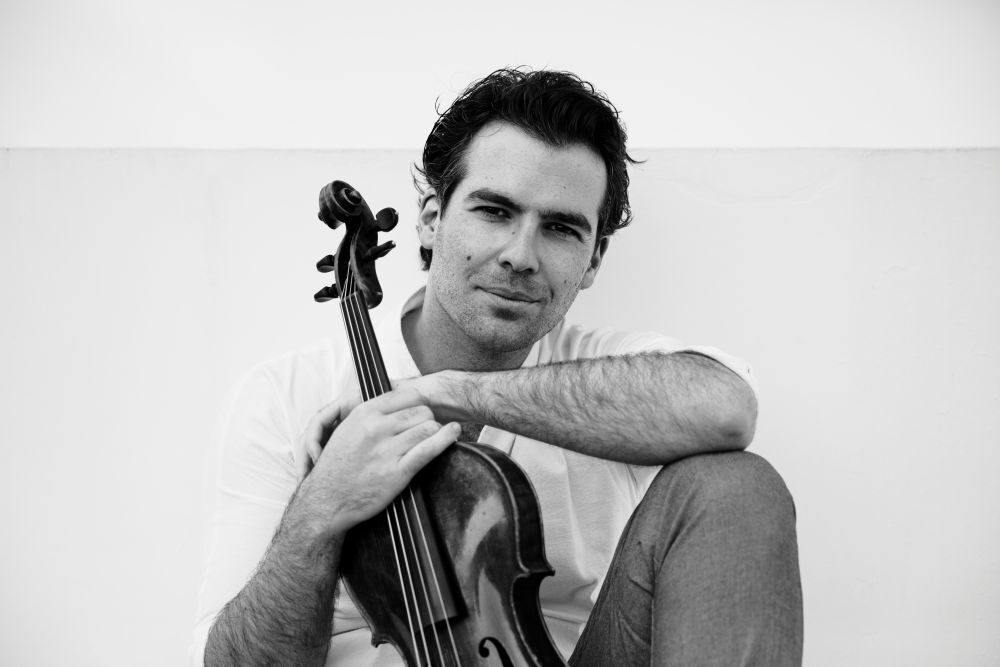
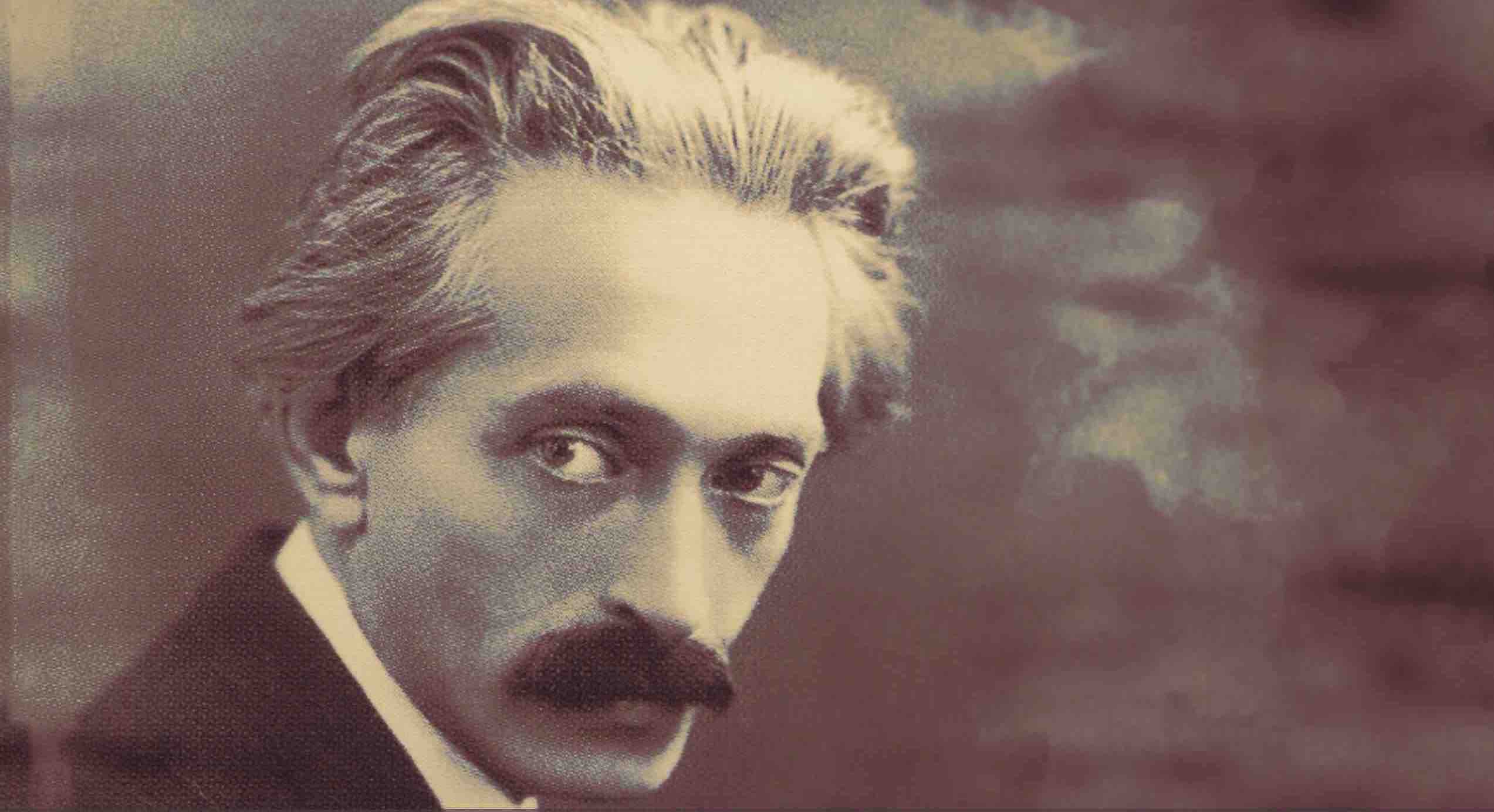
British pianist Jonathan Powell once again confirms his dual status as a musical treasure hunter and brilliant pianist with this CD featuring works by the obscure Russian composer Grigory Krein (1879-1955). Of the nine compositions on this CD, eight have never been released before.
Grigory Krein was part of a group of Russian-Jewish composers that also included his brother Abraham, Joseph Achron, and Alexander Veprik. These were composers who, in the first three decades of the twentieth century, incorporated increasingly more Jewish elements into their music alongside various foreign influences. What united them was the combination of worldly and sacred Jewish motifs with influences from Impressionism and Romanticism.
That we know so much about this great unknown figure in Russian music is thanks to the biography that his son Yulian dedicated to his father.
That Grigory would become a musician was written in the stars. His father was a klezmer violinist, poet, and folklore collector, and all seven of his sons became musicians. Young Grigory began his musical career as a violinist, but quickly switched to composition when he realized he lacked the perseverance needed to become a virtuoso. In 1905, he established himself as a violin teacher and married one of his students. The couple traveled to Berlin and Leipzig to study, so that Grigory could pursue composition studies. In Berlin, he witnessed performances by Strauss, D'Indy, Saint-Saëns, and Grieg. He also became acquainted with Debussy's work, which would have a lasting influence on him.
He received an invitation from Max Reger to join his composition class. However, it would only last a few lessons. Reger's initial enthusiasm quickly cooled when the stubborn Grigory refused to comply with his request to compose simpler works. He continued his studies with Reinhold Glière, but this teacher too soon lost patience with his obstinate student.
Back in Moscow in 1909, the most successful period of his career began. A performance of his First Sonata in the presence of Scriabin and Medtner caused a sensation. Even greater successes followed in the years leading up to the Russian Revolution, but then hard times came. Grigory was forced to give violin lessons again.
In the twenties, the musical climate in the Soviet Union improved. In 1926, Grigory was honored to give a concert of his own chamber music. It must have been a highlight in his musical life. With the growing recognition of his work, the number of publications of his compositions increased considerably. He was now a famous man.
In 1926, Grigory abruptly ended his successful career and moved with his family to Vienna and a year later to Paris. Presumably, his son Yulian's studies were the reason, as he would develop under the guidance of Paul Dukas into a leading pianist.
The fact is that the damage Grigory inflicted on his position would prove irreparable. For when he returned to the Soviet Union in 1934, he found a musical landscape that had completely changed. In the few years he had been away, he had been virtually forgotten. He performed only sporadically.
In 1954, his son managed only with great difficulty to organize a concert to celebrate his father's 75th birthday.stGrigory died a year later in what his son called 'honorable obscurity.'
Krein's musical legacy is richly varied. It encompasses symphonic music, concertos, chamber music, songs, and piano works. Critics praised not only the layered complexity and colorful richness of his music but also his harmonic approach, which made the music not only impressionistic but sometimes even decadent.
But his colleagues also appreciated him and noted that it was actually unforgivable that Krein received so little recognition during his lifetime and after his death.
This CD contains a number of compositions for piano, mainly shorter works such as poems, preludes, mazurkas, and a large sonata.
With the Deux poèmes Op. 5b that opens the CD, the tone is immediately set. The first is emotional and full of drama. The dense layering clearly reveals the influence of his teacher Max Reger. The second is more Russian in character, full of passion and melancholy.
It immediately becomes clear that Krein is able to say a great deal in a very short time and turn a simple prelude form into a complex structure.
The Cinq Preludes are a good example of this. These short pieces are so bursting with ideas that they almost burst out of their modest form. They are permeated with melancholy, sometimes even brooding in character. Impressive is the second prelude with its dark, descending melodic line in the left hand. Here and there you hear a snippet of Scriabin. Grieg is also prominently present, especially in the fifth prelude, but it is ultimately Krein himself who speaks in a wholly unique language and does not shy away from confronting extremes with each other in short bursts of time, allowing dreaminess to degenerate into the wildest outbursts.
In Prelude Op. 5, the influence of the Grieg whom Krein so admired is almost tangible: a simple melody, modulating inventively, creates an introspective atmosphere, entirely in the spirit of the Norwegian master.
Two Poems Op. 10 (1915) demonstrate how thoroughly the innovator Krein had developed his own harmonic language and how far ahead he was of his contemporary Scriabin in this regard. The first is explosively chromatic, the second stands out with its extended melody against a calm harmonic background.
Poem Op. 16 based on a contemporary poem by an unknown poet, evokes with its bell tolls, its long drawn-out opening melody and its turbulent middle section a desolate, barren landscape where the shadows of the dead wander in solitude.
In Two Mazurkas (published 1926) Krein distances himself far from his other model Chopin. He adds all sorts of oriental elements and gives simple melodies a rich chromatic accompaniment. In doing so, he undermines the melodic and rhythmic properties typical of a mazurka by exaggerating, distorting or repeating them.
In Cortège Mystique Op. 22 (1916) Krein conjures up with trills, rapid arpeggios and for him unusually frequent repetitions a mysterious, almost ritualistic atmosphere. It is tempting to see in the title a reference to the funeral of Scriabin, who had died a year earlier, but this is not certain.
The Three Poems Op. 24 written over a period of 5 years (1918-1923) give an impression of the development Krein underwent in the intervening time.
The first Poem Dramatique still connects in its world of thought to the earlier Poems Op. 10, but the second (Poem Lyrique) and third (Poem Antique) open up a new world full of harmonic and expressive richness, and in the third one can also hear an artful combination of Ravelian and Jewish melodies.
The culmination and highlight of the CD is the Sonata No. 2 Op. 27 (1924), the only one of Krein's three sonatas that was published. It is a large-scale single-movement work lasting 23 minutes, which can be regarded as one of the most difficult works in pre-war piano literature. It is a work full of contrasts, now introspective, now restless and expressive, full of elegant rhythmic movements that invariably give way to violent obsessive passages, ultimately reaching an ecstatic climax after a long drawn-out coda.
This is a splendid CD with music by a composer who equals, if not surpasses, his much more famous contemporaries such as Grieg, Scriabin, and Ravel.
Just as on his acclaimed Sorabji CD from last year, Jonathan Powell once again demonstrates here that he is an exceptionally complete musician. Not only does his interpretation of this sometimes very complex and virtuosic music stand out for its musicality and good taste, but he also manages effortlessly to take the listener along to a world that has long since disappeared.
With this phenomenal tribute to a forgotten genius, Powell renders the music lover a service of inestimable value.
WHAT: Grigory Krein Piano Music
WHO: Jonathan Powell, piano
RELEASED BY:Toccata Classics TOCC 0581
BUY: Cypres CYP8614