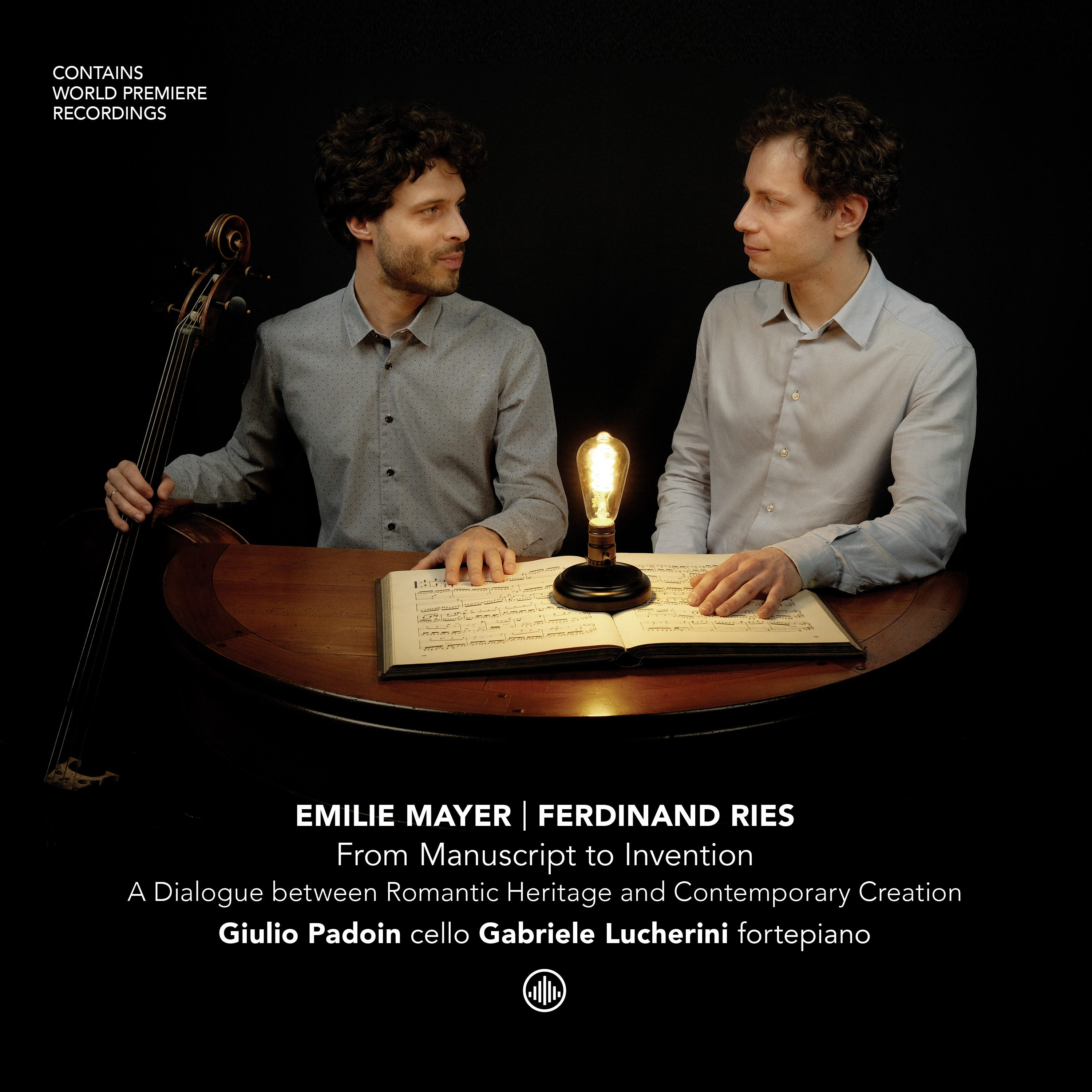
Plenty of CDs feature "unknown repertoire", but rarely does a program feel as thoughtfully considered as this debut by the duo Ricerche Parallele. Cellist Giulio Padoin and fortepianist Gabriele Lucherini, who met at the Schola Cantorum Basiliensis, compiled a program that not only unearths two forgotten nineteenth-century works, but allows that discovery to resonate in two original compositions. Moreover, they do so on historical instruments – a fortepiano based on a Graf model from 1819, built by Paul McNulty, and a cello by Carlo Annibale Tononi from Bologna, circa 1710 – which immediately gives the whole enterprise its own authentic timbre. The result is a release that tastes of more both musicologically and musically.
Ahead of her time
The heart of the CD is formed by the Duet in F Major for cello and piano by Emilie Mayer (1812-1883), at the time the most prolific German female composer of the Romantic era, but who (unfortunately) fell largely into oblivion after her death. The work is heard here for the first time in its original instrumentation for cello and piano; Mayer later arranged the piece herself for violin and piano, and it was precisely this later version that had been known until now. Padoin and Lucherini traced the original manuscript in the Berlin State Library and now present it as a world premiere – which alone makes this CD worth the effort.
The first movement opens tenderly, searching, intimate (Andante), then gradually builds playful energy (Allegro non troppo, cantabile). What immediately stands out is how stylistically versatile this four-part work is: from gallant lightness to pronounced Beethovenian drama. The duo deliberately chooses not to smooth over these fault lines but rather to emphasize them – an interpretative choice that gives the work more relief than a "safe" Romantic reading would provide.
Especially the second movement, Adagio non troppo, is a highlight. It is a piece of music to fall in love with – the cello softly sings an arresting melody, the piano colors it with increasing intensity and seems to tell its own lyrical story, and yet the relationship between the two instruments remains clear: neither merely accompanies the other. The scherzo that follows is a brisk, witty dialogue between piano and cello that in tone seems closer to Brahms than to Mayer's own era. In the finale, that playfulness simply sparkles.
Throughout the entire work, what particularly stands out is how well both musicians are attuned to each other: they complement one another, give each other space, and play as an ideal duo. One can only hope that more of this caliber awaits discovery in libraries.
In its original form
Where Mayer remains relatively uncharted territory, things are different with Ferdinand Ries (1784-1838) – student and for years closest collaborator of Beethoven, and together with Franz Wegeler co-author of one of the most important early Beethoven biographies. His Cello Sonata in G minor, op. 125 from 1823 is not a completely unknown work, but this recording is the first to go back to the autograph manuscript rather than the printed edition from 1825, which differs on several points.
The first movement, Grave – Allegro, has an almost theatrical arc of tension: the introduction immediately catches attention, you wonder what will come next, until the piano – playfully – launches the Allegro, while the cello lingers a moment longer in that tense atmosphere. A remarkable moment, and skillfully played: the piano's finger dexterity is not mere bravura, but nicely fills out the long singing lines of the cello and gives this movement a special brilliance. You can't help but wonder why this work doesn't appear more often on concert programs – at this performance you're on the edge of your seat. The resting point at the beginning of the development is also beautifully worked out: the fortepiano sounds muted and thin, giving the moment an almost elusive intimacy, while the cello sets against it a warm, singing color in pianissimo.
A well-developed pianoforte introduction leads nicely to the adjoining Larghetto con moto, in which the cello fills that atmosphere in the depths: a wonderfully dark movement that, when the piano plays, even acquires something of a slight funeral march. The concluding Rondo combines dancing energy with a lyrical middle section, before it again drives toward the finale with verve – here too a fine interplay between both musicians.
Original work as a bridge
What is interesting is the way Padoin and Lucherini place themselves as composers in the program as well, thereby restoring something of the dual role that performer and composer often fulfilled in the nineteenth-century salon. The album opens with Padoin's Prelude in F minor for cello solo, inspired by Mayer's Overture No. 3 and by thematic material from the Duet – a brief, mood-setting introduction to that work.
The CD closes with a jointly composed Fantasia in C Major on the Basel folk song "Z'Basel am mym Rhy" (by Franz Wilhelm Abt), a tribute to the city where the duo lives and works, in the tradition of the single-theme fantasia as Czerny practiced it. Only that original idiom sounds somewhat less self-evident alongside that of Mayer and Ries: the Fantasia comes across more as a successful encore from a concert than as an essential closing piece for this CD. The ensemble playing convinces here too, the composition itself rather less.
More than a curiosity
From Manuscript to Invention is not sheet music archaeology for its own sake. Padoin and Lucherini play with boldness and freedom and that makes the difference between a cd that sounds like a study project and a cd that simply captivates. Mayers Duet thereby finally deserves a place alongside the better-known cello romanticism of her male contemporaries, and Ries also sounds fresh, as if you're hearing the work for the first time. The recording itself is clear, with both instruments nicely balanced.
A recommendation for anyone who enjoys nineteenth-century chamber music off the beaten path – and is curious about how that music could actually have sounded back then.