Five days exploring Vienna and four concert evenings in the Große Saal of the Musikverein: you should be satisfied with nothing less. With a host of composers on the program such as Bartók, Schumann, Mahler, Strauss, Dvorák, Verdi, Puccini and performers such as Jonas Kaufmann, Diana Damrau, Helmut Deutsch, Vilde Frang… It was quite something, that itinerary mapped out by the music travel organization Cimarosa.
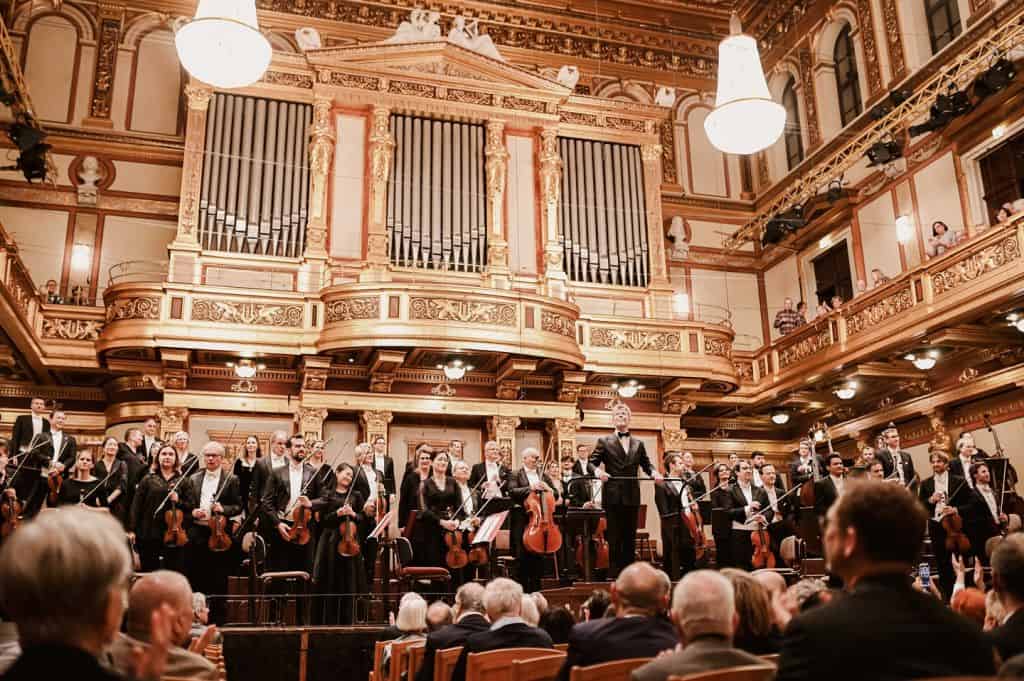
Violinist Vilde Frang with SchumannOf course you know that Musikverein hall from TV with the annual broadcast New Year's Concert, full of golden glitter and glamour. You're glad you can finally be there in person without having to reserve a seat years in advance. Under all those TV spotlights, the Musikverein seems polished and shined as never before, but when you step inside yourself, you see that the hall does show some wear. It's not as dazzling as it appears on the TV screen. Charm, yes, but comfortable seats, worn parquet, peeling gilding? It could be better, yet it remains an experience, especially when you can hear a violinist of stature: the Norwegian Vilde Frang.
First the Münchner Philharmoniker played a familiar Bartók: his divertimento for string orchestra, in a version with a full orchestra on stage. Usually the music of this composer grates harshly. This is a divertimento and here the strings caressed quite tenderly. Only towards the end did the first violinist manage to voice the dissonances expressionistically. Even more skillfully on that instrument was Vilde Frang in the violin concerto of Robert Schumann. Yet a work you wouldn't immediately hear at an Elisabeth competition. Schumann wrote it at the request of a friend violinist and considered it an occasional work himself. The original commissioner saw a certain weariness in it from the composer. Incidentally, it was only performed after his death. Indeed, it starts rather bombastically and there's little surprise except when Vilde Frang solos. Effortlessly and with restraint, she brings the numerous technically difficult passages with romantic schwung virtuosically. As a finale, we could listen to a better-known composition of Schumann, his Spring Symphony. It is conductor Pablo Heras-Casado, known to us from his collaboration with the Bruges Anima Eterna, who executes all this flawlessly with the Münchner Philharmoniker.
Exceptional "Liederabend" with Jonas Kaufmann and Diana Damrau
Our second concert evening at the Musikverein was sold out, even with chairs on the stage and standing room at the back of the hall. We don't see that at home yet. It concerns a renowned trio: alongside star of the evening Jonas Kaufmann also his singing partner soprano Diana Damrau and the lieder accompanist par excellence, pianist Helmut Deutsch. The program: Lieder von Richard Strauss und Gustav Mahler. Not among the lesser in the lieder genre and two lifelong friends. Strauss wrote more than 150 of them. He did so mainly in his young composer years. Of these we first heard his opus 10/1, with the famous love song Zueignung. Soprano and tenor took turns singing other lieder from that cycle and did so together on stage. It was somewhat theatrical, as if they wanted to make a whole love story out of that cycle, including mime. Both have magnificent voices but the excellent control they have of their voices suffered from that theatrical staging and their sometimes too powerful volume. In the interpretation of the Strauss lieder, and especially in passages they sang "leise", the subtlety of their vocal ability truly came into its own. He for example in Nachtgang and she in Freundliche Vision. After the interval, Diana Damrau took the stage alone with Mahler lieder and felt much more at ease without the commanding presence of the imposing Kaufmann. She sang a selection from the Des Knaben Wunderhorn cycle. More familiar work of course, melodically richer and more mature. Then Kaufmann again with a couple of those magnificent Rückert lieder: Ich atmet' einen linden Duft or Ich bin der Welt abhanden gekommen. This is how you want to hear Kaufmann, at his best! Then the two again in turn with a number of Strauss lieder with Diana Damrau enchantingly beautiful in Morgen!
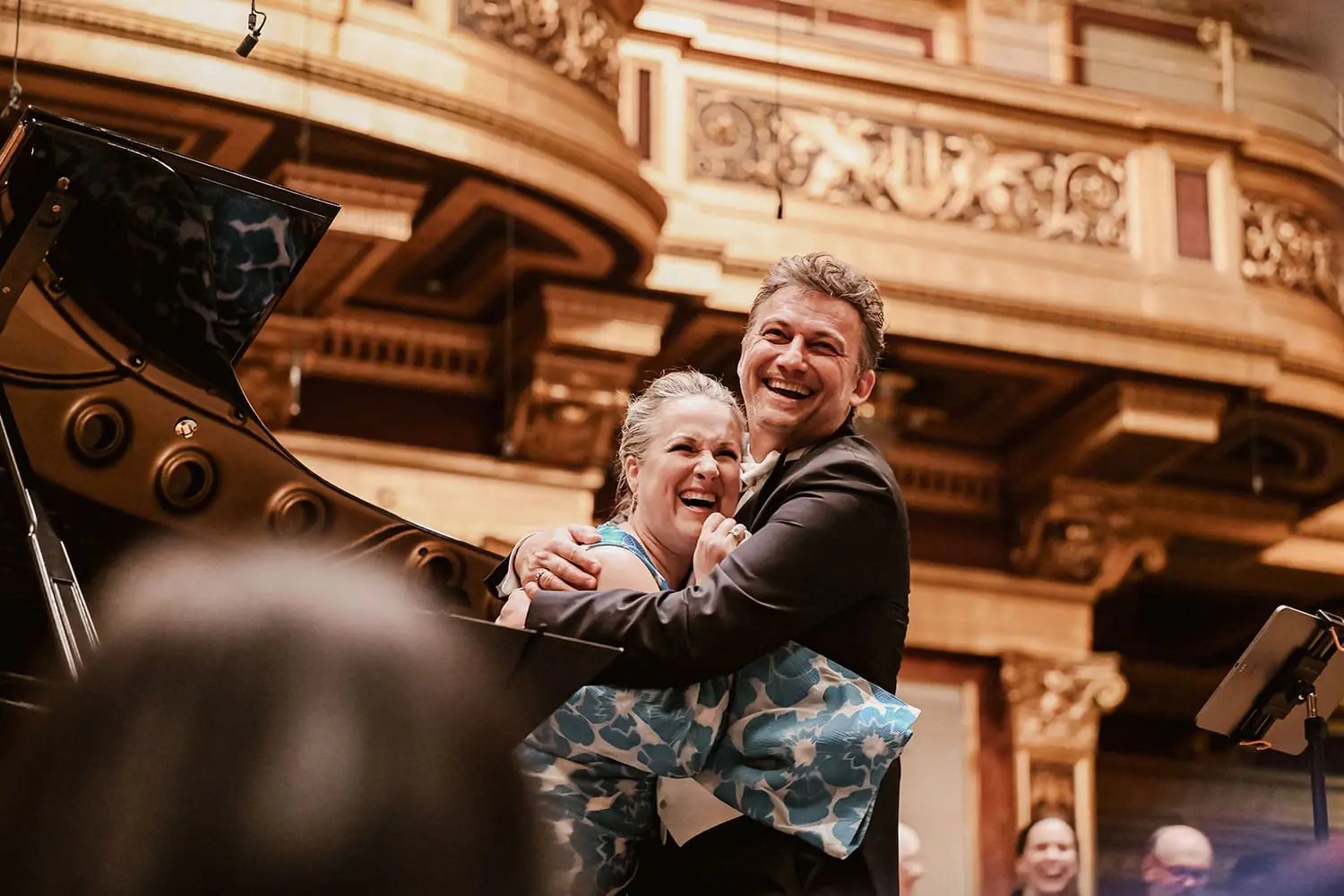
Of course a standing ovation, a couple of encores (they sang as a third encore the Wiener Blut duet, what do you expect, we're in Vienna). And another nice moment: for his outstanding performance, the eighty-year-old Helmut Deutsch received a heartfelt kiss from Diana Damrau.North and South American-tinged concert
Our musical program on the third evening at the Musikverein had North and South American color. With the Austrian Tonkünstler Orchester conducted by Venezuelan Domingo Hindoyan, an orchestra in permanent residence at the Musikverein. They play a symphony by Puerto Rican Roberto Sierra and we hear North Macedonian pianist Simon Trpceski in a concerto by Argentinian Alberto Ginastera and listen finally also to that New World symphony composed by Dvorák when he arrived there.
For all concerts we first received daily a solid and fluent introduction in a typical Viennese coffeehouse by Klara presenter and musicologist Nicole Van Opstal, musical tour guide on duty with quality at the forefront!
First, in world premiere for Austria, that symphony by Roberto Sierra, the 6th. Because it had to, just like Beethoven's 6th, become a Pastoral. The nature from Beethoven's years has certainly sounded quite different by now. In the first part (Reflexion urbana) this Puerto Rican composer first tries to escape the noisy city. An extensive percussion instrument collection, including xylophones, marimbas and bongos, helps him do so and he then dives in the second part (La noche) into the silence of the night but then collides with a tropical hurricane that dissolves into a finale full of Caribbean music. Do I hear Puerto Rican sounds here that remind me of Bernstein's West Side Story? The verve with which the Venezuelan Domingo Hindoyan conducts his orchestra can't help but remind one of that other impressive countryman of his, Gustavo Dudamel.
[caption id="attachment_42501" align="alignleft" width="341"]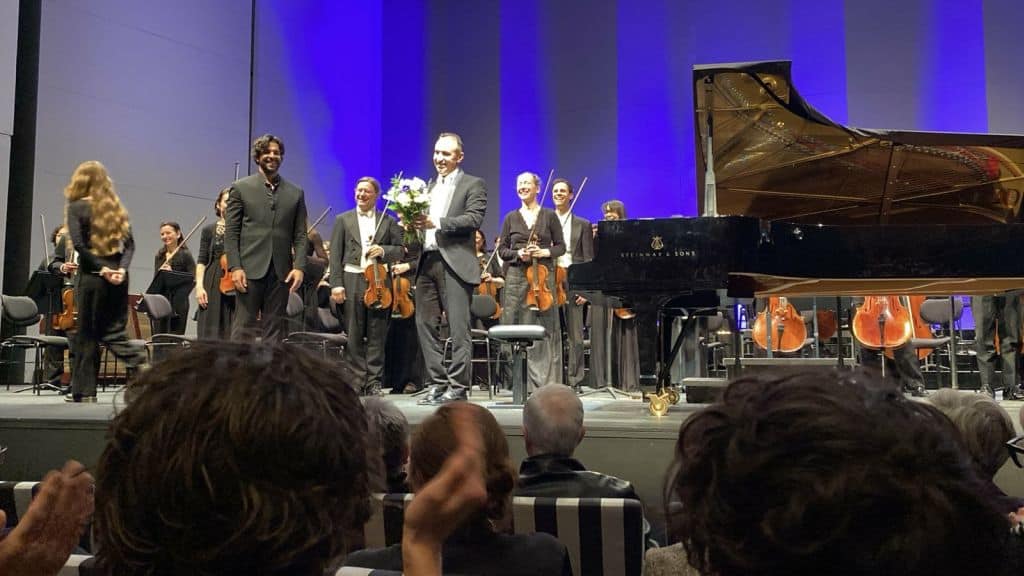 Tonkünstler Orchester conducted by Domingo Hindoyan and pianist Simon Trpceski[/caption]
With the "Concierto Argentina" by Alberto Ginastera we land in South America. Jazzy and rhythmic, sometimes somewhat dissonant, the brilliant pianist from North Macedonia Simon Trpceski waltzes fortissimo through a charming simple theme. With an Adagietto Poetica we enter a quieter mood and we close with brisk passages and a heavily orchestrated Allegro. The orchestra plays very articulate both in the quieter passages and at the mighty explosive moments. All this in a very recognizable South American musical idiom. The cherry on top of that evening was Dvořák's ninth. It is known as a masterpiece. Everything has already been said about it. The Tonkünstler Orchester can only confirm this status and does so. It made the reputation of that New World Symphony only more perfect.
"Il Fiamingo della Tiorba": Philippe Vermeulen
[caption id="attachment_42504" align="alignright" width="300"]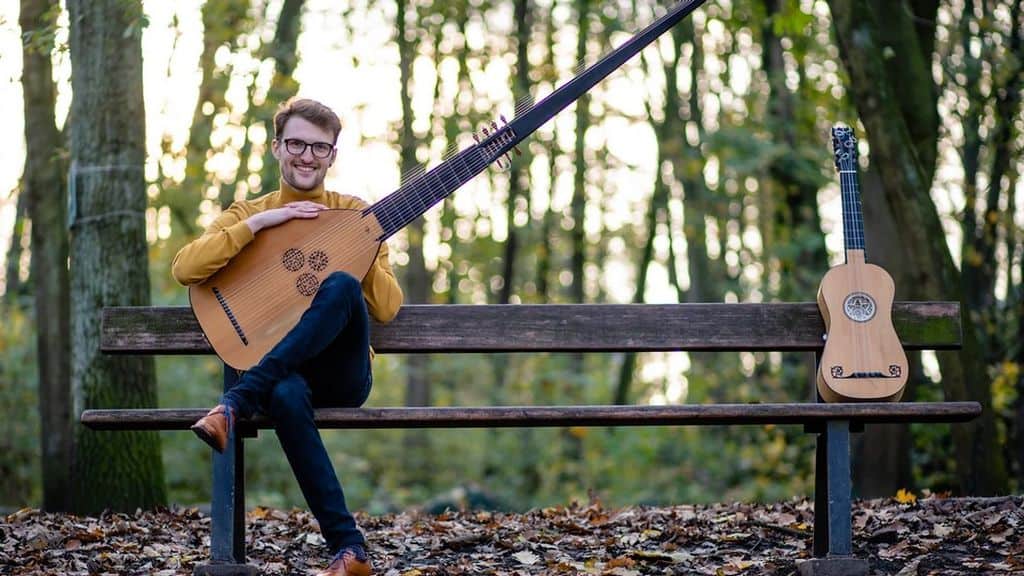 Adriaan Lauwers, theorbo[/caption]
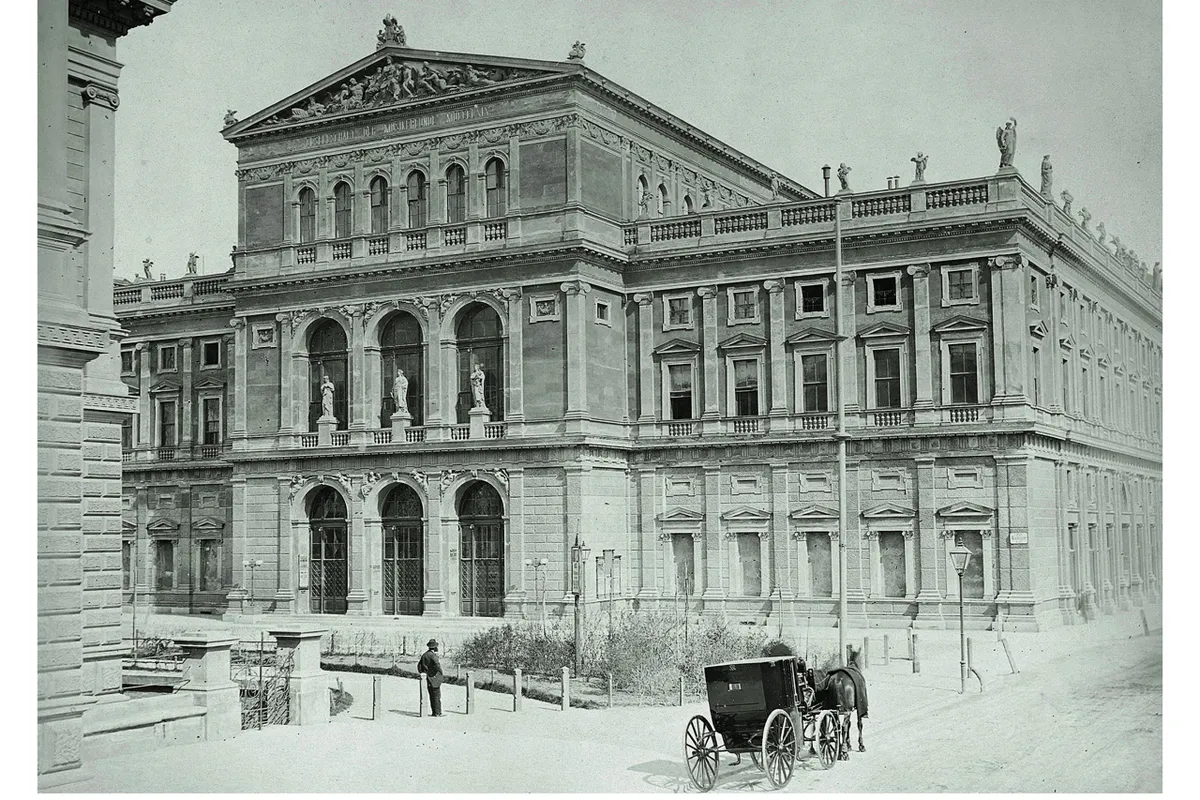
Of course we not only encountered composers but also all those other famous Viennese from their time: Klimt, Schiele, Wagner, Loos, Hofmann, Kokoschka, also our Breughel and Rubens and not to forget Franz-Joseph I. With him came an end to that exceptional Viennese period but he did leave behind a world heritage of buildings. We visited that famous Belvedère, the Leopold Museum, Kunsthistorische Museum, the Secession building. Cimarosa Music Travel made sure we could meet two Flemings for a private concert. They were two theorbo players: a lively Adriaan Lauwers and the 17th century Philippe Vermeulen.
The latter was a musician-lutenist at the court of Albert and Isabella in Brussels and traveled by their order on a study trip to Rome to learn this "new" instrument there, the chitarrone (bass lute or theorbo). About his adventures, expert Adriaan Lauwers spoke at length and also played for our enjoyment a number of works by the German-Italian composer Johannes Kapsberger whose music our Fleming had learned there in Italy. Surprisingly interesting.
Puccini and Verdi their respective Requiem
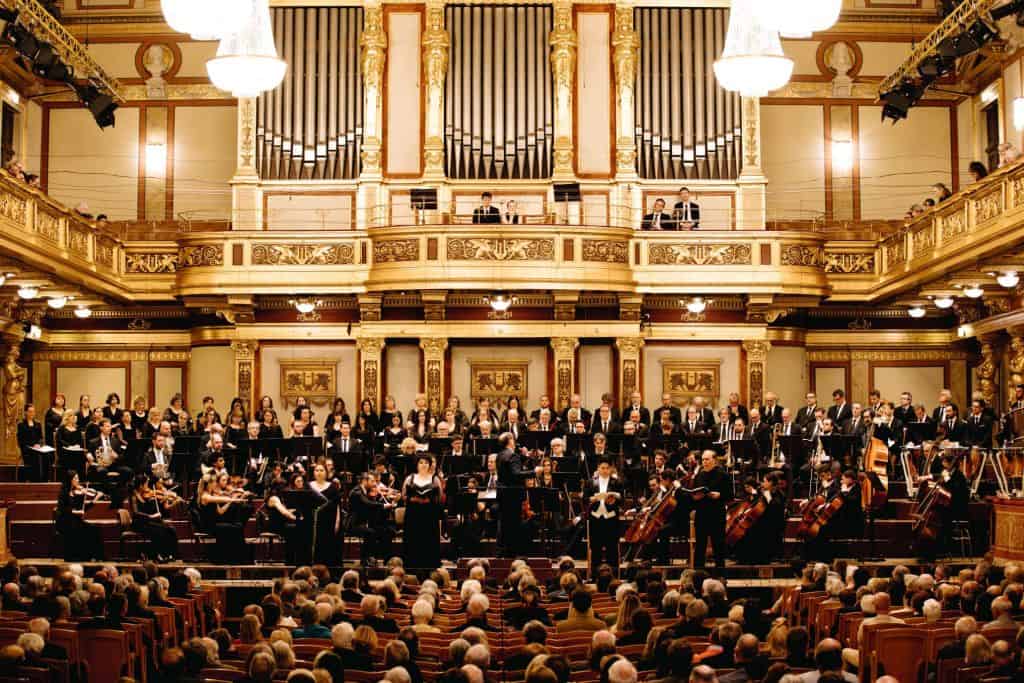
For our fourth and last concert in the Große Musikvereinssaal Wien two opera composers with their Requiem. Puccini wrote his as homage to Verdi and Verdi wrote his in memory of Rossini. Puccini's work we heard in an arrangement for string orchestra, viola and choir. It lasts barely five minutes but in that short time can still awaken quite a lot of quiet emotions. Verdi's Requiem is of a different order. Even though it begins almost silently, the choir, the strings and the soloists lead the orchestra in an ascending line with brass and timpani to a deafening opening. Fierce and solid parts throughout and an enormous instrumentation. The Dies Irae alone lasts 40 minutes. A masterwork full of contrasts and above all a vocal work. What a beautiful instrument the human voice is, what a powerful ensemble a choir is with those voices and what a mighty combination they are with an orchestra. An opera in liturgical robes was one criticism. And yes, when you hear those singers in quartet or in trio, in duet and solo then that also sounds like arias from the opera. With the still excellent bass of the legendary Ferruccio Furlanetto (76 years old!) flanked by young soloists from the Viennese Musik Universität, two South Koreans, tenor Sehyun Kyung and soprano Eunhye Grace Kwon and the Croatian Anthea Barac. All this under the direction of the Italian Roberto Zarpellon, founder of that Orchestra Lorenzo da Ponte with the Venice Monteverdi Choir. Gasping for breath was it after this performance. Whoever is buried with this musical masterpiece can certainly rest in peace. At the end of our musical Vienna trip, the last words from the first song by Richard Strauss that we heard perfectly fit, from Zueignung: Habe Dank.