

His music does not contradict this: it comes from a musical culture that had been stripped of any tradition, with nature as an important source of inspiration – the vast Finnish forests, the lakes, the national folklore, the Kalevala epic. We hear this reflected in his music, which often seems just as expansive as the Finnish landscape. Yet: in his seven symphonies, these characteristics are less prominent; the genuine symphonist Sibelius speaks more clearly there. Which certainly fits with what he remarked in 1907 in Vienna during a meeting with Gustav Mahler: that in the symphony it was above all about strict formal design and that it was logic that had to connect the many motifs with each other. A view that stood diametrically opposed to Mahler, who believed that the symphony should encompass the entire world, everything.
Sibelius did not stop at these words between 1899 and 1924, but created a symphonic oeuvre in which organic development is indeed central. This is also strongly expressed in the Fourth Symphony from 1911, an extremely somber work, probably created under the influence of a deeply profound event that had struck him about three years earlier: throat cancer, and the ever-present possibility of its return, despite the successful operation performed in Berlin. A sober work also, due to the relatively monochromatic orchestration, the rather dispiriting character further strengthened by the frequent use of the tritone and (albeit slightly) dissonant chords. It is an image that fits what the composer once remarked to Swedish writer and painter August Strindberg: 'Det är synd om människorna' (Being human is misery).
The greyness, incidentally, cannot be read from the prescribed instrumentation, consisting of 2 flutes, 2 oboes, 2 clarinets, 2 bassoons, 4 horns, 2 trumpets, 3 trombones, glockenspiel, timpani and string section. Moreover: lighter moments also appear – albeit not for long – that push the dark mood into the background. Just as comfort and resignation speak from the work, though the somber tenor of the opus will remain most with the listener.
But what that Fourth Symphony also contains is its intractable originality, by which the piece proves far from easy to perform. Contributing to this are the many ambiguities (also concerning the prescribed keys!) which the composer employed and which create an almost continuous unrest. Add to this the fragmentary structure as a precursor to the organic development that unfolds only later, and it will be clear that not every conductor is capable of getting a firm grip on the structure and from there creating the desired tension arcs. These are the elements that are part of a creative process whose culmination point lies much later, in the Seventh and also last symphony, where it becomes unclear even when one section ends and the next begins.
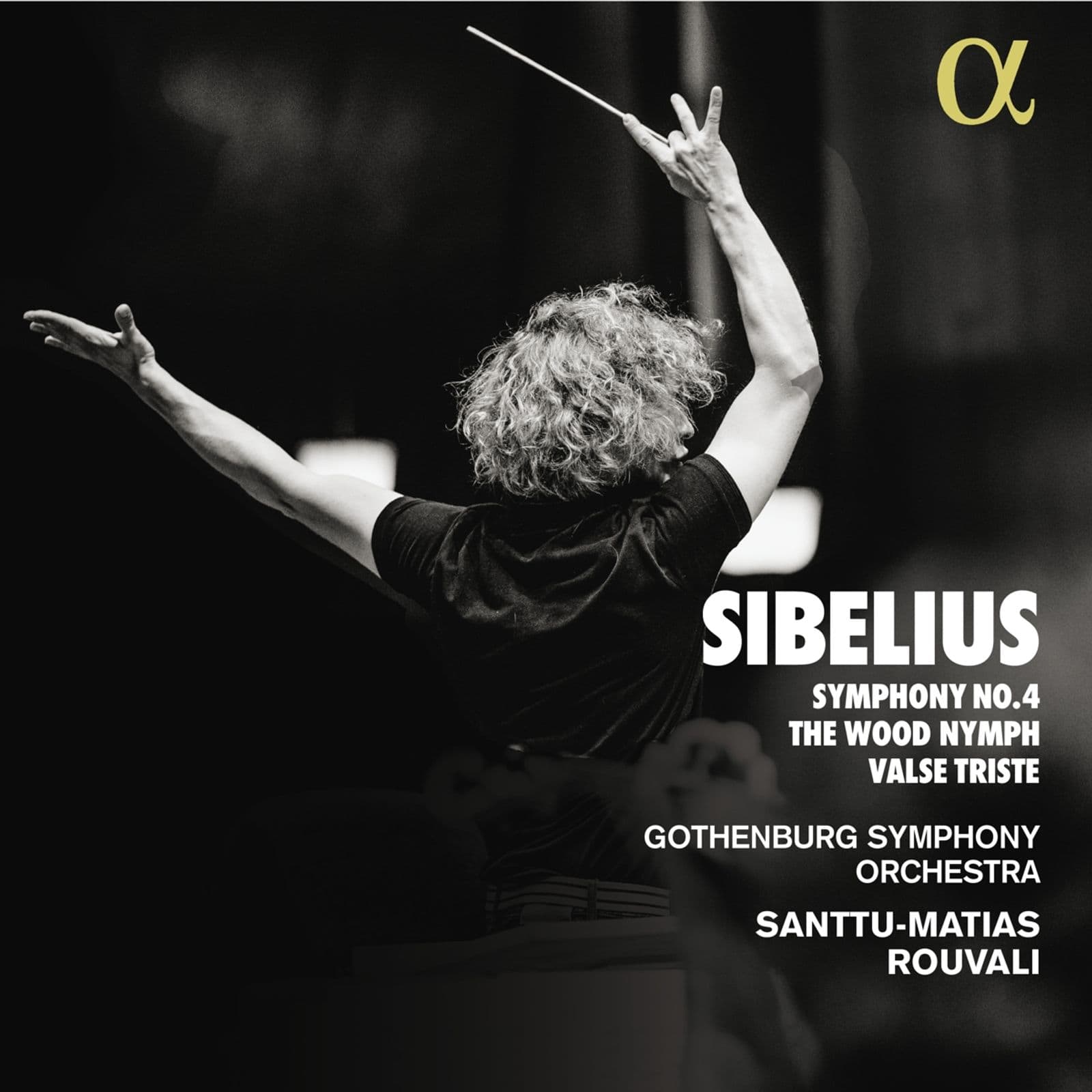
Such interpretations demand quite a lot of insight from the conductor, but Finnish conductor Santtu-Matias Rouvali (Lathi, 1985) – he is clearly working on a complete cycle – has already demonstrated more than once that he knows the way excellently in this so distinctive, if not unique idiom (I discussed earlier the First, Third and Fifth symphonies, as well as on this new album supplemented with separate orchestral works, with the same orchestra under his baton).
The two supplementary pieces are a bullseye from a programmatic perspective alone because they provide fitting contrast. Skogsrået (The Wood Nymph), internationally better known as The Wood Nymph, a symphonic poem in the form of a ballad, inspired by the poem of the same name by Viktor Rydberg and completed in 1895, is closely related to the much better-known Karelia suite. Unlike the Fourth Symphony, the work is cast in an extremely colorful orchestration and suffused with sensuality. The eroticism woven into the original poem has also been given shape by the imaginative Sibelius with true mastery.
Also the famous Valse triste from 1903, the pensive music that Sibelius composed for the play Kuolema (Death) by his compatriot Arvid Järnefelt, offers more than sufficient contrast and certainly in the hands of this conductor, who wanted to emphasize the dramatic qualities in this episodic setting of no more than just over five minutes. Less expressively leveling but for that reason more exciting than the much-praised reading by Karajan and the Berliners, the illustrious ensemble that in the mid-sixties also provided a formidable performance of the Fourth Symphony, first of course on vinyl, later transferred to cd.
Unlike Klaus Mäkelä, Rouvali places the musical emphasis on a strongly developed sense of theater, for which that small bit of tonal refinement and subtlety can well be sacrificed that is present in Rouvali's fellow countryman and contemporary in his Sibelius interpretations (on Decca). The Alpha recording lets the particularly fine orchestral playing of the Gothenburg orchestra be heard in its full glory.
© Aart van der Wal, June 2024