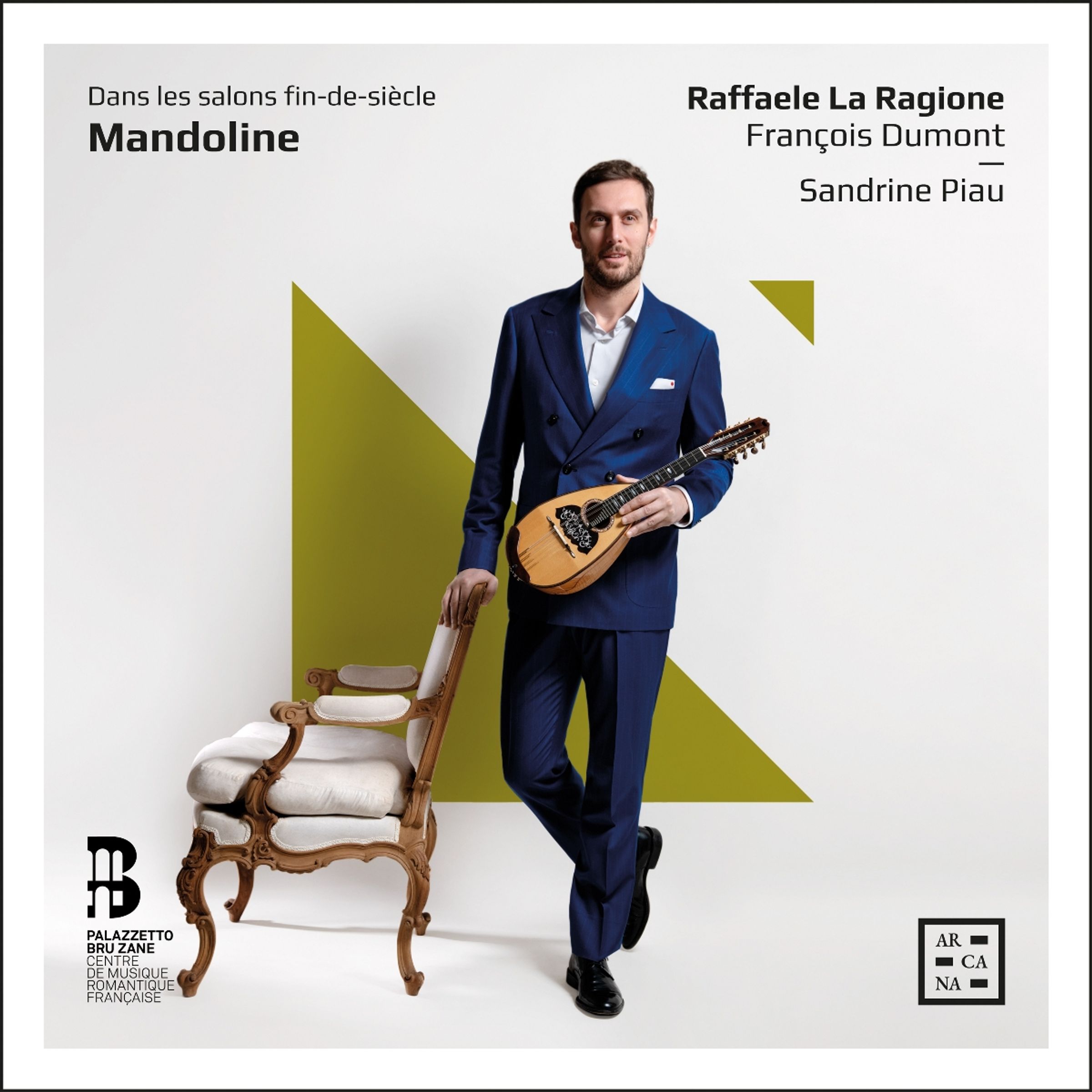
"La mandoline aujourd'hui est tellement abandonnée…" – so lamented Hector Berlioz in his orchestration treatise from 1843 about the forgotten instrument. What an irony that his name would later be connected to the Salle Berlioz, one of the Parisian concert halls where mandolinists such as Vittorio Monti and Laurent Fantauzzi performed. And what a joy that Neapolitan mandolinist Raffaele La Ragione recalls us with his new cd "Dans les salons fin-de-siècle" to that enchanting world of the Belle Époque, where salons buzzed with guitars and mandolines, the verses of Verlaine were sung and all of Europe – from barber to magistrate – stood under the spell of her strings.
An instrument with a tumultuous past
The accompanying texts by musicologists Paul Sparks and Hélène Cao – extensive and carefully crafted – sketch how the Neapolitan mandoline, after a period of oblivion, flourished again, thanks in part to the Paris World Exposition of 1878. Italian virtuosos such as Giuseppe Silvestri and Ferdinando De Cristofaro travelled to Paris and unleashed a veritable "craze" there. Pioneers such as Jules and Alfred Cottin followed in their footsteps, and soon the mandoline found its way into Parisian salons, although shortly before it had been regarded as a mere folk instrument. It is precisely this rich background that Raffaele La Ragione wishes to unlock with his programme – and he succeeds brilliantly.
Virtuosity with style and taste
La Ragione plays on a mandoline made by Lorenzo Lippi (Milan, 2025), modelled on the legendary Vinaccia makers, and on a tenor mandola by Raffaele Calace Jr. (Naples, 2017). His tonal ideal is clear: warm, nuanced, without affectation. The tremolo technique – the secret of the mandoline's cantabile character – he handles with admirable calm and evenness, so that melodic lines breathe rather than tremble. In Silvestri's Lo Sport, a waltz that the composer himself performed at the World Exposition of 1878 and which may have been recorded for the first time, La Ragione proves himself a storyteller who sweeps his audience along without ever forcing matters.
The arranged pieces – from Bizet's Pastorale (a delightful opener that immediately sets the tone and invites more) via Gounod's Le Soir to Chaminade's Havanaise – come in part from Jean Pietrapertosa and the brothers Cottin, arrangers who knew the music of their time inside and out. La Ragione respects their work, but adds his own typically mandoline idiom to it: in Dupont's "Mandoline" and Saint-Saëns' "Guitares et Mandolines" the repeated notes of the instrument sound as they should – like the tinkling water of a Neapolitan fountain on a summer night. Not every work on the album possesses the same compositional significance, but it is precisely this variety that makes clear how versatile the salon repertoire around the mandoline was. The whole makes for a most entertaining recording.
A triangular relationship: instrument, piano, voice
The conscientious François Dumont is heard on a Pleyel grand piano from 1896 – a deliberate choice that makes the story credible. The instrument lends the accompaniment a characteristic muted lustre, a patina that the modern concert grand cannot match. Dumont is an excellent partner: he listens, fills in and never takes more space than necessary. His Liszt (Danse des sylphes) and Chopin (Variation from the Hexaméron) are small pearls of stylised elegance.
Sandrine Piau, long at home in baroque music but also here entirely convincing, sings three 'mélodies' on "Les donneurs de sérénades" ("Mandoline") by Paul Verlaine: the settings by Debussy, Dupont and Fauré, ideally distributed throughout the programme. Her voice has that special quality that even in light, apparently airy music it carries something of inner intensity. Her Debussy comes closest to the spirit of the instrument – it begins, after all, with the open strings of the mandoline itself, sol-ré-la. Her Fauré is more intimate, her Dupont deeply felt.
A rediscovery that lingers
What makes this album special is the coherence of the concept. La Ragione and his partners are not reconstructing a museum piece, but offering a living musical conversation with the past. The repertoire – a mix of originals and ingenious arrangements – is carefully chosen, the performance is thoughtful and the recording quality (Chiesa di San Rocco, Miasino, June 2025) is warm and transparent.
After "Beethoven and his Contemporaries" (2020) and "Mandolin on Stage" (2022), La Ragione confirms with this third album for Arcana his position as one of the leading mandolinists of his generation. He rehabilitates the mandoline as Gustav Leonhardt once rehabilitated the harpsichord: by giving a forgotten instrument seriousness, colour and historical depth once again.
This is a cd that one will not quickly put away after the first listening.