Love, light and transience under the starry sky
Where architecture, music and emotion meet
When August casts its gentle glow over Erfurt, the heart of this medieval city transforms into a living stage, filled with breath and sound. The monumental steps between the Dom and the Severikirche form the setting for the annual DomStufen-Festspiele, an open-air experience that blurs the boundary between city and story. Theater Erfurt builds no temporary set here, but creates a spirited interplay of stone, air and light.
Against this centuries-old backdrop, director and scenographer Matthew Ferraro presented a La Bohème by Giacomo Puccini (1858–1924) that defied time. Not a romantic retrospective or dusty homage, but a living artwork – layered, sensuous and surprisingly contemporary. Under the inspired musical direction of Helmes Helfricht, Puccini's score blossomed like a flower in the evening light. The performance on Saturday, August 16, 2025 was no routine revival, but a moving meditation on love, loss and the transience of existence.
Experience in the open air
As in Bregenz, the orchestra did not perform on site here, but in the nearby theater. At the beginning of the performance, we saw on screens on either side of the stage a brief image of the orchestra preparing in the theater hall. Once the singers began, German translations appeared on the screens to follow the performance. All singers on stage were amplified.
The performance took place in the open air of a major city. Trams, sirens and the distant sound of traffic formed the backdrop. Before the intermission, street noise was less noticeable, but after the intermission it became more bothersome, especially during intimate moments. The sound of glasses, fireworks from another event and cars with pounding music occasionally disrupted the chemistry of the scene. Fortunately, Puccini's music quickly drew you back into the experience.
Life captured in music and word
Inspired by Henri Murger's Scènes de la vie de bohème from 1830, Giacomo Puccini paints with sound and drama a vivid tableau of the Parisian Quartier Latin — a world of ideals, poverty and passion on the eve of modern times. In this tale, playfulness intertwines with tragedy, the lightness of the moment with the eternity of memory. Puccini, like no other, knows how to sing the transience of life musically, making La Bohème a universal mirror for us all. This production made that palpable, like a timeless ode to youth and transience.
A visionary direction with an eye for detail
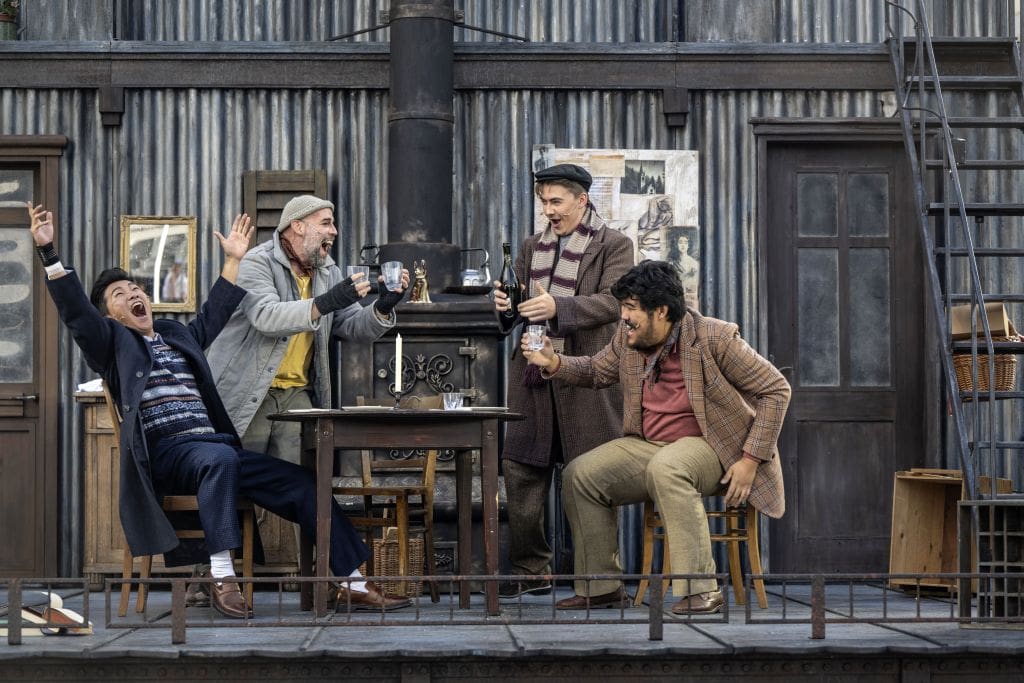
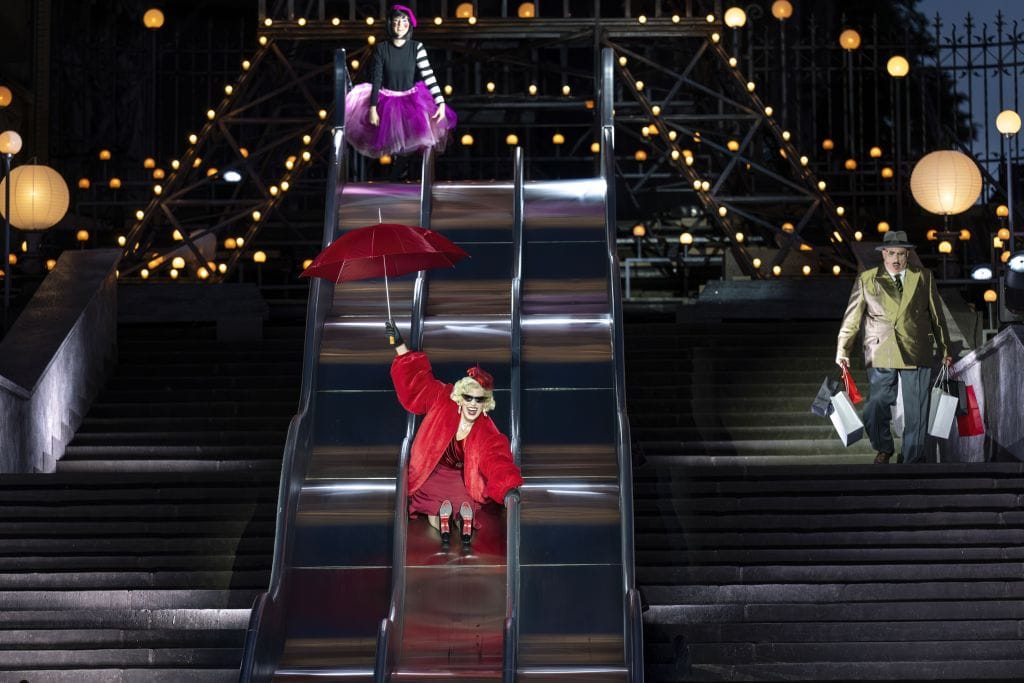
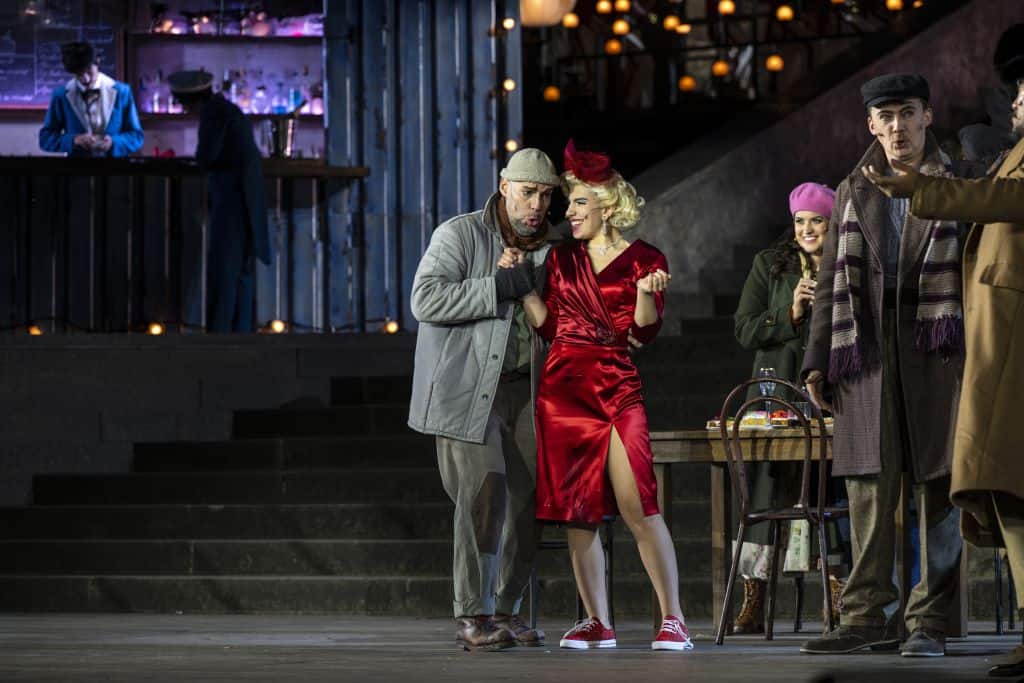
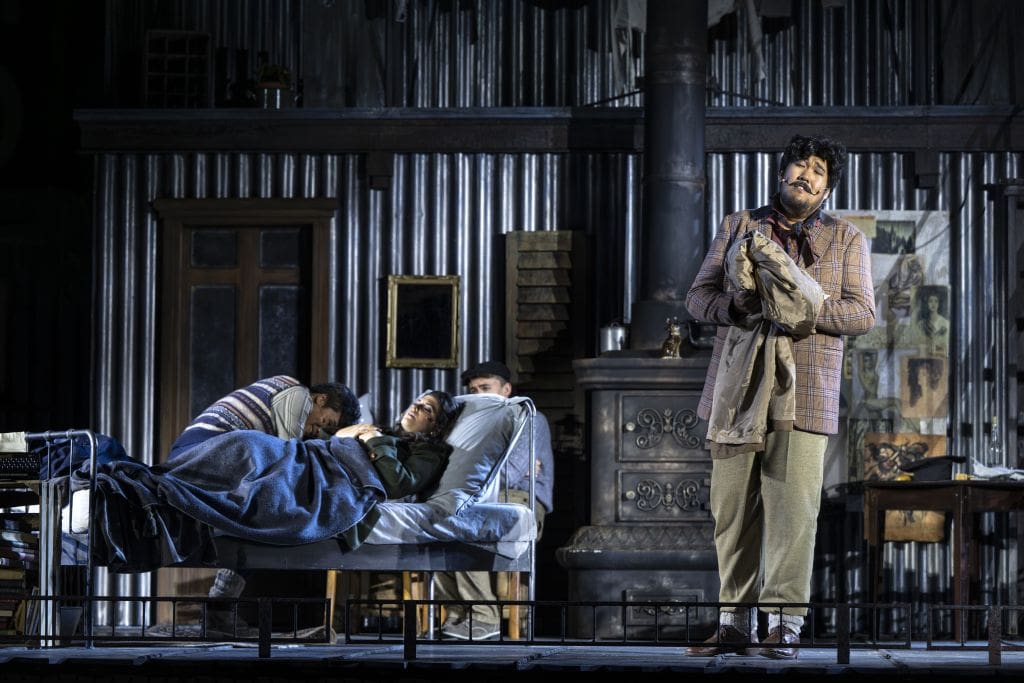
Ferraro's direction walked skillfully across the threshold between past and present. He did not tear anything down, but built upon it – with respect for tradition and a keen eye for today's world. The set was not only visually pleasing, but wove itself into the story. The impressive steps gave the space a loftiness, while an imposing 16-meter-high Eiffel Tower (which did not yet exist in the time of the novel) loomed as a silent beacon of modernity. The many lamps on stage, beside the Eiffel Tower, were a clear reference to the city of light. The 22-meter-long slide brought playful energy that supported the action – a tangible metaphor for youthful impetuosity. The iconic Café Momus did not appear as a classical Parisian bar, but as a pop-up bar in a container: a find that brought the bohemian lifestyle closer to contemporary life without sacrificing artistic credibility.
There were some small details in the direction that stayed with me. For instance, soap bubbles were blown when love was being sung about in the second act. Parpignol arrived with his companions on a bicycle. They wore special costumes, which nicely aligned with Paris's reputation as a fashion city. At the end of the third act, Mimì and Rodolfo were beautifully lit in a heart shape.
In this way, the open-air theater itself became a living, breathing stage. Matthew Ferraro's scenography, with five hundred glowing warm lights, transformed every scene into a painting of light and shadow. The sound of a distant church bell, a sudden breeze, the hushed whisper of the audience – everything became part of the music. The DomStufen, with their imposing steps and breathtaking view, set the tone for the dramatic story that unfolded.
The score as emotional engine
Helmes Helfricht, at the head of the Philharmonisches Orchester Erfurt, conducted with inner clarity. His reading of Puccini's music glided between vulnerability and passion, between whisper and storm. What stood out was his ability to let the orchestra speak as one breathing body. In the grand ensemble scenes, transparency and structure rang out, even in the open air. Intimate moments – such as "Che gelida manina" and "Donde lieta uscì" – were reduced to their essence: silences, breathing spaces, arcs of tension that were not played out, but sustained. Helfricht let the music sing without forcing it. He shunned effect and chose meaning. Thus the score became not a musical frame, but an emotional engine that propelled the drama from the depths. His conducting brought the breathing of the young lovers to life, with a refined attention to every musical nuance, through which he perfectly expressed the richness and drama of Puccini's sonic landscape.
Portraits of young love and poignant vulnerability
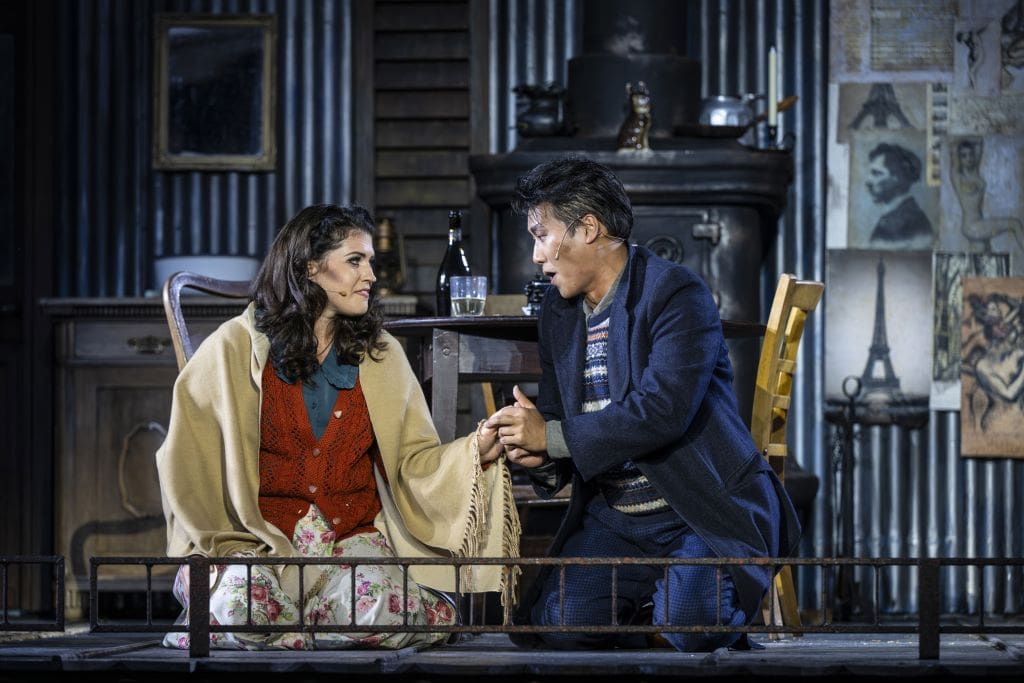
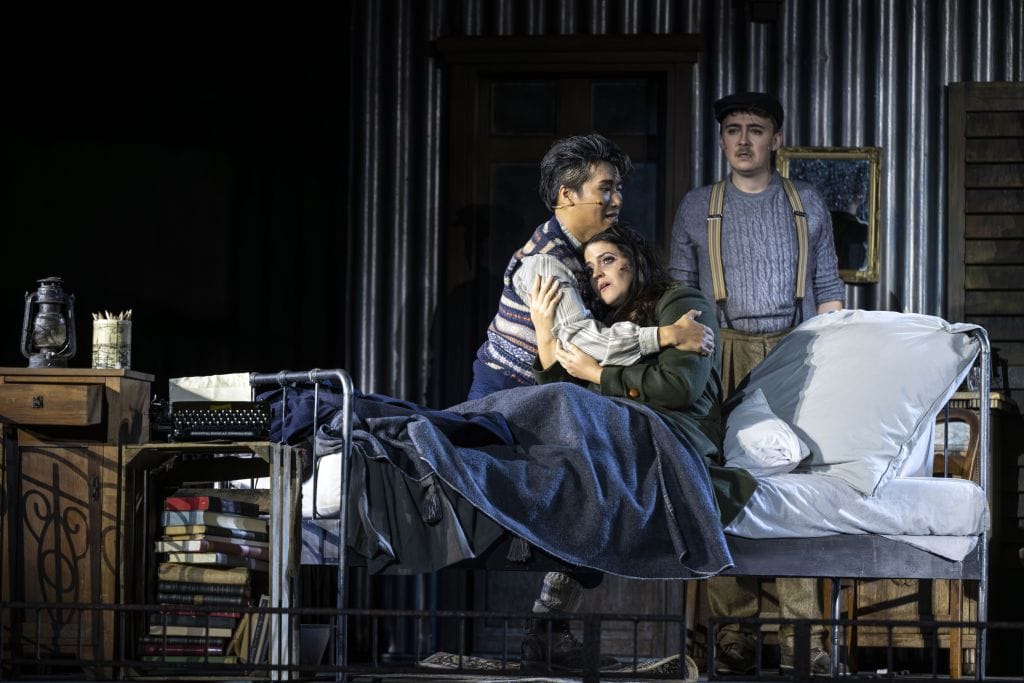
In the heart of La Bohème blooms the encounter between the young poet Rodolfo, performed by the masterful Jongwoo Kim (for me the revelation of the evening), and the fragile, dreamy Mimì, moved and crystal-clear sung by Daniele Gerstenmeyer. Two souls that find each other in an attic room full of dreams and draughts, in a world where love shines like a match in the wind. This production laid with a delicate hand the emphasis on human relationships – a mosaic of longing, friendship and loss.
Gerstenmeyer's Mimì moved with a voice that sounded both fragile and determined, a soprano with the lustre of morning light on frosted glass. Her "Sì, mi chiamano Mimì" became not an aria, but a whisper of hope in the twilight of fate. In every phrase rang the longing for an ordinary life – for warmth, for closeness – all the more poignant in her silent decline.
Jongwoo Kim gave his Rodolfo a tenor voice with a glow of sincerity, like an open heart beating to music. His "Che gelida manina" became a confession without embellishment, a melodic touch that said more than a thousand words. And in "O soave fanciulla", his duet with Mimì at the end of the first act, his voice coloured the darkness with a love that shone without blinding.
Konstantin Ingenpass (Schaunard) and Kakhaber Shavidze (Colline) formed a warm, brotherly foundation under the ensemble. Shavidze's "Vecchia zimarra" became a moment of pure stillness: an ode to transience, sung as a farewell to more than just a coat.
Anna Sophia Theil's Musetta radiated, sparkled, challenged – but beneath the glittering play of her soprano lay also softness, compassion, insight. Her "Quando me'n vo'" was both a flirtation and a mirror. Musetta stole the show like a modern Marilyn Monroe, and her appearance on the barrack, in a red dress (naturally with skirt swinging up) in Moulin Rouge style, was a masterpiece of acting and singing.
Ensemble power and poetic simplicity
This Bohème was not a sum of strong soloists, but a breathing ensemble in which every voice was interwoven with the other. The Opernchor des Theaters Erfurt, strengthened by members of the Philharmonischer Chor Erfurt and the Kinder- und Jugendchor der Chorakademie Erfurt, put in a stunning performance in the second act and gave the sound image a living frame. This performance was a symphony of human voices, like an echo of a city that lives, laughs and mourns.
Ferraro's direction did not emphasize grand gestures, but broken glances, hesitant steps, the silences between words. His La Bohème was not only a musical journey through the past, but also a reflection on the here and now. The simplicity of the materials, the stronger emphasis on the singers and the music that flowed like breath through everything, made the drama visible even outside the steps of the Dom.
A final chord in silence and shadow
The fourth act was delivered with a hushed stillness that took the breath away. No melodramatic climax, no bombast, but a slow fading – like the flicker of a candle in the night. In "Donde lieta uscì" the farewell was palpable as a shadow gliding across the stage. And then the finale: Mimì's death, Rodolfo's despair – drained to a moment of intense distress. The orchestra withdrew, the voices became breath, the silence spoke. Puccini's music slipped away like life itself: unnoticed, and therefore all the more heartbreaking.
DomStufen-Festspiele: a stage of timeless art
With this performance, the DomStufen-Festspiele confirm once again their reputation as a place where classical opera and modern stage art meet in an unforgettable open-air atmosphere. Here La Bohème was not merely performed, but reborn as a story that continues to resonate in the heart of the spectator, caught in a subtle play of light and shadow, of dream and reality.
Final thoughts: an evening that resonates
This La Bohème at the DomStufen-Festspiele was more than opera. It was a rare convergence of theatre, music and emotion. Every element worked together, like a symphony of life itself. The result was an experience that nestled not only in the ears, but also in the heart.
Matthew Ferraro brought Puccini's masterwork with respect, but at the same time gave it a fresh breath. His visual choices did not seek to impress, but to deepen, and the human interpretations brought the drama closer.
Helmes Helfricht conducted the orchestra with lyrical intelligence and dramatic finesse. The singers gave their characters not only a voice, but also a soul. And above Erfurt, beneath the soft light of hundreds of lamps, the air was not merely a spectator, but a witness to this magical moment.
When the final applause began, a carriage suddenly appeared. In it sat the conductor, who accepted the well-deserved applause for his orchestra, which came back into view. This orchestra deserves high praise for their perfect timing and seamless collaboration with the singers – a well-oiled machine that knows what it is doing. What intrigues me most after this technically smooth performance is how everything comes together so perfectly. That must have been a feat!
There are productions that confirm what we already know. And there are productions that make us forget that we already knew it. This La Bohème undoubtedly belongs to that latter category.
What we saw and heard on 16 August 2025 was not a performance. It was a memory in the making – of love, of loss, of the wonder that is music.