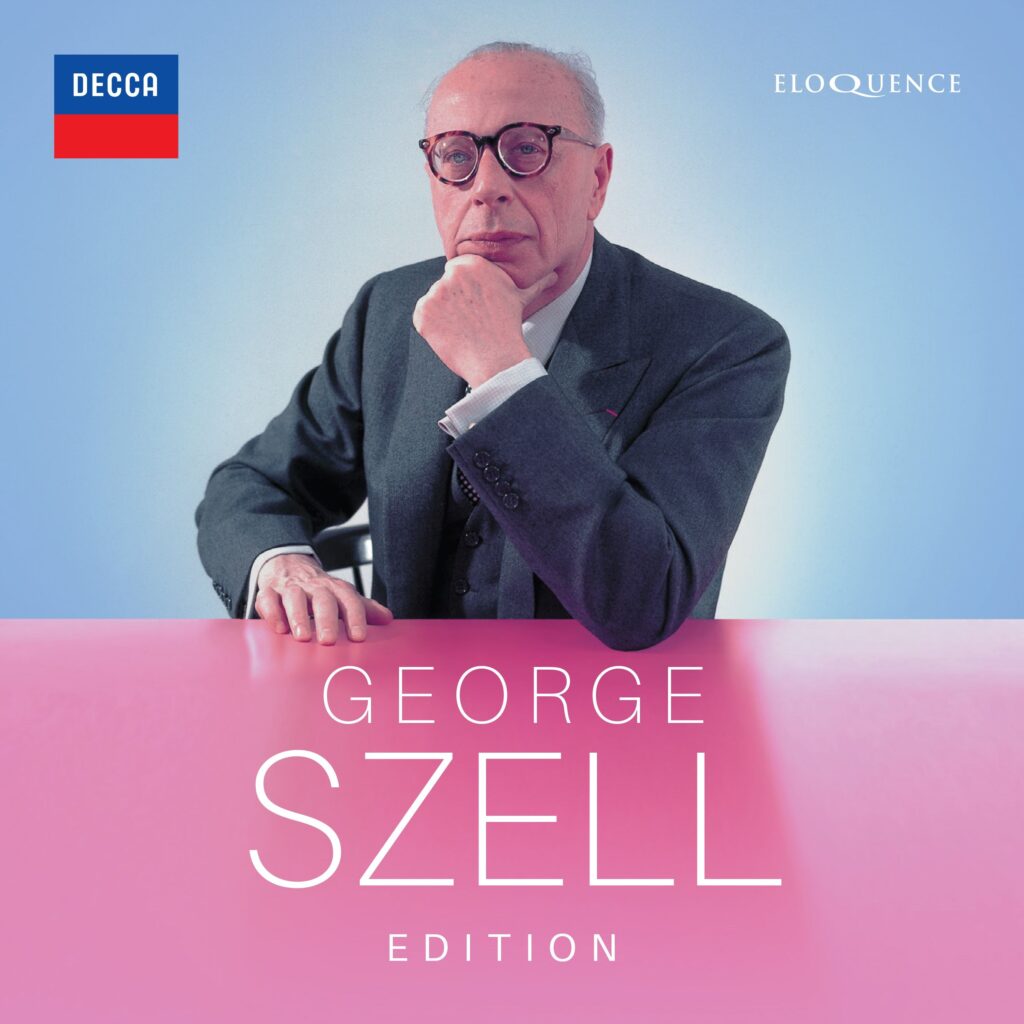
George Szell (1897-1970) cannot be easily captured in a single sentence. His name stands for exceptional technical mastery, an almost obsessive attention to the score and an orchestral discipline that made him one of the most influential conductors of the twentieth century. At the same time, that same precision has given him the image of the cool perfectionist, the conductor who wanted to control everything and left little room for spontaneity. After listening to the ten CDs in this George Szell Edition, that image proves to do insufficient justice to the complexity of his musicmaking.
Decca Eloquence brings together in this new CD box recordings from the period 1949-1964, made for Decca, Philips and Deutsche Grammophon. This is not the Szell we know primarily from his years with the Cleveland Orchestra, the orchestra with which he worked for almost a quarter of a century, but rather his encounters with other major ensembles: the Concertgebouworkest, the Wiener Philharmoniker, the Berliner Philharmoniker and various London orchestras. It is precisely these encounters that are interesting: Szell does not simply copy his Cleveland sound anywhere, but responds to the musicians in front of him. This sometimes produces surprising results.
This box is not, however, a collection of masterpieces. There are performances that have moved me deeply, others that are interesting primarily for their historical significance, and a few where Szell's striving for control seems to me to come too much to the surface. That tension between control and expression runs like a red thread through the entire box: with Beethoven and Brahms it sometimes becomes almost painfully clear, while with Dvořák, Mendelssohn, Mozart and especially Sibelius it becomes apparent how much warmth and emotional power could lie behind that seemingly cool façade. So Szell's precision does not automatically lead to expression, but when everything comes together, it does become the basis of exceptional musical intensity.
In this first article we focus mainly on Szell's view of Ludwig van Beethoven (1770-1827) and Johannes Brahms (1833-1897).
More than just the overture
That the score is always Szell's starting point is immediately evident from the complete Egmont incidental music on CD 1. Beethoven here is not only the composer of the famous overture, but of a full drama in which the lesser-known entr'actes, melodramas and songs also have their place, and it immediately becomes clear how Szell treats them one by one with the same seriousness. The Wiener Philharmoniker sound warm and rich, but never heavy.
The real discovery is Klausjürgen Wussow as narrator. The actor who for the general public remained mainly known as Professor Brinkmann from Die Schwarzwaldklinik possesses here a warm voice, refined diction and an exceptional sense of text. He does not recite Goethe's words, in the connecting version by Grillparzer, but experiences them, making the spoken parts an essential part of the drama rather than a necessary link. Pilar Lorengar is equally convincing: her clear soprano and impeccably pure diction fit perfectly with Beethoven, and in Freudvoll und leidvoll she strikes a tone that touches directly decades later. A recording that richly deserves its place in the discography.
When control becomes too visible
Beethoven's Fifth Symphony with the Concertgebouworkest (CD 2) shows another side. Szell thinks strongly from the big picture here: every instrumental voice is exemplarily balanced and even in the densest passages the structure remains clear. Yet this is the first moment in the box where his approach does not completely coincide with what I myself want from the work. The performance is so well thought out and polished that I miss a certain rawness, something more unpredictability – though that is of course a matter of taste.
On the same CD there is also Wolfgang Amadeus Mozart's (1756-1791) Symphony No. 34, and there the same discipline works quite differently. Szell chooses brisk tempi and keeps the orchestra light and agile, without the voices losing any of their clarity. The large symphonic apparatus is never heavy; on the contrary, the music moves with a contagious joie de vivre, as if Szell himself enjoys what he is conducting. Those who listen to this recording from the perspective of contemporary historical performance practice may have reservations about the large ensemble, but those who set that aside will hear a particularly lively and convincing Mozart. Precisely opposite Beethoven's Fifth, this symphony makes clear that Szell's need for control does not necessarily lead to distance: here it actually gives the music direction and energy.
On cd 3 it becomes clearer where the problem can arise. Two works here show how the same starting point – control as method – can lead to very different results. The Fifth Piano Concerto dates from 1949, one of the oldest recordings in the box, and you can hear it: the acoustics are dry and wooden, the strings sometimes acquire an unpleasant slippery character and not all orchestral details come through equally well. The opening measures also sound old-fashioned – struck too heavily, too emphatic – though that impression proves partially misleading. Once the opening is past, there emerges a performance with drive and a clear line. Yet the control remains audible on the surface: everything sounds tight and carefully crafted, while the music, to my mind, fails to come fully alive. The second movement is taken broadly and contains beautiful moments, but the recording does not always do justice to the solo passages. For the completeness of Szell's discography this is a relevant recording; as a listening experience it offers much less.
That same observation applies, incidentally, to Pjotr Iljitsj Tsjaikovski's (1840-1893) First Piano Concerto on cd 10, where again the recording quality and a lack of spontaneous radiance hamper the interpretation – a parallel to which I return in the second part of this review.
Brahms' Third Symphony, further along on the same cd, makes a more favourable impression, and it is worth pausing to consider why. The beginning of the first movement is dramatic, with forceful accents and solid drive, after which space opens up for pleading strings and beautiful woodwind solos; the second movement acquires a particularly beautiful glow. Presumably the answer does not lie with the orchestra – the same Concertgebouworkest as in Beethoven's Fifth, though in a much older recording – but with the work itself: Brahms gives Szell's need for architecture something to cling to, whereas Beethoven's Fifth is precisely the kind of unpredictable drama that he avoids here. Yet this Brahms also stays with me less than what follows later on cd 4: everything sounds so carefully worked out that here too spontaneity is sometimes lacking.
When control becomes expression
The decisive turning point comes on cd 4, with Brahms' First Piano Concerto and Clifford Curzon. The orchestral introduction is perhaps the most impressive I have heard in this box: Szell builds from the opening measures a tension that never slackens, the brass receive precisely the right weight and the dreamy horns halfway through the first movement are a moment of great beauty.
Curzon proves to be the ideal partner here – he plays without exaggerated romanticism, with an aristocratic refinement that never becomes distant, and carefully controls every outburst. The slow movement touches through simplicity, with an orchestra and a soloist who seem constantly to be listening to each other. The finale is matchless: virtuosity and strength are abundantly present, but always subordinate to musical logic.
Here it becomes clear what Szell can achieve at his best. The same need for clarity that elsewhere on cd 3 led to a result that was too emphatically delineated becomes here a means of building tension. It is a Brahms without rhetorical exaggeration, in which strength and emotion gain their full weight precisely through restraint. A reference recording, and the best proof so far that control in Szell is not a given, but something that emerges – or does not – in the encounter between conductor, musicians and score.
In part II: Dvořák, Mendelssohn, Schubert, Mozart's piano concertos, Händel and Sibelius – the part of the box in which that control increasingly leads to warmth, and why Sibelius ultimately proves to be the ideal encounter.