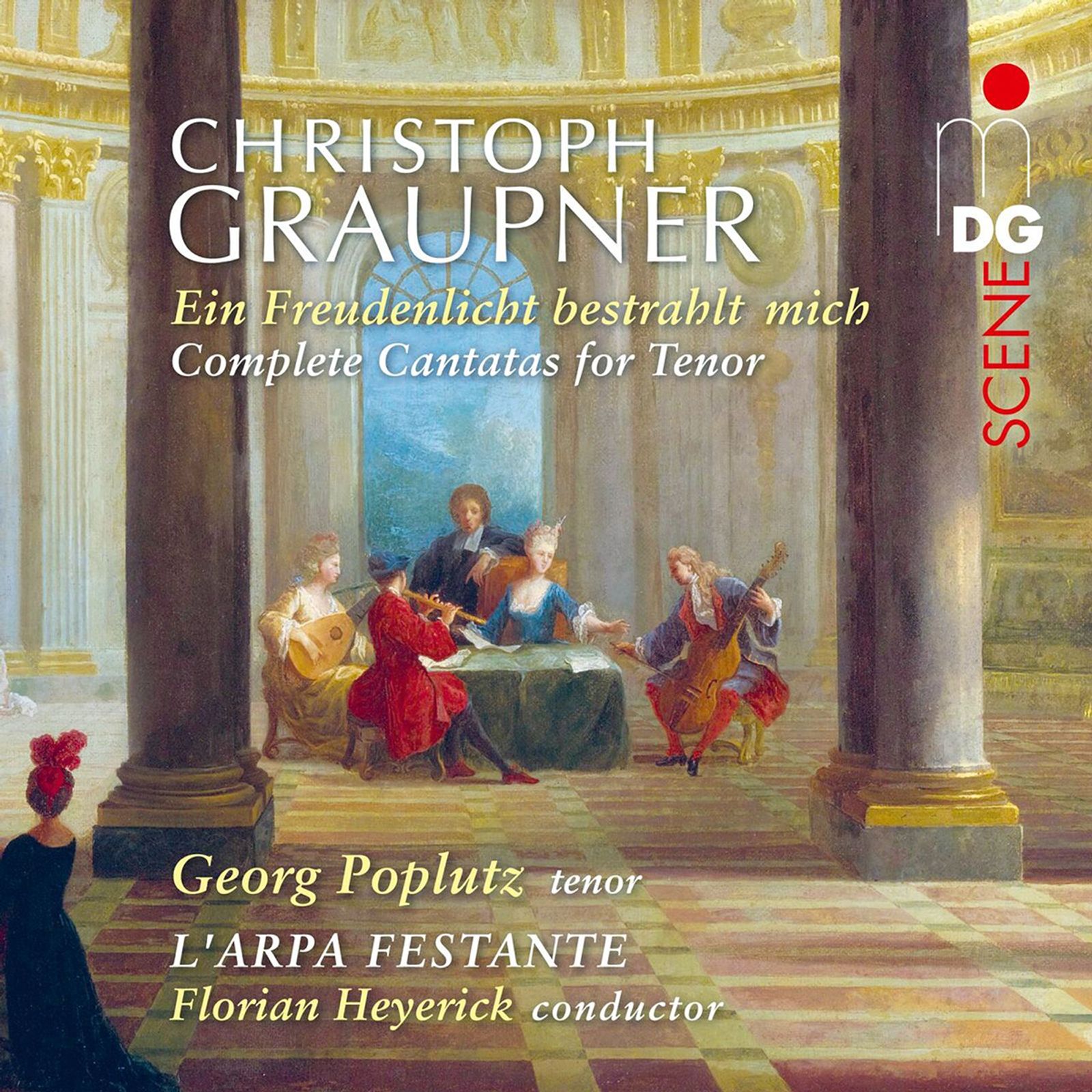
Christoph Graupner (1683-1760) is a name that sounds less familiar even to lovers of Baroque music than those of Johann Sebastian Bach, Georg Philipp Telemann or Georg Friedrich Händel. Yet in his own time he was anything but a marginal figure. Graupner was an exceptionally prolific composer who left an enormous oeuvre in Darmstadt, including operas, orchestral works and some 1400 surviving church cantatas.
A missed opportunity for Leipzig
His name became associated above all with an event from 1722-1723. After the death of Johann Kuhnau, Leipzig sought a new Thomaskantor. Georg Philipp Telemann was initially a candidate, but ultimately declined the post. Graupner then came into view. The Leipzig city council chose him, but his employer, Landgrave Ernst Ludwig of Hesse-Darmstadt, refused to release him from his service. Graupner therefore remained in Darmstadt, and Johann Sebastian Bach eventually got the position. It is a historical footnote that kept Graupner stubbornly in Bach's shadow for a long time.
In recent decades this has gradually changed. Florian Heyerick has devoted himself intensively to Graupner's music for years and, through performances and recordings, has contributed to the rediscovery of a composer who has far more to offer than his link with Leipzig.
Six cantatas for tenor
This new release brings together the six surviving cantatas Graupner wrote for solo tenor: Fürwahr, er trug unsre Krankheit, Ihr frommen Schafe, Ihr Lieben, glaubet nicht einem jeglichen Geist, Das Leben war das Licht der Menschen, Das ewig Licht and Ihr Gläubige, entäußert euch der Sorgen. They date from the period 1725 to 1747. The texts are by Johann Conrad Lichtenberg, who was not only Graupner's brother-in-law but from 1721 also worked as court preacher in Darmstadt.
The title of the CD is taken from Das Leben war das Licht der Menschen. In a recitative from that cantata the line „ein Freudenlicht bestrahlt mich auf das Trauren“ resounds. The image of a light falling over sorrow is characteristic of the textual world of several of these cantatas. Worries, grief and human doubt stand alongside trust and hope. Graupner translates that contrast musically as well: the voice sometimes receives support from the instruments, sometimes they respond to it emphatically or add an accent of their own. The Freudenlicht of the title is thus more than a metaphor: it describes how Graupner makes room for joy within texts full of care.
A fixed form, much musical colour
At first glance the premise seems to leave little room for variation: each time the tenor stands at the centre of a comparable cantata form. Yet within that familiar structure Graupner manages to introduce differences. The solo part alternates virtuosic coloratura with more sustained lines, and the instrumental accompaniment also regularly takes on a profile of its own. The variation often lies in small interventions: a different accent, an instrumental answer or a musical turn that gives a particular word extra weight.
Georg Poplutz is an excellent interpreter for this approach. His clear, warm tenor keeps the words constantly in the foreground, even when Graupner has him sing virtuosic coloratura. The diction remains easily intelligible and the rhetorical accents are sharply chosen without the delivery ever becoming exaggerated.
L'arpa festante under the direction of Florian Heyerick follows this approach with great attention. The ensemble does not have to remain in the background throughout. It is regularly given room to let Graupner's instrumental writing speak, while at other moments all attention goes to Poplutz and the text. The continuo scoring also adds colour: alongside cello and double bass, bassoon, harpsichord, lute and organ can be heard, among others. The accompaniment therefore remains more than a harmonic underlay and actively contributes to the musical rhetoric.
Words acquire their own sound
In Fürwahr, er trug unsre Krankheit, "Ich will hier bei dir stehen" receives a strikingly direct treatment. The musical line makes the character of the text audible, and Poplutz keeps the words in the foreground. Also in Ihr frommen Schafe, individual words are emphatically coloured musically. "Wachet und betet" and "Schafe" receive a marked accentuation, while "Diebe und Mörder" takes on a sharper undertone in the aria. In the recitative, "Stolz" too receives extra emphasis. These are small interventions, but it is precisely in them that it becomes clear how closely Graupner's music responds to the text.
In the first aria of Ihr Lieben, glaubet nicht einem jeglichen Geist, "Wenn Trennungen entstehen" sounds more urgent. At "Satan" the violins place an accent of their own. "Zähne bricht" in the following recitative also gains extra weight through its musical treatment. The chorale that follows then takes on a different colour. The succession of such small accents makes audible how closely Graupner intertwines text and music.
In Das Leben war das Licht der Menschen this interplay is perhaps felt most strongly. In the dictum, "Finsternis" receives emphasis. In the first aria, Jesus is gloriously sung of as "meine Sonne". "Fleuch, mein Herz" also draws attention: Poplutz brings the Christmas joy with unconcealed gladness, at moments even fervently accompanied by the strings and continuo. For me this is an absolute highlight of the CD.
In the following aria, a strong contrast arises once again. The strings underline the urgency of the Christmas message, while the tenor, in complete calm, sets the Glad Tidings against it. The recitative from which the CD takes its title brings joy and sorrow together in a single image.
Light and faith
Das ewig Licht also has a number of remarkable moments. The first aria in particular stands out, with a refined attention to “Wen Gott adelt”. The message to the listener gains weight, while the strings are emphatically present. In “Ach” the emotion is strongly felt, truly as if it comes from the heart. This is followed by a penetrating aria with the restrained, gentle “Komm du”, set against the somewhat searching “mich Dunkelheit bedeckt”. It is once again a memorable moment on the recording, precisely because the emotion never sinks into sentimentality.
In Ihr Gläubige, entäußert euch der Sorgen, the first aria shows how the text is brought out musically. At “der ist ernährt” the phrasing gains extra relief, while the violins are present as a powerful underlayer. In the second aria, “Zufriedenheit” draws the attention: cleverly conceived and deeply felt in its singing, precisely in its simplicity.
Within the individual cantatas, Graupner thus ensures sufficient variety, but over a complete double CD the kinship in form and scoring does become palpable. The differences often lie in small rhetorical and instrumental details. That is precisely why it pays to listen to the music in spread-out fashion: whoever gives the cantatas some time will experience the mutual differences more strongly.
The transparent recording allows both Poplutz and the finely detailed responses of L’arpa festante to come fully into their own.
With this release, Graupner becomes audibly a composer in his own right. His strength lies not in grand gestures, but in the way a single word, an instrumental answer or an unexpected turn can change the meaning of a text. Das Leben war das Licht der Menschen in particular shows how rich the interplay between text, tenor and ensemble can be. The double CD does call for some moderation, but whoever listens to the cantatas separately discovers a composer who is far more than the almost-Thomaskantor of 1722.