


When Age Veeroos recently approached me for a CD review, no light bulb went on for me (yet). I had never heard of her before, let alone was familiar with her work. I would be surprised if that were the case with you, dear reader, with an exception of course. So first let me look into her background.
Age Veeroos, also known as Age Hirv, was born on 11 May 1973 in Võru, Estonia. In 1998 she graduated in German philology from the University of Tartu, with a detour in the period 1993-1994 studying literature at the University of Göttingen. She learned composition from 1996 to 1998 at the Tartu Heino Music School, and in 2006 obtained her master's degree in composition with distinction from the Estonian Academy of Music and Theatre (EAMT). Shortly after, she joined Wolfgang Rihm, who would be her last teacher at the Hochschule für Musik in Karlsruhe. During her student years she followed several international learning trajectories, including with Salvatore Sciarrino (Rome, 2004), IRCAM (Paris, 2005) and the Arditti String Quartet (Metz, 2005). She also participated in various masterclasses, including those by Michael Finnissy, Georg Friedrich Haas, Veli-Matti Puumala and Betsy Jolas.
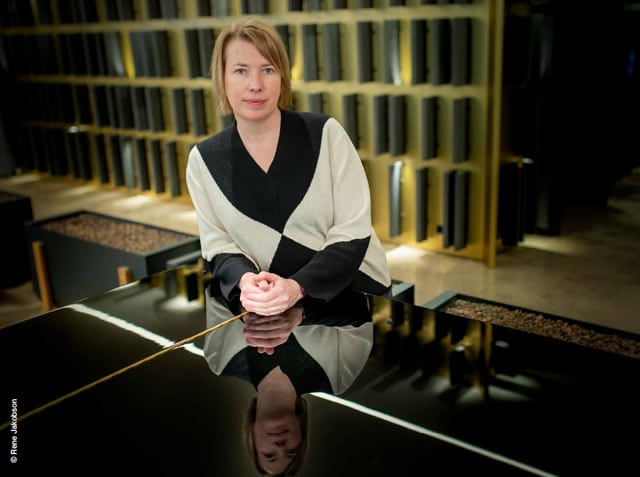 Although Veeroos' oeuvre may be little or unknown in Belgium and the Netherlands (although Slagwerk Den Haag has indeed programmed a number of her works), her compositions are regularly performed both within and outside her own country's borders, both in regular concert programmes and at music festivals, and not by the least ensembles, such as Ensemble Musikfabrik, Sinfonietta Riga, the Estonian National Symphony Orchestra, the Arditti String Quartet, the Berliner Philharmoniker, but also at the Staatsoper Hannover.
In 2010 Veeroos won the main prize with a team of six members of the competition organized by Zeitgenössische Oper Berlin in the field of music theatre Operare 2010. In 2020 the European Composer and Songwriter Alliance (ECSA) nominated Ma olen suur kuu su silmapiiril ('I am the great moon on your horizon') for the concert in the context of the European Orchestra of Contemporary Composers (ECCO). As part of the sixty-minute programme, compiled on the basis of a referendum, her piece was selected for the seventeenth online edition, performed in February 2021 by Joey Marijs van Slagwerk Den Haag. In 2023 Veeroos received the Lepo Sumera Composition Prize.
A new album with seven works by Age Veeroos recently appeared on the Kairos music label, specializing in modern and contemporary music. The title, Outline of the Night, refers to the piece of the same name for ensemble, which Veeroos completed last year.
Simon Cummings provided the excellent commentary. Of course one may wonder whether and, if so, to what extent music needs this, but certainly in the contemporary field even a not too elaborate analysis can work wonders. If only to foster auditory understanding of music that is often less easily accessible.
Central to the music of Age Veeroos: nothing is what it seems. Or perhaps everything is exactly as it seems. This paradoxical character is fed by its elusiveness, the most characteristic feature of her composing for me. This in contrast to the 'subjects' she has chosen. It has something mysterious about it: this music with its unavoidable sense of the inviolable, which, inherent to this concept, is not easily put into words. Veeroos excels in the symbiosis of radiant energy and tense, ambiguous rhetoric. Music that equally easily connects microtoniality with electronics, in which playback technique boundaries are also explored and obsessive surrealism is embraced as much as the offshoots of Estonian folk music.
Many contemporary composers often deploy new sound material to make a completely new listening experience possible. From the idea that the traditional sound world has become worn out from a historical perspective and has thereby become unusable.
Why would it be different with Veeroos? For her, new sounds - as this album also makes clear - are not an end in themselves. Rather, it is music in which hyperexpression is reflected as her most important spiritually rooted 'sign language'. Not monolithic sound blocks but ascetic diffusion and (seemingly?) intuitive hushing, welling up from subtly shaped sound sculptures that manifest themselves as freely floating sound objects.
Contemporary music demands, no, requires strongly engaged musicians who have completely made their own the most complex pieces. On this album it comes together perfectly: the intense engagement, the playing technique skills and the clear recordings that offer more than just the cherry on top. For it is often overlooked: that from the very beginning the recording is strongly co-determinative of the final result, however excellent the music and the musicians may be. It is, after all, the quality of the recording that opens up music, as it were, and makes the listener a participant in it. On this album it is realized in the smallest detail.