


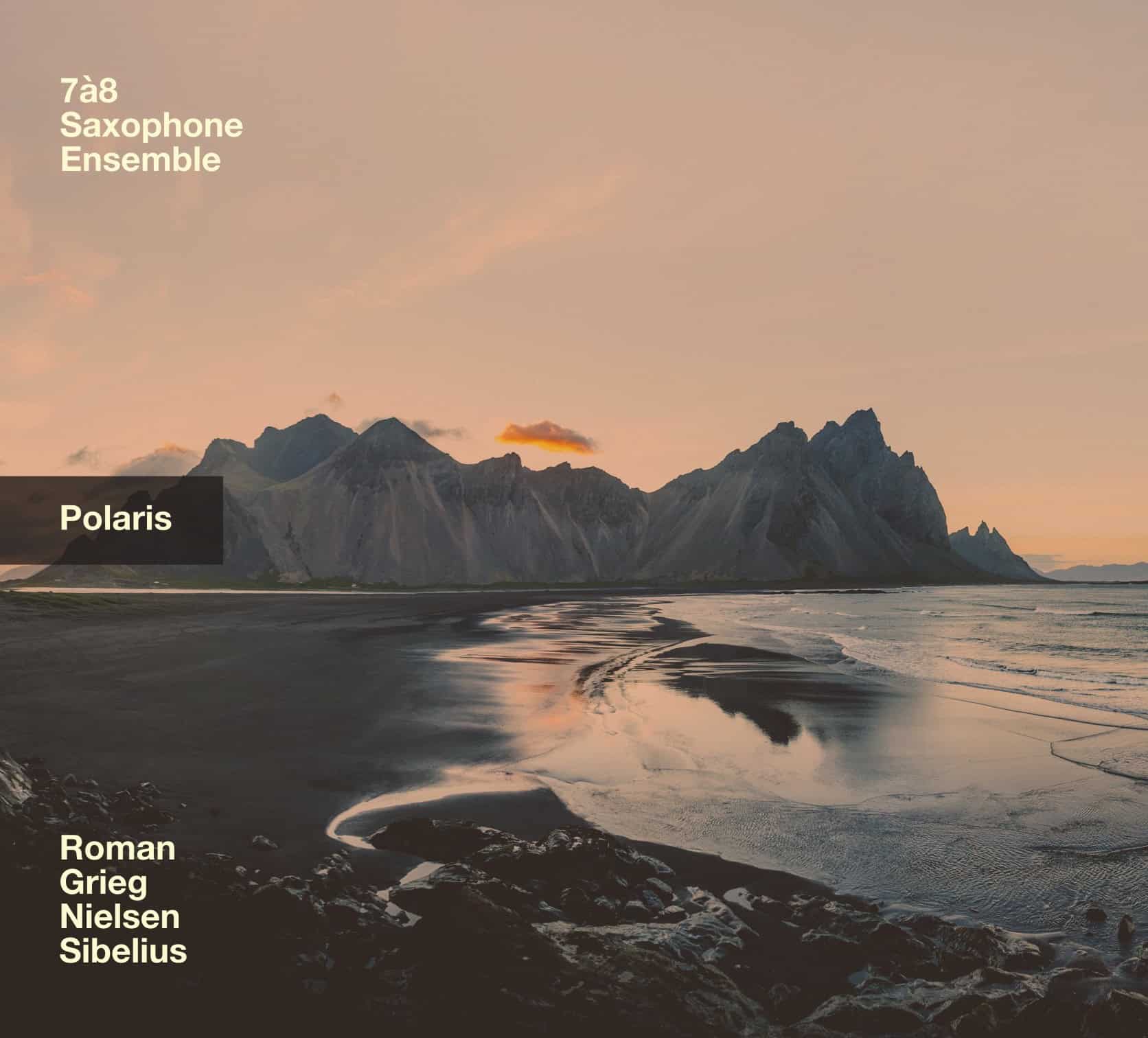
With four Scandinavian composers, 7à8 Saxophone Ensemble takes the listener on a journey through northern Europe. The musical exploration trip starts in Sweden with a virtually unknown name. It is a selection from Bilägers Musiquen (1744) by Swedish Baroque composer Johan Helmich Roman (1694-1758) that resonates. This festive music on the occasion of a royal wedding immediately sets the cheerful and upbeat tone of this cd.
Thomas Pechot arranged the pieces on this album. Romans Baroque work comes pleasantly into its own with the warm sound of this saxophone ensemble. To preserve some of the original Baroque sound, Jonathan Bridoux accompanies on the basso continuo with the harpsichord. The fusion of Baroque with the Romantic invention of the saxophone gives this work a unique sound.
After Sweden we move westward toward Norway with a classic by Edvard Grieg (1843-1907) Peer Gynt Suite no. 1 op.46 (1888). When thinking of Scandinavian music, this musical setting for Henrik Ibsen's play of the same name is one of the first works that comes to mind. It is therefore an obvious choice, yet it sounds new. Once again, it is the remarkably warm color of the saxophone ensemble that provides a fresh listening experience.
In particular, the second movement "Åses død" [Asse's death] works exceptionally well. The deep, dark sounds of the bass saxophone played by Fabrice Muratore give it an ominous character. Above it, the other saxophones color this funeral march in various combinations. Again, an arrangement that ingeniously plays with timbre.
After being able to escape from the hall of the Mountain King, we cross the water and arrive in Denmark. There sounds Pan and Syrinx op.49 (1918) by Carl Nielsen (1865-1931). In this pastoral scene, the music tells the legend of how the god Pan invented the pan pipes. The enamored god pursued the forest nymph Syrinx, but she wanted nothing to do with his advances. At the edge of the river, she asked for help and transformed into reeds just in time. The frustrated Pan sighed and the reeds produced a pleasant tone. He cut the reeds and designed the first pan pipes.
To imitate the sound of the pan pipes and give voice to the character of Syrinx, Nielsen makes abundant use of the woodwinds in the orchestral version. These solos are performed on this album by soprano and alto saxophones. An effect that imitates the thin wind. In addition, the saxophone ensemble is accompanied by three percussionists, one of whom plays the xylophone and the bells. This is an important addition to the instrumentation. It generates a fuller sound and makes it possible to fully bring out the programmatic character of this symphonic poem.
After Nielsen's nature scene we return to the north. The album ends with Finlandia op.26 (1899) by Jean Sibelius (1865-1957). This is a work in which the composer makes extensive use of the extremes of his orchestra (extreme lows and extreme highs). To my delight, this means a return of the bass saxophone. The low, droning notes of this instrument give the arrangement extra depth and a fuller sound. With seven saxophonists and three percussionists, 7à8 Saxophone Ensemble manages to match the volume of a full orchestra.
Pechot's arrangement of this symphonic poem, despite the full sound, still makes it possible to follow each line individually. The reduction in musicians compared to the original creates a kind of distillation through which the individual musical lines sound clearer. Even if you have heard Finlandia in various orchestral performances, in this arrangement you can therefore focus on other aspects that otherwise get lost in the vastness of the crowd. 7à8 Saxophone Ensemble offers a new listening experience for this Scandinavian classic.
And with this last work, the circle is complete. From Sweden to Norway, the crossing to Denmark in the south and then back to the north in Finland. With four known and lesser-known compositions, 7à8 Saxophone Ensemble takes us on a musical journey. Scandinavian classics take on a different, warm color through the saxophone sound, evoking a new listening experience. With Roman's Bilägers Musiquen, they bring hidden gems to light. Hidden gems that make you hunger for more…
4/5
- WHO: 7à8 Saxophone Ensemble
- WHAT: Polaris
- RELEASED: self-released
- ORDER: available from the artist