This final evening has a Belgian flavor, as an alumnus of the Musica Mundi School in Waterloo is defending his candidacy: Krzysztof Michalski. Like the eleven others, we wish him every chance and an honorable prize. The presenter made a special appeal at the beginning of the evening about something that had been bothering several people: please refrain from coughing, or if absolutely necessary, do so as discreetly as possible. Did her plea have any effect? Right at the first note of the required piece, you hear a cough—and it's not in the score…
Fang Man (b.1977) – Four Odes to the Tidings of Flowers
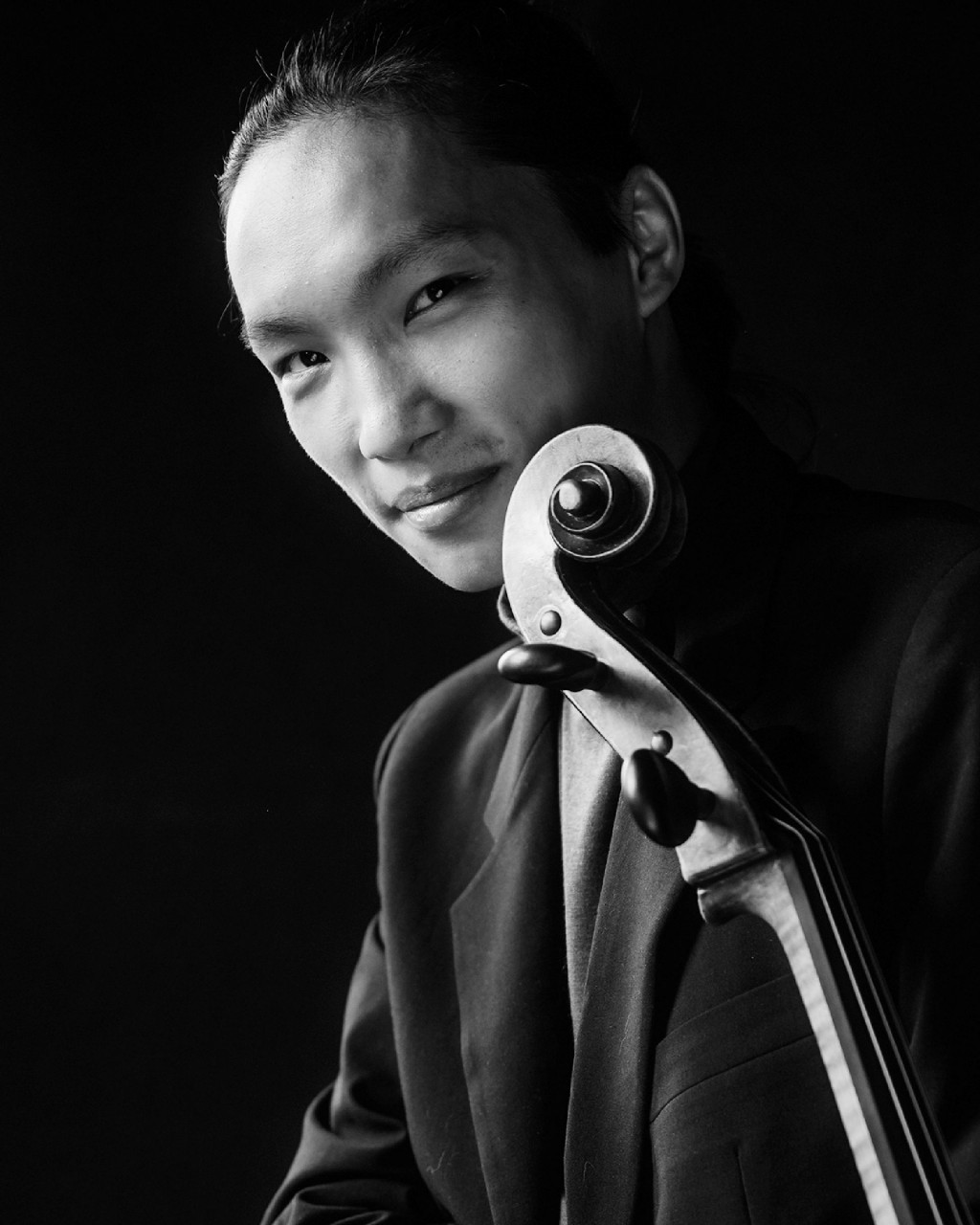
You can tell from Leland Ko's bearing that he's used to competing. He's a prize-winner, as they say, and he certainly plays with a rich cello sound, though he doesn't quite convince in the opening movement of this required piece. He's tremendously accomplished technically and radiates ambition that's unmistakable. Is he perhaps too self-assured? In the second movement you hear some less beautiful tones from imperfect bow control—or rather, it seems that way, but that's not it; he's choosing to do it. The final chord referencing Bach could be much more striking. It's minimal. His third movement starts off strong, but it's primarily a highly technical section with glissandos, running passages, pizzicatos and so on, though it doesn't really add up to a coherent musical statement. The fourth movement is equally technical and yet you hear that same ungainly bow sound again. Does he always rely on the showmanship to carry it through?
Samuel Barber (1910-1981) - Concerto in A op. 22
Ko makes me wonder whether he's actually following the musical line at all in his entry. It's quite different from that of the orchestra. Very shortly after, he picks up the musical threads beautifully—fine phrasing, subtly colored harmonies, and orchestral colors entirely. He may be a bit willful and limits the nuances, restricts the phrasing somewhat, which doesn't really serve the cinematic and lyrical character of this work. It's too much 'cello tricks.' (And did we really hear a smartphone again? Thankfully between the first and second movements, but still: 'ugh!') Barber deliberately wrote an especially melodic second movement for the cello with some orchestral contrasts. The third energetic movement, offering a richly filled palette that's more than mere bravura, settles for bravura—the kind that wins over the audience but doesn't serve the work. A strong performance? Certainly, but not one that interprets the music.
Dmitri Shostakovich (1906-1975) – Concerto No. 1 in E-flat Op. 107
Technique unites itself, insofar as possible, into music. Although the orchestra must transcend the cello—which is indeed foreseen by the composer—you can still hear Michalski even in the nearly deafening passages. He phrases and breathes in the quieter sections, something impossible in the overwhelming passages. His chosen second movement is very fragile, subtle, cautious. No show, no displaying of 'see what I can do,' but rather climbing into the piece and performing it fully, making better music from it. Throughout the work, he goes for something interesting, intelligent, and as faithful as possible to Fang Man's composition. How does he interpret that brief Bach reference? It's immediately Bach—you're suddenly in Bach's world with that short closing fragment. He concludes with the somewhat mystical, floating, elusive final movement. The solo in this section is genuinely beautiful music-making; he puts life into it, phrases strongly.
Dmitri Shostakovich (1906-1975) – Concerto No. 1 in E-flat op. 107
Indeed, in this concerto we get right away not just power and rhythm but nuance and phrasing as well. This work likely contains difficulties meant to highlight technical ability, but especially in this twentieth-century, not entirely tonal music, it's about drawing a musical line, establishing thematic substance and recognizability, creating a dialogue between orchestra and soloist. We get all of that. Sometimes this first movement is played quite aggressively, but that's not the case here. It's certainly well-founded. The second movement begins very lyrically, with a wistful horn part that transitions into the cello taking the lead. This slow movement is so inviting; it's soothing, comforting. That's how it feels in this interpretation. A contemplative calm comes over me. In the third and especially fourth movements, there seems to be a slight weakening, but the thread is picked up strongly again and leads to a fine, thrilling apotheosis.