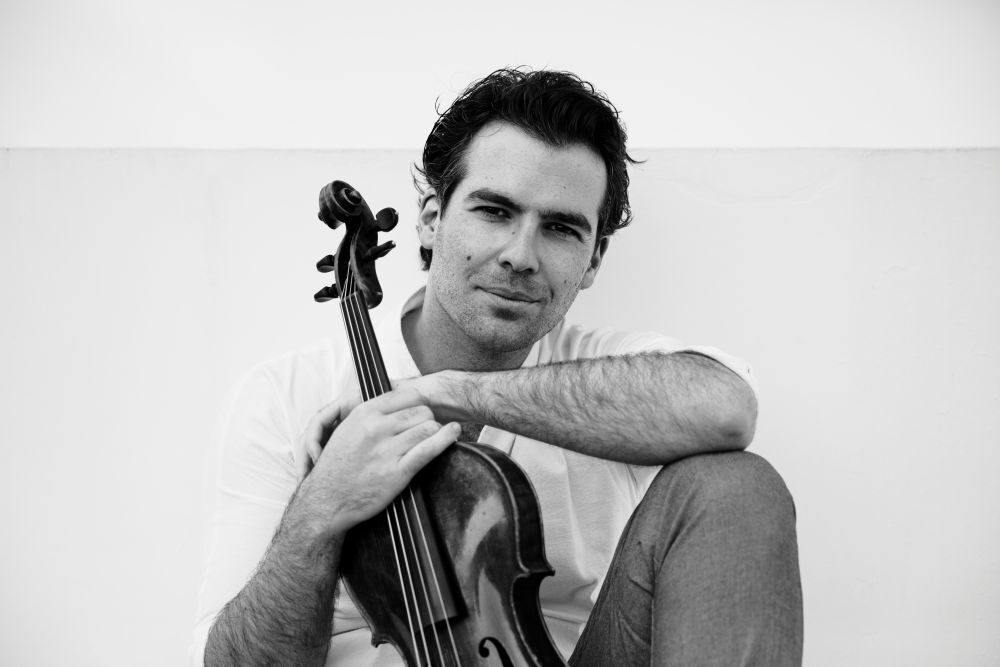
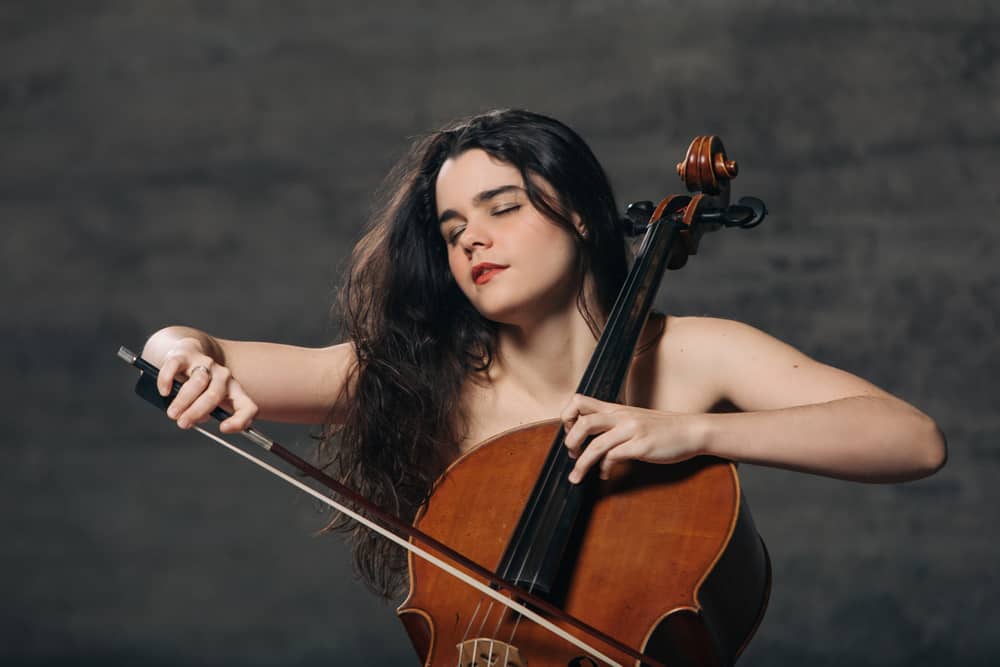
Young Swiss cellist Estelle Revaz recorded Frank Martin's Cello Concerto and Ballade for Cello and Chamber Orchestra with L'Orchestre de Chambre de Genève under the direction of Dutch conductor Arie van Beek. This engaging album is a welcome addition to the sparse discography of an underrated composer.
Frank Martin (1890-1974) enjoyed great success during his lifetime, but after his death he gradually faded into obscurity.
This is all the more puzzling since his music is easy on the ear without being facile, harmonically adventurous without embracing atonality, and characterized by stimulating orchestration that offers moments of impressive beauty at every turn. His music moves everyone, and this certainly applies to the works on this album. Although Martin was naturally influenced by his contemporaries, he speaks in his own distinctive voice.
One reason for Martin's lack of popularity probably lies in fragmented Switzerland, with its four languages and three different cultures, where he never found his footing. This stands in contrast to his fellow countryman and contemporary Arthur Honegger, who embraced French culture so thoroughly that many (and still do) regarded him as a French composer and reaped the rewards.
However, Martin felt at home with neither French nor German musical culture. He went his own way.
After World War II he settled in the Netherlands. But there too he never found acceptance in musical life. Nevertheless, his music was judged extremely positively and he received numerous international honors as recognition. Ultimately, however, this proved insufficient to sustain his reputation: after his death, Martin gradually disappeared from concert programs.
The Cello Concerto (1965-66) exemplifies Martin's transparent style and his ability to create a colorful atmosphere.
The Lento-Allegro opens with a slow and sorrowful theme in the solo voice, leading to a refined dialogue between soloist and winds. The middle section of the movement is a more or less traditional development of the theme in which the orchestra comes to the fore. But now the soloist incorporates the dialogue into a conversation with itself, ending with the opening theme after a powerful orchestral tutti.
The Adagio brings tranquility. Here Martin shows how little material he needs to create an oppressive atmosphere. A passacaglia built from a sequence of a few notes that recurs in various ways and different instrumentations forms the backdrop for the solo voice, which plays around the theme as if it were an improvisation. A colorful episode emerges in which the orchestra increasingly intervenes, but the agitated mood ultimately gives way to a meditative atmosphere, leaving the cello alone.
The Allegretto gets the listener back on solid ground. A perpetuum mobile in the low woodwinds and piano provide a challenge that the solo voice takes on with double stops and virtuosic playing. Sharp accents and syncopations in the brass add even more life to the mix.
Suddenly the mood shifts and an almost lyrical dialogue with the flute emerges. It doesn't last long before the ceasefire is broken and the exciting battle between solo voice and orchestra resumes, with the cello as the ultimate victor.
The Ballade for Cello and Chamber Orchestra (1949) begins with a slow, expansive multi-voiced theme in the cello, here and there supported by accents in the strings. A subtle orchestral entry follows with oboe and low strings. The transition to a faster tempo brings movement. But the solo voice remains in dialogue with the orchestra. Gradually the orchestra is driven to an obsessive organ point and a possessed cello. Then comes a surprising time signature change and a Bartók-like dancing motif. Peace returns. A short cadenza brings us back to the opening theme.
A welcome bonus on this album is the world premiere of Xavier Dayer's (1972) Lignes d'Est for Cello and Orchestra, a student of Frank Martin. He dedicated the work to the soloist.
With broadly spanning melodic lines, Dayer creates a static, oriental, meditative atmosphere in which the solo voice and orchestra each pursue an autonomous path, sometimes giving each other space or moving together. Gradually more movement enters the sound blocks and the atmosphere becomes more threatening, ending in stillness. Dayer drew inspiration from Romanian folk music without quoting it.
Estelle Revaz gives a beautiful interpretation of these melancholic and sometimes meditative works with her restrained and technically superior playing, entirely in Martin's spirit: understated, yet never timid.
Arie van Beek and L'Orchestre de Chambre de Genève provide subtle accompaniment that fully does justice to the tonal colors, rhythmic and dynamic contrasts so characteristic of Martin's music.
WHAT: Journey to Geneva; works by Frank Martin & Xavier Dayer
WHO: Estelle Revaz cello; L'Orchestre de Genève conducted by Arie van Beek
PUBLISHED BY: Solo Musica SM 345
FOR SALE: Cypres CYP8614
PHOTO: Batardon