

Beneath the Royal Square in Brussels lies a piece of history that few visitors to the capital are aware of. The archaeological site of the former Coudenberg Palace preserves the remains of a residence that for centuries played an important role in the political and cultural history of the Low Countries. Among those who stayed here were the Burgundian dukes and Emperor Charles V. Archduke Albert and Archduchess Isabella also left their mark on the palace, until a devastating fire in 1731 largely reduced the complex to ashes. What has survived beneath the Brussels city centre now forms the setting for a festival that takes the historical layering of this place as its starting point.
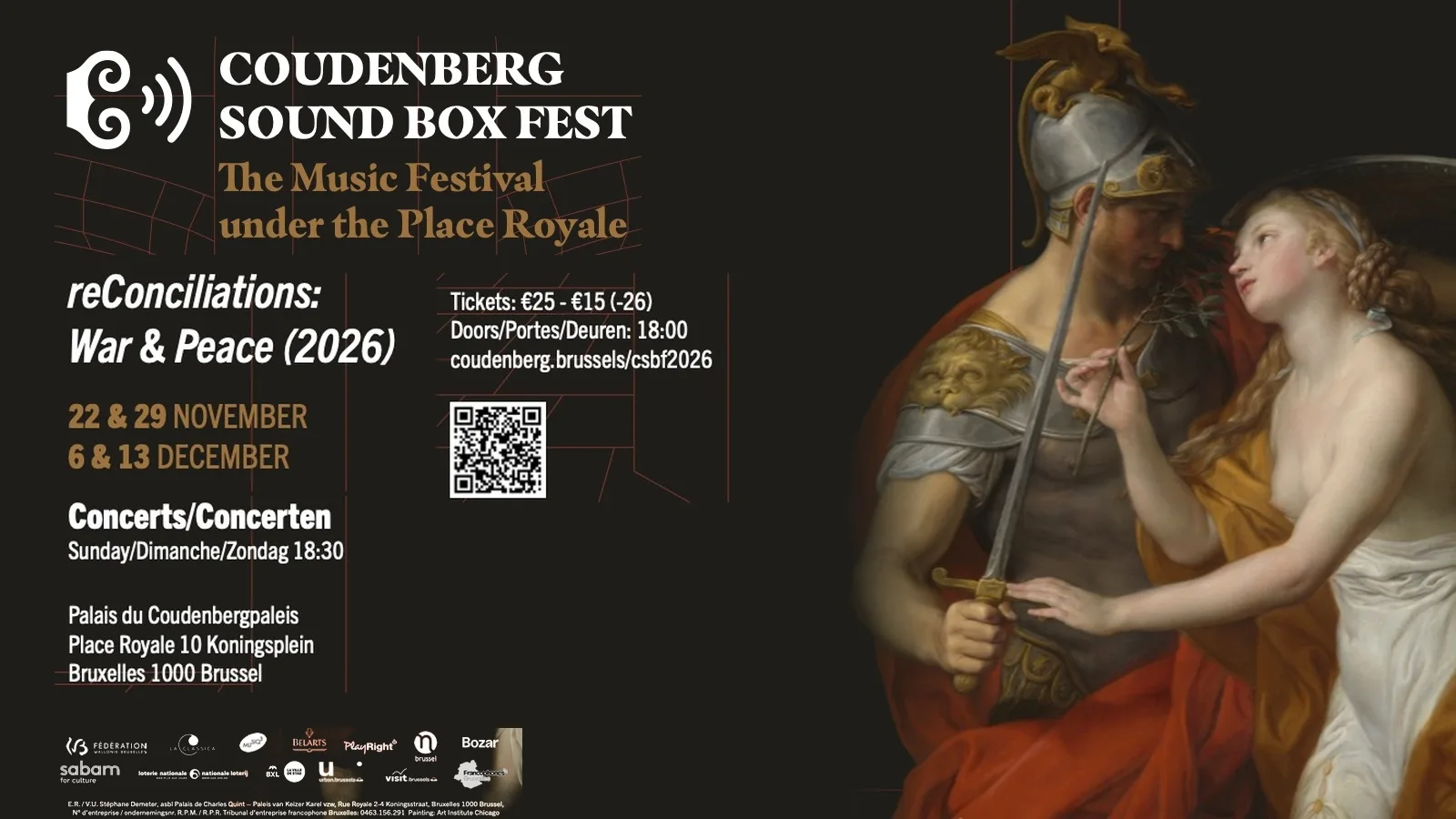
From 22 November to 13 December, the sixth edition of the Coudenberg Sound Box Fest takes place. Under the title reConciliations: War & Peace, the festival brings together musicians and ensembles from diverse traditions around war, peace, remembrance and reconciliation. Early music stands alongside contemporary compositions, traditional sounds alongside jazz and improvisation. The underground spaces of the former palace are more than a special concert venue: their history and acoustics form part of the artistic experience.
A festival in historical context
The Coudenberg Sound Box Fest was founded in 2021 under the artistic direction of flautist and musicologist Matteo Gemolo. From the very beginning, the festival has sought a dialogue between the architectural heritage of the site, early music and contemporary artistic developments. The concerts are not simply placed in a historical environment; the location itself forms part of the starting point for the programming.
 This interplay reflects the broader vision of Gemolo. As a specialist in historical performance practice and contemporary music, he wishes to bring the largely forgotten musical life of Charles V's former palace back into the spotlight. Within the research and development project reCoudenberg, running from 2025 to 2031, historical research is linked to new artistic creations, co-productions and audience engagement. The past is thereby not regarded as a closed chapter that must merely be reconstructed, but as material with which artists can work today.
With reConciliations: War & Peace, this idea acquires a distinctly social dimension. The history of Europe is marked by wars, shifts of power, religious conflicts and cultural encounters. Music cannot undo that history, but it can create space to listen to it from different perspectives. The underground halls of the Coudenberg Palace provide a meaningful setting for this: a place where traces of the past are tangibly present and where new sounds acquire current significance.
From the Thirty Years' War to the twentieth century
The first two festival concerts start from music that emerged in times of political and religious unrest. On 22 November, InAlto, led by Lambert Colson with soprano Alice Foccroulle, presents the programme Onrust voor de vrede (Unrest for Peace). The music of Heinrich Schütz (1585-1672), including from his Symphoniae Sacrae of 1647, sounds alongside works by Johann Theile (1646-1724). Both composers lived in the seventeenth century, a period in which the consequences of the Thirty Years' War deeply affected European social and religious life. Their music shows how composers, in that context, gave expression to faith, loss and the hope for peace.
The programme takes on a very different physical dimension through the presence of AkroPercu, with Max Charue, Julien Mairesse and Thomas Delplancq. Percussion and acrobatics bring a combination of sound and movement into the underground spaces. Opposite the vocal and sacred character of InAlto stands a more bodily approach to rhythm and expression. Each of the two ensembles illuminates, in its own way, how music and movement can respond to a world that is out of balance.
A week later, on 29 November, attention shifts to voices that were silenced through persecution and censorship. With Verbannen stemmen, gecensureerde waarheden (Banished Voices, Censored Truths), Ensemble Matica de Flor performs music from the Sephardic tradition. That tradition carries the traces of a long history of migration, expulsion and cultural mixing. Songs and musical customs were passed down across generations and changed along the way with the communities that kept them alive.
Trio Satellite – Lia Manchón Martínez (violin), Coline Meulemans (viola) and Marc Martín Nogueroles (cello) – connects this perspective with the work of two twentieth-century composers: Gideon Klein (1919-1945) and Sofia Gubaidulina (1931-2025). Klein was deported to Theresienstadt during the Second World War and died in the Fürstengrube concentration camp. His music belongs to the work of composers whose lives and oeuvres were cut short by Nazi terror. Gubaidulina developed an idiosyncratic compositional output in the Soviet Union, in which spiritual and religious themes play an important role. Together, these works place different forms of oppression, remembrance and artistic freedom side by side.
Music at the court of Charles V
On 6 December, the festival turns its attention to the music that may have resounded in the Coudenberg Palace itself. The co-production with Bozar is titled Het heilige en het profane in het verloren paleis and takes place at two locations: the archaeological site and the Coudenberg Church. In this way, the historical setting itself becomes part of the programme.
ClubMédiéval, with tenor Jonatan Alvarado, lutenist and vihuela player Ariel Abramovich and gambist Thomas Baeté, presents music from the time of Charles V. The programme starts from repertoire that the emperor and his entourage may have known. The combination of voice and historical stringed instruments evokes a sound world closely connected to the musical culture of the sixteenth century.
In the Coudenberg Church, Dionysos Now!, under the direction of Tore Tom Denys, takes the audience into the polyphonic music of composers such as Johannes Ghiselin, Pedro Ruimonte and Thomas Crecquillon. Their works demonstrate the richness of the multi-voiced vocal tradition, which held an important place at the Habsburg court and in the wider European musical culture. The two concerts thus offer different perspectives on the musical life of the Renaissance: from the more intimate combination of voice and stringed instruments to the elaborate polyphony of the vocal ensemble.
Between East and West
The closing day, 13 December, brings the theme of cultural encounter and exchange into the present. In Breuklijnen tussen oost en west, the oud takes centre stage. Elias Bachoura starts from the Middle Eastern modal tradition and explores the possibilities of a dialogue with Western classical harmony. The programme is linked to his album Biharayto and addresses the question of how musical languages can influence one another without losing their own character.
BeraadGeslagen also deliberately seeks out the boundaries between genres. The duo of keyboardist Fulco Ottervanger and drummer Lander Gyselinck moves between jazz, electronica and improvisation. Their music arises from the interplay between two instruments and two musical personalities, with room for unexpected turns and spontaneous interaction. Within the festival programme, this forms a distinctly contemporary counterpart to the historical and traditional music.
Room for young talent and research
The Coudenberg Sound Box Fest is not limited to concerts. On 17 and 18 November, the second edition of Next/Gen takes place, a track for young ensembles devoted to early music. Participants have the opportunity to develop further through masterclasses and mentoring, and then present themselves to the public. The track also comes with a scholarship, as well as a place in the festival programme of 2027. In addition, a new contemporary composition by Andreas Moulin will be included in the project. In this way, a connection is created between the training and support of young musicians, historical performance practice and new music.
The lecture series Oorlog en vrede, tussen muziek en samenleving also broadens the perspective. In collaboration with the Université libre de Bruxelles and the Institut des Hautes Études de Belgique, four sessions are organised from 19 November to 10 December in the Ursulinenkapel. Researchers Jessica Rosa, Cecilia Paredes, Pieter Lagrou and Emmanuelle Soupart shed light, from their own expertise, on the relationship between music, conflict and society. The lectures place the artistic programme in a wider historical and social context.
The fact that the festival has joined REMA, the European network for early music, underlines the ambition to anchor its work internationally as well. The Coudenberg Sound Box Fest thus aims not only to offer a platform to diverse ensembles, but also to be a place where research, artistic development and encounters with the public reinforce one another.
A living dialogue
The strength of reConciliations: War & Peace lies in the way the festival brings different eras and musical worlds into conversation. The music of Schütz and Theile, the Sephardic tradition, Renaissance polyphony and the contemporary soundscapes of Elias Bachoura and BeraadGeslagen do not form a continuous historical line, but offer varied perspectives on conflict, memory and coexistence.
The choice of the Coudenberg Palace gives this encounter an additional layer of meaning. Beneath the city, among the remains of a vanished residence, music resounds that spans centuries and cultures. The past does not remain buried underground here: it is given a voice.
Practical information
Coudenberg Sound Box Fest – reConciliations: War & Peace
22 November to 13 December 2026
Coudenbergpaleis, Koningsplein 10, 1000 Brussels
On 6 December also in the Coudenberg Church.
Concerts on 22 and 29 November and 13 December at 6:30 p.m. On 6 December there are two concert series, starting at 5:30 p.m. and 7 p.m., respectively at 7 p.m. and 8:30 p.m.
Tickets: €25 for the concerts on 22 and 29 November and 13 December; €32 for the co-production with Bozar on 6 December. Young people under 26 pay €15 and €22 respectively. Children under 12 have free admission.
More information and tickets: coudenberg.brussels/csbf2026 and belarts.art
The lecture series Oorlog en vrede, tussen muziek en samenleving runs from 19 November to 10 December in the Ursulinenkapel.