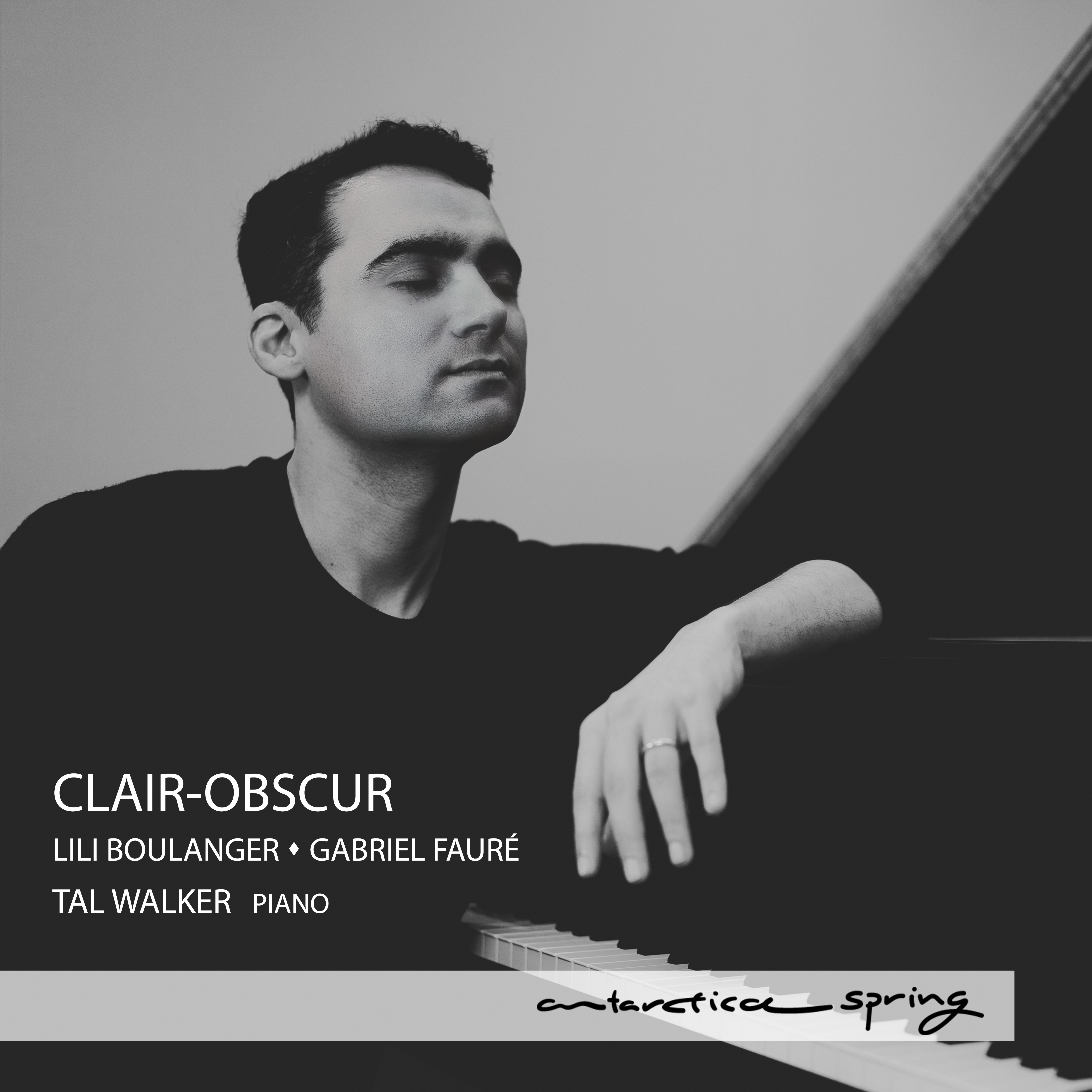
Actually, one could not have found a better title for this cd than Clair-obscur. If there is one concept that immediately connects with the works performed here, it is this: light and dark, stillness and movement, pain and sometimes a glimpse of hope run continuously through this music. Pianist Tal Walker has a fine touch and immediately grasps the tone of this intimate music. He brings color to stillness: a silence carries with him a kind of restrained tension. At other moments he gives somewhat more force, always measured, as if he senses precisely how much a phrase needs and no more than that.
The chosen miniatures by Lili Boulanger (1893-1918) alternate in mood, though it remains predominantly dark. Walker generally plays with restraint, but in Cortège he lets that reserve loose a bit more: suddenly there is more movement, more air – a welcome relief among the more introspective pieces. In Thème et variations the intensity immediately increases, and that is no coincidence: the first section bears the inscription in the score Assez lent, avec douleur, mais noble – slow, with pain, but noble. That pain is precisely what you hear in the piano playing and it remains present throughout the rest of the variations. Every now and then something like light seems to shimmer through, but it is almost immediately stifled in the bud, as if the music denies itself escape.
This closely reflects Lili Boulanger's biography. Her short life was deeply marked by illness, while at the same time she possessed an exceptional musical ambition and creative drive. In his notes accompanying the cd, Walker himself mentions this tension between light and dark as one of the elements that particularly attracts him in her music. Because of this it is difficult to hear Thème et variations completely separately from her life story. The strength of this performance, however, is that the pain comes from the music itself, in the touch and the phrasing, rather than from explicitly using biography as an interpretive key.
The combination with music by Gabriel Fauré (1845-1924) is particularly logical. Boulanger knew Fauré from an early age; as a child she attended lessons at the Conservatoire where he later became director and dedicated one of her songs to him. Fauré's Thème et variations in C-sharp minor from 1895 – his longest work for piano – moreover formed an important reference for Boulanger's own work. Those who hear both works one after the other will recognize similarities in the broad piano textures and in the way the theme is repeatedly illuminated. Boulanger's version has a stronger romantic drive and a dramatic tension that you do not quite find in the same way in Fauré.
Perhaps Boulanger and Fauré could even have been alternated more – that could have made the listening experience even more exciting. Those who did not look at the track numbers might sometimes wonder: am I now hearing Boulanger, or Fauré? In Fauré there is occasionally a slightly firmer touch, for example in the Allegro vivo from his Thème et variations, but both composers are in any case played with great care.
With the Huit pièces brèves the atmosphere changes noticeably. Here we get to hear a more lively, more zestful side of Fauré. The Capriccio is played with much gusto, while the Adagietto provides a moment of rest, a brief pause after the intensity of what came before. The following Improvisation is brought with particular elegance: Walker lets the music flow without letting it become blurred. Allègresse then brings pace and lightness again, a pleasant shift after the more concentrated passages before it. And then follows that delightful Nocturne as a finale – not hushed like elsewhere in the program, but full of glow, only to fade slowly afterwards.
What remains most memorable after listening to this cd is the playing of Tal Walker. His light touch, his sense of color and especially his unerring phrasing make this recording convincing. He knows how to use force when the music demands it and is equally good at sensing when a restrained approach says more. This gives each piece its own character, while the program as a whole maintains a clear coherence.
A strong cd then, with intriguing works – and a pianist who after this introduction you especially want to hear performing live.