In the meantime, Music Hall has been active for 30 years and this season is being celebrated with numerous musicals, ballets and beautiful operas including Madame Butterfly and La Bohème by Puccini, Nabucco by Verdi, and as an opener Carmen by Bizet. Music from the 19th century that continues to captivate with melodies that belong to our collective memory.
Carmen is not a casual pleasure of sound. The French composer Georges Bizet was a daring innovator in his time who denounced abuses. He developed a new style: verismo.
Director Frank Van Laecke
Like a highway cruiser, he keeps producing. Today an opera, next month the world premiere of the musical '40-'45. An artist, and certainly a director, must have a feel for social trends. Frank Van Laecke does not travel back in time, but draws connections with today and makes it a contemporary spectacle. Prostitution, human and arms trafficking, drugs.. it is something of all times and is presented raw and unfiltered, confrontational on stage. Images taken from an unsparing reality and planted in a theatrical dimension.
At a time when women are finally daring to speak out about how they are pawns of male power lust in the #MeToo storm, this staging is not only an eye-opener but also very much in place. The filth of the criminal underworld is further emphasized by the colors of the dark and gloomy set design and the costumes in black/grey tones.
Carmen is not a casual pleasure of sound but music with a mission in which ruthless cruelty and sex form the mainstay. Frank Van Laecke directed this opera in 2015 for the Summer Opera of Alden Biezen. A different environment breathes new inspiration. Half of the concept was retained and half was adapted to the new environment. The fiery glow of the original is preserved.
The setting
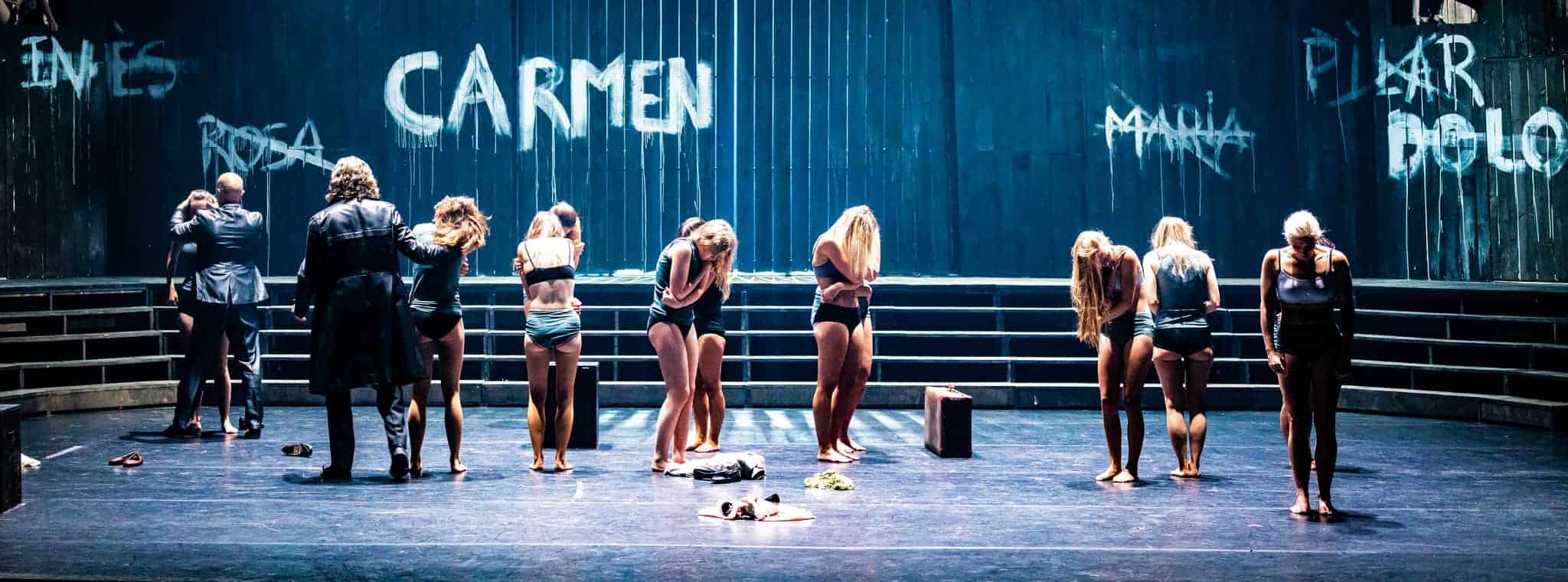
Upon entering the hall, the audience is immediately drawn into the story. You are instantly in the red-light district. An open space, surrounded by a wooden palisade with the names of women chalked on and crossed out again, only Carmen's name remains. Behind windows, prostitutes entice customers. Two pimps, Hans Peter Janssens as Remendado and Fabrice Pillet as Dancaire, keep watch over the girls. Two shady underworld figures. A task that both gentlemen execute with flair. On the intro to Carmen, a new batch of women are pushed in, stripped of their possessions and inspected like meat.
Lonely, abandoned souls. Their last resistance is broken. Young girls ground between the teeth of human trafficking/prostitution. They disappear into a trapdoor. Shortly after, they re-emerge from the basement, scantily and provocatively dressed. The male choir appears. Their voices resonate in the space (the Music Hall Classical Chorus brings together a select group of committed choir members). Horny men, eager for a quick fix.
Micaëla, sung by Hanne Roos, arrives with a letter from Don José's mother. She quickly retreats from the pushy men. A bastion of testosterone and macho behaviour prevails. Among them the young Belgian baritone Koen Van Agtmael, a semi-professional with stage presence. To tease the prostitutes, he begins a striptease, which is interrupted by the arrival of the higher-ranking soldier Don José, played by Slovenian tenor Ajaz Farazin. A tenor with a beautiful timbre who creates a very credible character, first there is his disinterest when Carmen directs her arrows at him, then love, complicity, jealousy and finally revenge. A whole palette of emotions that he knows how to translate not only in body language but also in the timbre of his voice.
Carmen's destructive life takes shape. Her charm weapon is well honed. With her sensual appeal, she knows how to bind every man to her. However, she has wandering hands and must go to prison as an example. She knows how to ensnare Don José and makes a deal with him. She is released, but he must now go to prison. When he is released, he may go to bed with her. The beautiful French soprano Ahlima Mhamasi is an interpreter with a dramatic talent that forces reality into imagination and imagination into reality, especially with the aria 'L'amour est un oiseau rebelle.'
The new batch of prostitutes come to hand over their wages. Their life has become a living hell. The criminal underworld swallows them with gaping mouth. To keep them going, they are offered drugs. They smoke, inject, swallow. For one girl, this drug use becomes fatal. She dies convulsing. Like a piece of trash, she is thrown into the basement. Once free, Don José must confront his superior who has also set his eye on Carmen. They engage in a knife fight. He is swept away by the pimps and must shoot his boss, making him declared an outlaw.
A whole group of children is brought on stage. On their young faces, a bottomless fear is evident. The pain of their confusion and anxiety evokes a physical, almost painful sense of distress. Eventually, toreador Escamillo appears on stage, portrayed by Marco Moncloa. He too falls for Carmen. If I may offer some criticism. A toreador is all grace, agility and strength. Marco Moncloa acts rather statically. Beautiful is the scene in which Micaëla comes by again with a letter because Don José's mother is dying. She loves the man. In singing curves that effortlessly rise and fall, she realizes that she must yield to the intriguing and sensuous Carmen. Hanne Roos also sang this role in Alden Biesen. Though she could not entirely convince then, now she stands her ground. Micaëla has gained in empathy.
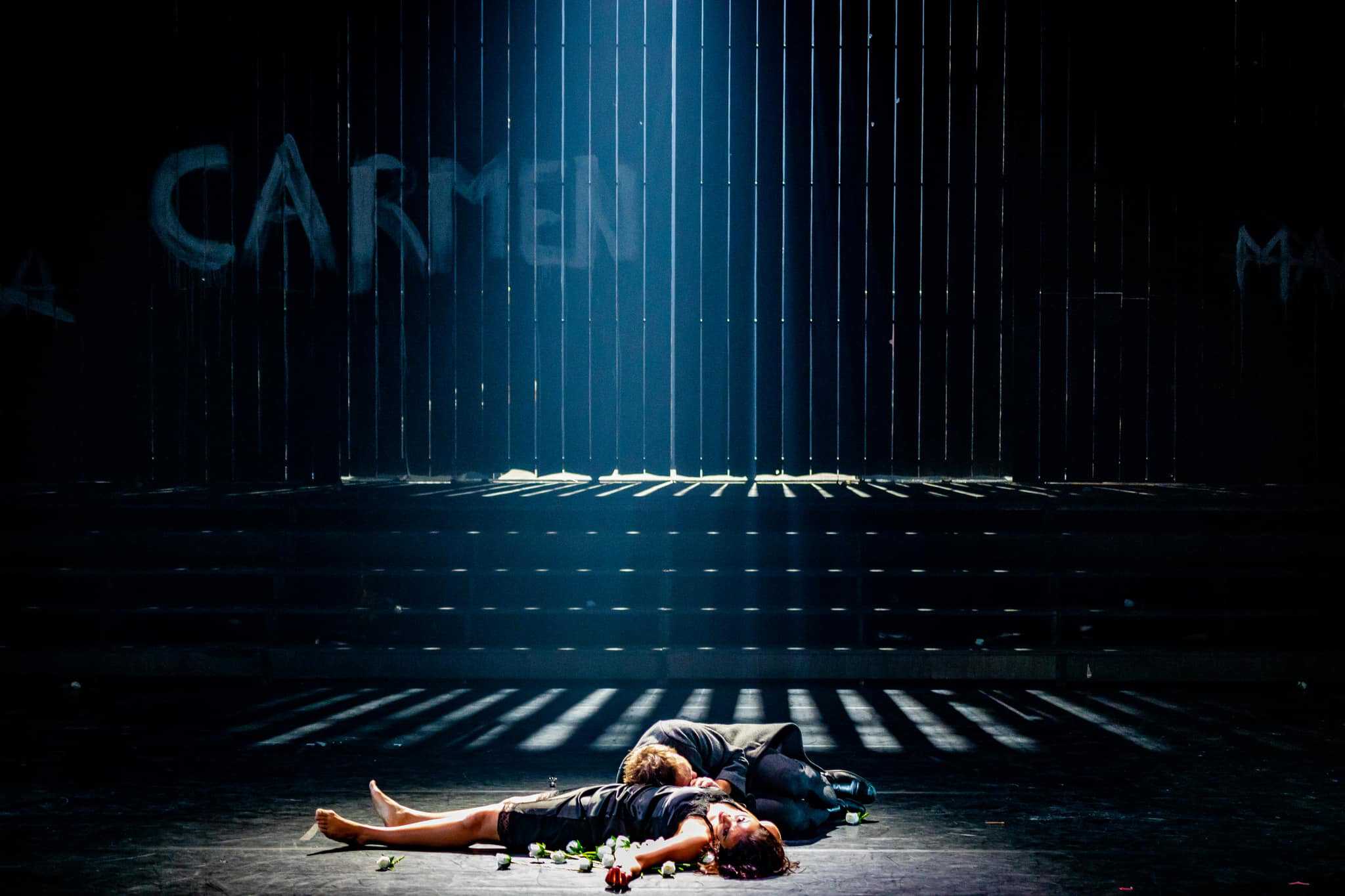
Then you get the chronicle of a death foretold. The inevitability of a fatal end. Carmen stands at the front of the stage, trapped in a blue halo of spotlights, psychedelic lighting. Taking pity on her fate, the girls dance around her and lay a white rose at her feet. Her friends Frasquita (Valérie Vervoort) and Mercedes (Zofia Hannes) gather the flowers in a bouquet and place it in her hand. Carmen appears thus like a black madonna.
She sings with a powerful, vibrant empathy, her existential loneliness and yearning for an all-consuming love. Behind her fragile exterior lies an enormous strength and steadfastness. She has chosen her toreador and does not back down.
Every life knows high peaks and deep valleys. Don José's coup de foudre leads him to the highest peaks of happiness, Carmen's rejection of him to a deep valley and his restraint snaps. He feels an uncontrollable surge of violence and kills his beloved: crime passionnel. The clash between content and music works wonderfully.
Carmen received a, doubly and thoroughly deserved, standing ovation.
- WHAT: Carmen, Georges Bizet
- ORGANISATION: Music Hall
- DIRECTION: Frank Van Laecke
- WHERE & WHEN: Stadsschouwburg Antwerpen, 15 September 2018
- PHOTOS: © Hugo Segers