

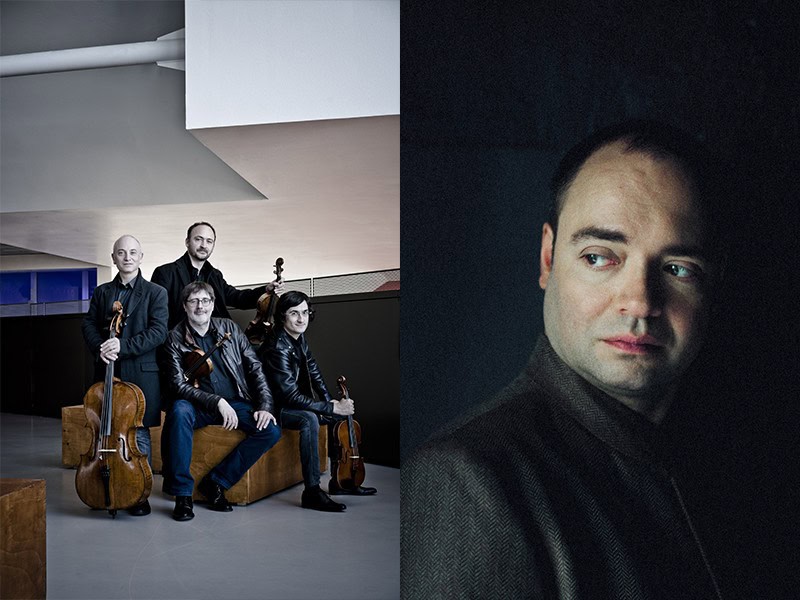
Dmitri Sjostakovitsj (1906-1975) is in. The sound of his masterful Piano Quintet, as performed on 9 October in the Paleis der Academiën by the Ensemble Mendelssohn (Daniel Rubenstein, Anouk Lapaire, Gergely Kota, Johannes Burghoff and pianist Alessandro Cervino), still lingered in the air and shortly afterwards it was back on the programme of De Middagconcerten.
The familiar hall of the Instrumentenmuseum at the Kunstberg was packed. Chairs were brought in. The anticipation was palpable. With reason. Five masters of the craft, five established values: pianist Alexander Melnikov and violinists Marc Danel and Gilles Millet, viola player Vlad Bogdanas, cellist Yovan Markovitch, together the Quatuor Danel. They replaced the planned viola player Adèle Ginestet and pianist Nino Sené, who fell ill.
 The String Quartet No. 1 from 1938 came first. Sjostakovitsj was 32 when he wrote it and called it himself 'springlike and cheerful'. Youthful exuberance? Camouflage? Probably both, because for two years the Soviet regime had been exerting pressure on him to make music accessible to the masses through the use of simple language. And yes, from the first notes the dissonances of the party were evident. They alternated with a broad melody, with short violin strokes, with an exuberant finale and with a cello part to contradict. I was far from the only one who noticed that. So a question for the charming French cellist Yovan Markovitch. He plays a Petrus Guarnerius from 1739 (Venice) and stressed that Petrus was the older brother of the more famous Guarneri del Gesù, who made himself immortal through his 'Il Cannone' of Niccolò Paganini. The Moderato was a treat for viola player Vlad Bogdanas. In dialogue with the cello and with the violins of Marc Danel and Gilles Millet, this all too often underestimated instrument received the attention it deserves.
From four to five
What everyone was waiting for, the Piano Quintet, began with a resounding statement from pianist Alexander Melnikov. After an emotional confrontation with the quartet as a whole and with the individual players, a naive melody gradually led to a poignant ensemble piece. A well-constructed Fugue determined the second movement. Melnikov's hammering staccato playing in the grim Scherzo and the Finale made clear how much at home he is in Sjostakovitsj's music. No wonder that his recording of Sjostakovitsj's complete Preludes and Fugues was praised by BBC Music Magazine as one of the "50 Greatest Records of all time".
Two 'bémols' dampened the listening pleasure. Before the concert, the new musical director Nicolas Dupont announced the death of Alexei Moshkov, concertmaster of the NOB, about which colleague Ludwig Van Mechelen had already published a moving In Memoriam. Towards the end a string broke under the urgency of Marc Danel, as if the deceased violinist was sending a sign...
