

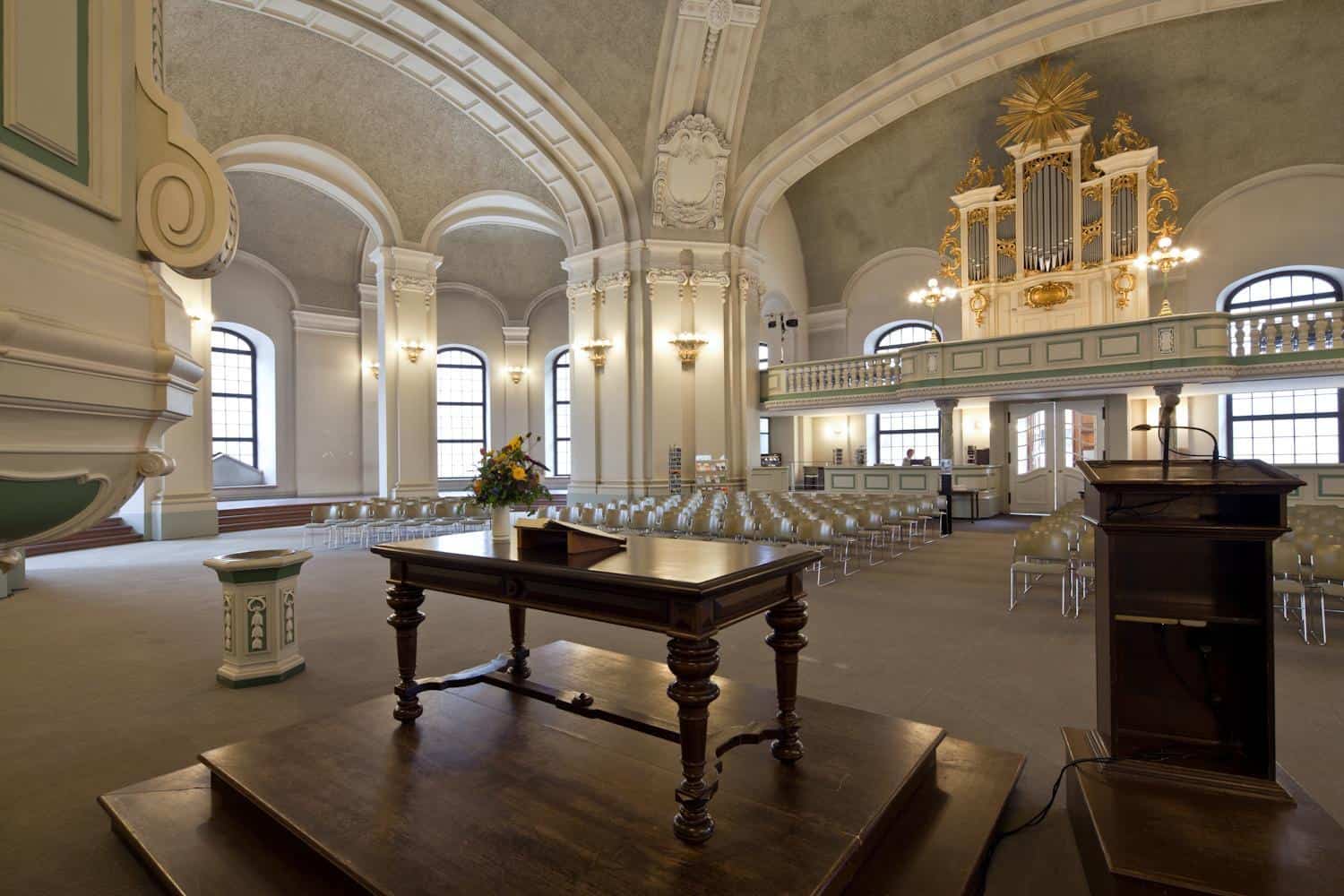
On Monday, April 13, KMD Kilian Nauhaus presented a varied Easter programme on "his" organ in the Französische Friedrichstadtkirche in Berlin, better known as the Französischer Dom at Gendarmenmarkt. In this striking church space stands the Eule organ from 1985, built by Hermann Eule from Bautzen. The instrument is clearly rooted in the French Baroque tradition, with a rich and colourful disposition that is particularly well suited to French organ literature, yet broad enough to convincingly bring Bach and later repertoire to life. In the church's characteristic oval space, an acoustic field is thus created in which transparency and sonority reinforce each other.
What made the concert immediately special was the way Nauhaus framed the programme. His brief introductions before the various works were clearly appreciated by the audience: they provided a framework, context and an extra layer of listening pleasure.
The recital began with the Choralsatz zu dem Osterlied "Christ ist erstanden" (BWV 627) by Johann Sebastian Bach (1685-1750), a powerful and solemn opening gesture that immediately set the tone. This was followed by his Triosonate in c-minor (BWV 526), one of the most demanding works in the organ repertoire. Here the organist is confronted with an almost chamber-musical complexity: three independent voices, each giving the impression of separate instruments, something that only the organ can achieve with its full polyphonic capabilities. Nauhaus succeeded in articulating this complex fabric with striking clarity, and the acoustics of the space did not obscure the voice leading anywhere, but rather reinforced it.
Next came a less frequently heard composer: Georg Böhm (1661-1733), organist, composer and in Lüneburg also an important influence on the young Bach as his teacher. We heard his Fantasie über das Osterlied "Christ lag in Todesbanden". A few hours earlier I had heard Bach's own arrangement of this chorale in the Marienkirche, which provided an interesting comparison. Yet I must admit that Böhm impressed me most here: his setting sounds almost like a free improvisation on the Lutheran chorale, in which a strict, sustained atmosphere is first built up, after which the work unfolds in a dramatic contrast between Death and Life. Ultimately this culminates in an almost dance-like joy, in which the triumph of Life over Death is convincingly sealed.
Finally came work by a third Baroque master: Georg Friedrich Händel (1685-1759). From his Feuerwerksmusik (HWV 351), two movements were performed: "La Paix" and "La Réjouissance". "La Paix" unfolded as an almost naïve, serene dialogue – a curious yet at the same time striking mirror of a world that even today seeks rest and stability. "La Réjouissance" then formed a festive and energetic conclusion that fitted nicely with the Easter mystery that permeated the programme. These performances also made clear why this organ is so frequently used for recordings and performances of French Baroque music.
The clarity of the Eule organ, in interplay with the acoustics of the Französischer Dom, resulted in a sound image in which the various voices and colours remain razor-sharp in definition, without the warmth of the whole being lost. Instrument, space and performer thus came together convincingly in an artistic trinity, in which the Baroque repertoire – despite the stylistic differences between Bach, Böhm and Händel – sounded as one coherent and self-evident musical universe.