The performance of Les Contes d'Hoffmann at the Nationale Opera can certainly be called original. And idiosyncratic. Moreover, particularly dark and actually depressing. Fortunately, there is the brilliant musical performance, which makes the bizarre staging digestible and saves the opera experience.
Tobias Kratzer changes Hoffmann's art form, which in Offenbach's opera tells the story of three failed loves. Hoffmann is not a poet here but a photographer. References in the libretto to his poetry then naturally make no sense – but that's the least of it. Each story gets its own act in Offenbach's opera and its own musical style. Each story ends badly, because there is always the "devilish" figure who trips Hoffmann up and makes his (imagined?) story end fatally. At the beginning of the opera, Hoffmann has placed his new hope in the diva Stella, but she is just as unreachable as the women he has had relationships with in the past – or imagined relationships? The only woman who remains faithful to him throughout the entire opera is the (nameless) Muse, the constant idea that an artist needs to practice his art.
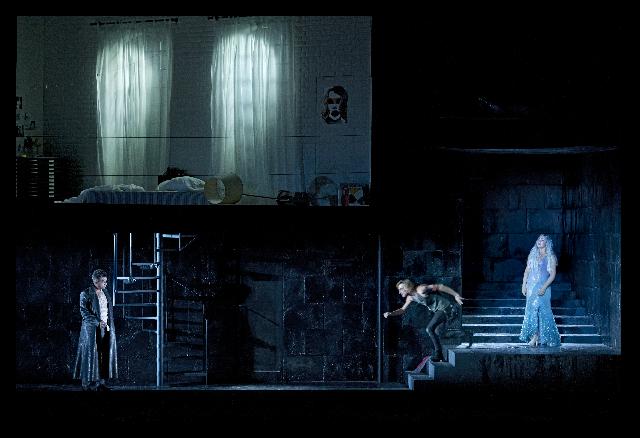
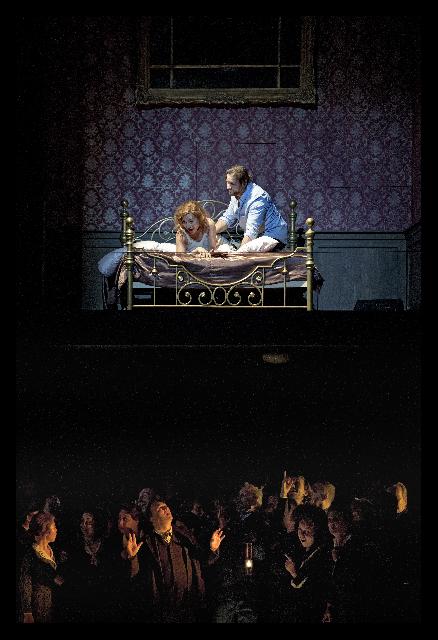
The opera's set makes ample use of the enormous stage of the Nationale Opera, which is, however, fragmented into a large number of small rooms. One room remains always central and forms the largest space: Hoffmann's studio with a series of close-up photographs. Of the Muse, of course. The opera also begins in this studio, and not in a tavern, where Hoffmann waits for the diva Stella. Sleeping off his drunken stupor, Hoffmann lies in bed. The Muse watches over him. She cleans up the bottles that Hoffmann has emptied with the students. Those students come in, drunk and some sniffing coke. The Muse gets to open the opera with her couplets, followed by the invisible opening chorus that sings the praises of drink in a dark corridor under that central room.
Hallucinatory story lacks tension
From that studio, the story moves us each time to the location of the successive tales. Through a narrow ventilation hatch, the location of the Olympia act is shown, a mysterious little room where Spalanzani designs his mechanical doll. The whole act creates a mysterious, creeping atmosphere that matches the deception that both Spalanzani and Coppélius perpetrate with their creation Olympia. The delightfully dancing music barely fits with the spectators crowded together in the dark corridor under the studio. One of the little rooms around the studio is a tiny little boudoir-like room where Hoffmann makes love to the doll, whipped up by the rhythm of the music. Olympia loses her eyes, smeared by Cochenille, and dies. But when the doll is destroyed, the next image back in the studio suggests that Hoffmann has deflowered Olympia.
The Antonia act also has the characters wandering around in small bare cubicles around the studio. Antonia is presented as a boarding school girl who tries to escape with Hoffmann from her father's strictness. But here too, the devilish Miracle is a spoilsport. Antonia searches for the magical voice of her mother, here not through a portrait but surprisingly through an antique gramophone, which is also set up in a tiny little room. For this, Antonia has had to lower an attic ladder, which produces a laughable image. After the first act, the division of Antonia's dwelling into cubicles has already lost its originality and the characters' running back and forth begins to become annoying. Then comes the final act, for which a hole is broken in the studio wall: the courtesan Giulietta must, by order of the devilish Dapertutto, rob Hoffmann of his shadow. Forget a babbling gondola on a rippling canal in the barcarolle. The act takes place in the darkest recesses of the prostitution underworld, where Hoffmann must abandon the illusion to win Giulietta for himself. A frightening spectacle, populated by perverse figures.
The return to the studio for the final act makes Hoffmann realize that the women were merely an obsession and that his only destiny is the Muse. But the conclusion only takes place after once again injecting a syringe of drugs, with the repetition of which becomes not only tedious but also has a déjà-vu effect. You simply don't care at all about Hoffmann's three unhappy loves.
Perhaps Tobias Kratzer's initial intention to place Hoffmann's story with its surreal content in a contemporary artist scene of drink and drugs is still understandable, but he did go about it rather hastily. Perhaps sobriety in the depiction of Hoffmann's traumatic experiences would have had more effect. The mosaic-like approach that Kratzer chooses also fragments the atmosphere, so you don't get caught up in tension in Hoffmann's hallucination. The spoken dialogues are limited to a few brief interjections.
Wealth of sound
The music is fortunately a wealth of sound. No wonder with the magnificent Rotterdams Philharmonisch Orkest in the pit under the direction of Carlo Rizzi. The lyrical violins and shimmering cellos regularly convey more drama than the stage itself. The orchestra plays lively and colorful, but also subtle and tender when the situation calls for it. The rhythm is propulsive and compelling. The singers are also excellent. John Osborn sings his exhausting part with a clear tenor and much commitment. An ideal Hoffmann. Erwin Schrott confirms his commitment as a super-actor in the four diabolical roles. With his deep bass-baritone voice, he masterfully brings each situation to life and clearly enjoys his villain role, which culminates in a super-hellish Scintille diamant. Among the ladies, Irene Roberts as the Muse/Nicklausse brings her full and empathetic mezzo and wins sympathy with her performance. The three "beloved" are ideally cast, each with their own character for the woman they portray: frail and supple coloratura for Nina Minasyan, lyrical and charming for Ermonela Jaho, seductive and challenging for Christine Rice. The many other roles are also skillfully cast. The audience in Amsterdam clearly enjoyed the performance.
- WHAT: Jacques Offenbach (1819-1880) | Les Contes d'Hoffmann
- DIRECTION: Tobias Kratzer
- VOICES: John Osborn, Irene Roberts, Erwin Schrott, Nina Minasyan, Ermonela Jaho, Christine Rice, François Lis et al.
- ORCHESTRA: Rotterdams Philharmonisch Orkest, Choir of the Nationale Opera, conducted by Carlo Rizzi
- WHERE: De Nationale Opera, Amsterdam
- WHEN: Sunday 24 June 2018
- PHOTO CREDIT: © Baus