

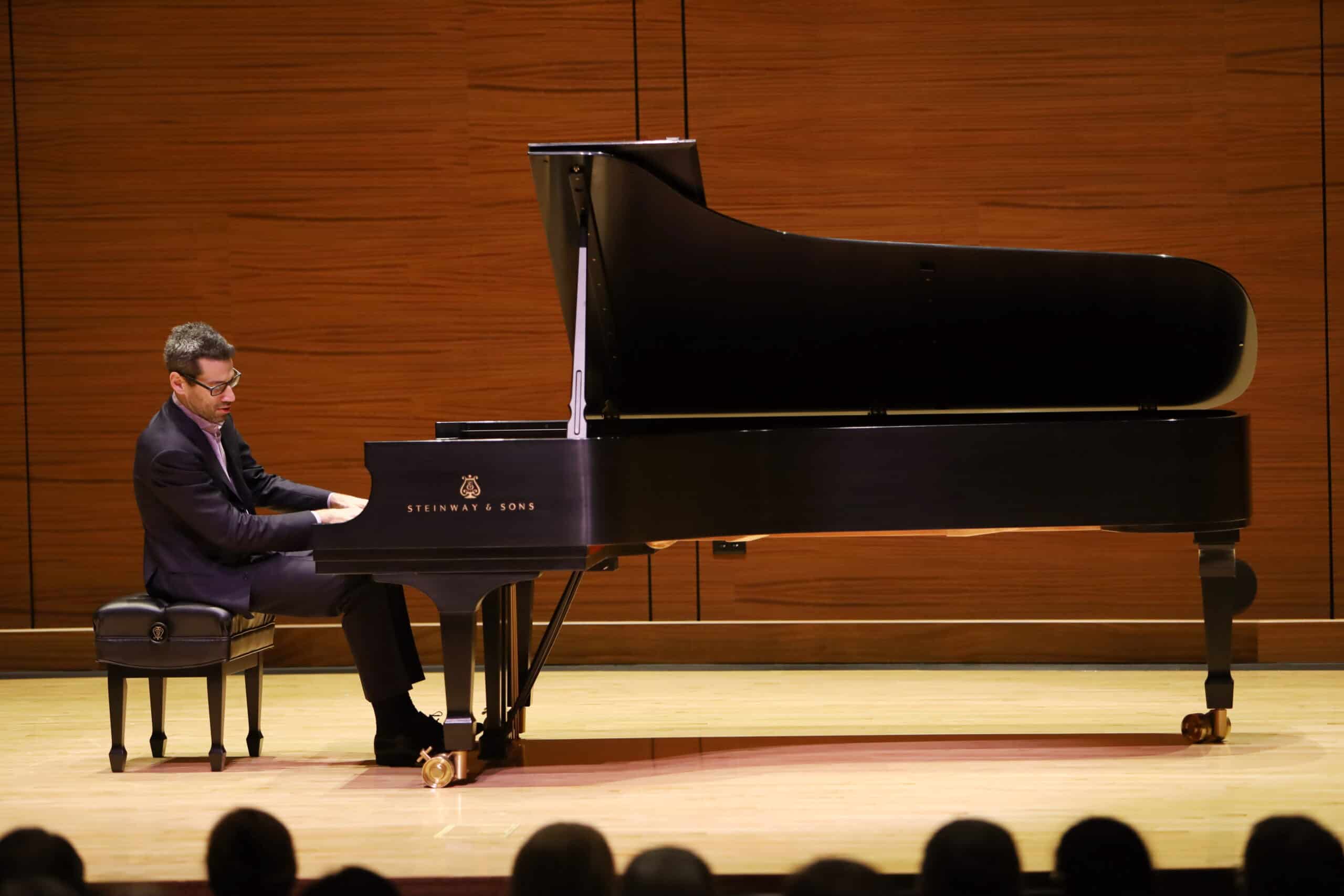
When Jonathan Biss took the stage of Studio 4 on Saturday afternoon, February 14, we discovered a pianist who did not play for the audience, but with the music. His presence immediately set the tone of attention: every touch, every phrasing felt like an invitation to listen, like a breath that filled the space. Here, technique was not displayed, but deployed as a means to create meaning.
Biss was at once a thinker and a dreamer, moving across the keyboard with the precision of an architect and the sensitivity of a painter weighing light and shadow. Each work he chose – from Robert Schumann (1810-1856) to Leoš Janáček (1854-1928), from György Kurtág (°1926) to Felix Mendelssohn (1809-1847) – unfolded as a small world, carefully illuminated and intensely experienced. The program formed a carefully constructed journey through different worlds of sound and emotion.
Shadows and breaths
The opening with Schumann's Geistervariationen resonated like a twilight in an abandoned house. These "ghost variations" emerged during a period of personal crisis for Schumann and breathe an almost visionary melancholy. With Biss, the variations whispered and glimmered, fragile and elusive, as if evoking memories we barely dare to speak of. Biss brought melancholy and tension into perfect balance; every note breathed, every pause resonated like an echo of Schumann's inner world.
Whispers of remembrance
After the ghost variations, the recital descended into Janáček's introspective world. Woorden schieten tekort from the collection of miniatures Op een overwoekerd pad did not sound like a stylistic break, but as a well-considered choice within the carefully constructed program. This miniature was steeped in the sound color of Czech folk music and personal memory. Biss listened to the silence as carefully as to the notes. His playing felt like a whispered conversation: fragile, introspective, but intensely present. He let the sounds breathe slowly, inviting the listener into meditative attention to the unspoken.
Silence as weight
Kurtág's short, concentrated pieces from Játékok, Book III, demanded utmost precision. In Quiet Talk with the Devil, followed by Hommage à Szervánszky – Silence, Biss let every sound breathe and every pause resonate. Silence gained explicit weight, the tones floated through the space, and every touch was charged with meaning. His playing emphasized the contrast between sound and emptiness, allowing the audience to deeply feel the subtle intensity of Kurtág. Biss did not seek to impress here, but rather to expose the essence of sound: a silent confrontation between performer and listener, intense and poetic at once, and a worthy homage to the composer who celebrates his hundredth birthday on February 19.
The piano as voice
After the concentrated silence of Kurtág, Biss brought the piano back to life as a human voice, during the brief selection from Mendelssohn's Lieder ohne Worte: warm, lyrical, playful, with a touch of melancholy. Each miniature breathed its own color and intonation, remaining woven into the sonic tapestry of the recital. Biss wove subtle nuances of phrasing and articulation, making the music sound more human than words ever could. Thus sound became language, and language became sound.
The crowning moment
In the subsequent Fantasie in C, op. 17 by Robert Schumann, the recital's climax unfolded, a dramatic landscape that was constructed both extraordinarily precisely and vulnerably. Stormy passages flashed like rays of sunlight through clouded skies. Soft chords gleamed like morning light falling through the windows of an old cathedral. Biss varied in tempo and dynamics with the sensitivity of a master storyteller: every arc, every breath, every moment of silence felt as if it arose naturally, and yet everything was meticulously constructed.
His playing gripped the throat and caressed the heart at once; delicate yet unyielding, emotionally powerful and intellectually challenging. Every key had weight, every silence resonated. It became a performance that kept the listener continually on edge, a play of light and shadow in which you surrendered completely to the music. Only regrettable that applause resounded after every movement, as if the spell were briefly interrupted before it could fully settle. And yet: even in these interruptions, the magic of Biss' interpretation remained palpable. Every passage, nuance, and phrasing lingered, an almost tangible breath of Schumann's inner world. It was a cinematic experience of sound and time, in which music stretched, breathed, and gripped us by the throat – a moment in which pianist and work merged completely.
A conversation without words
This recital was not a succession of works, but a continuous continuum of sound and silence. Schumann stormed and whispered, Janáček reflected in fragile moments, Kurtág weighed every note as if holding time itself in his hands, and Mendelssohn let the piano sing with the lightness of a human voice. Biss listened, followed, and opened a space in which the music breathed, floated, and touched us deeply.
Those who saw him at the piano noticed that this was no ordinary pianist performing, but a sound artist: a fascinating phenomenon that completely lost itself in the music, and at the same time opened a world in which we as listeners could breathe, float, and dwell. His hands, his phrasing, every touch formed not only notes, but feelings, memories, breath, and echo.
With Jonathan Biss, music was not a performance, but an experience. Sound became breath, silence echo, and we, listeners, found ourselves in a world that existed only between the notes – a world where time slowed down, emotions became intense, and the piano spoke without words, straight to the soul.