Klassiek Centraal undertakes again, as in previous years, an attempt to provide you with a report every evening about the progress of the Queen Elisabeth Competition. With our general impressions of the past evening, we write a short review per candidate.
First final evening
First of all, I would like to share my particularly positive impression of the imposed work. This is a work for the general repertoire. Without any doubt. Finnish composer Kimmo Hakola wrote for the QEC Violin 'Fidl' Op. 99 on commission. It is much more than a duty work that ends up in archives after the competition. This is an inspired composition with plenty of bells and whistles, but also with great delicate refinement that is complemented by everything a thoroughly trained young soloist must master in terms of instrument control. Whoever is not virtuoso enough will be exposed, but also whoever is too technical and less emotional will not get out of the work what is in it. This is certainly ideal for a jury member to compare and, with knowledge of the facts, even more than in thoroughly known violin concertos, to judge the candidate as objectively as possible. The composer deserves a standing ovation for his composition for the future that you may call 'new music' with all the effects the work is rich in, and yet can be listened to with emotion.
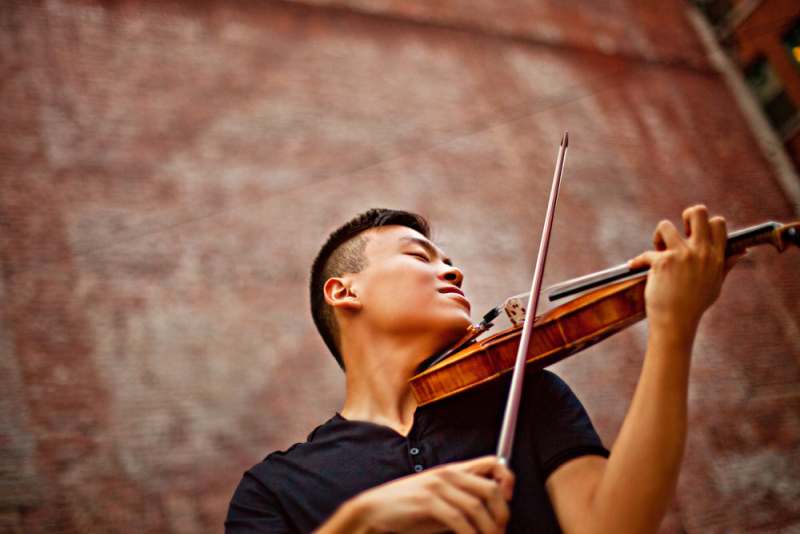
Candidate 1: Luke Hsu (USA, born 24.07.1990)
Self-confidence, that characterizes this oldest of the 12 laureates. His technical mastery is particularly advanced and you hear that not only in the parts that demand absolute virtuosity, but also in the purity of the sound, not to mention a few minor bow scratches. The imposed work is purely technical in its execution. He misses the curve of musicality and plays straight through and especially fast. Too fast? The fine details that Kimmo Hakola has hidden in the work remain hidden.
The violin concerto in D Op. 35 by Peter Tchaikovsky is performed in a similar manner. Very technical, enormously fast so that the dialogue with the orchestra is missing and that orchestra doesn't care about following. The countless emotions that a human life experiences and that Tchaikovsky lets the violin tell, apparently pass the violinist by. This laureate must rely on bravura.
Photo: © Kate Lemmon
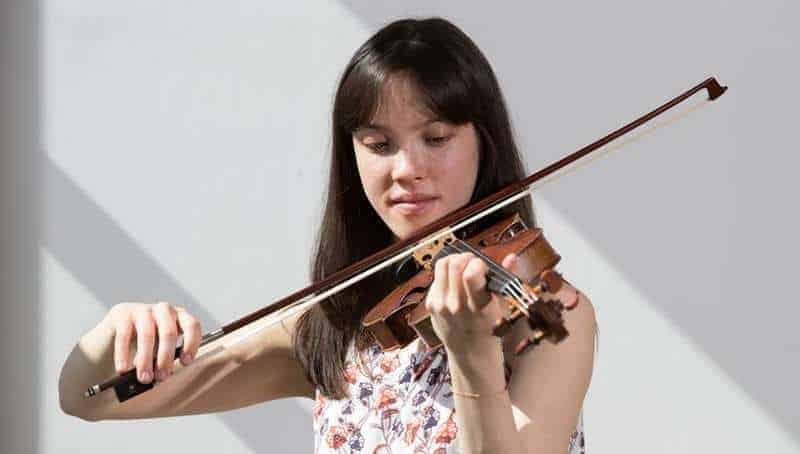
Candidate 2: Sylvia Huang (Belgium, born 20.04.1994)
What immediately stands out when the imposed work begins is that our compatriot is not so technical, but more musical. She lets the work sing more, although she also plays some more mistakes. She has understood the story of Fidl well and knows how to tell it to us in a gentle way with fine accentuations. Sometimes too soft, because it rains in this work double and triple forte's and she doesn't really get those out of her instrument.
Her choice for a concerto fell on the Concerto in a Op. 53 by Antonín Dvořák. Again, it stands out that she is physically not really strong enough to pull the orchestra along. That orchestra, the National Orchestra of Belgium, pulls back somewhat so as not to drown out the violinist. Sometimes an impossible task for the wind players who have an important role not only in Dvořák's concerto, but also in the imposed work. You hear the Czech with his Slavic/German culturally influenced background throughout the work and Sylvia Huang continues to embroider along with the melodies of the composer. She does that very sweetly, fragilely and in the solo string (the 'heavy' string of the violin) you get a very warm sound that looks more like a viola. Very beautiful, but is all that lovely caressing enough to convince the jury? She lacks strength and that is a weak point…
Photo: © Belga