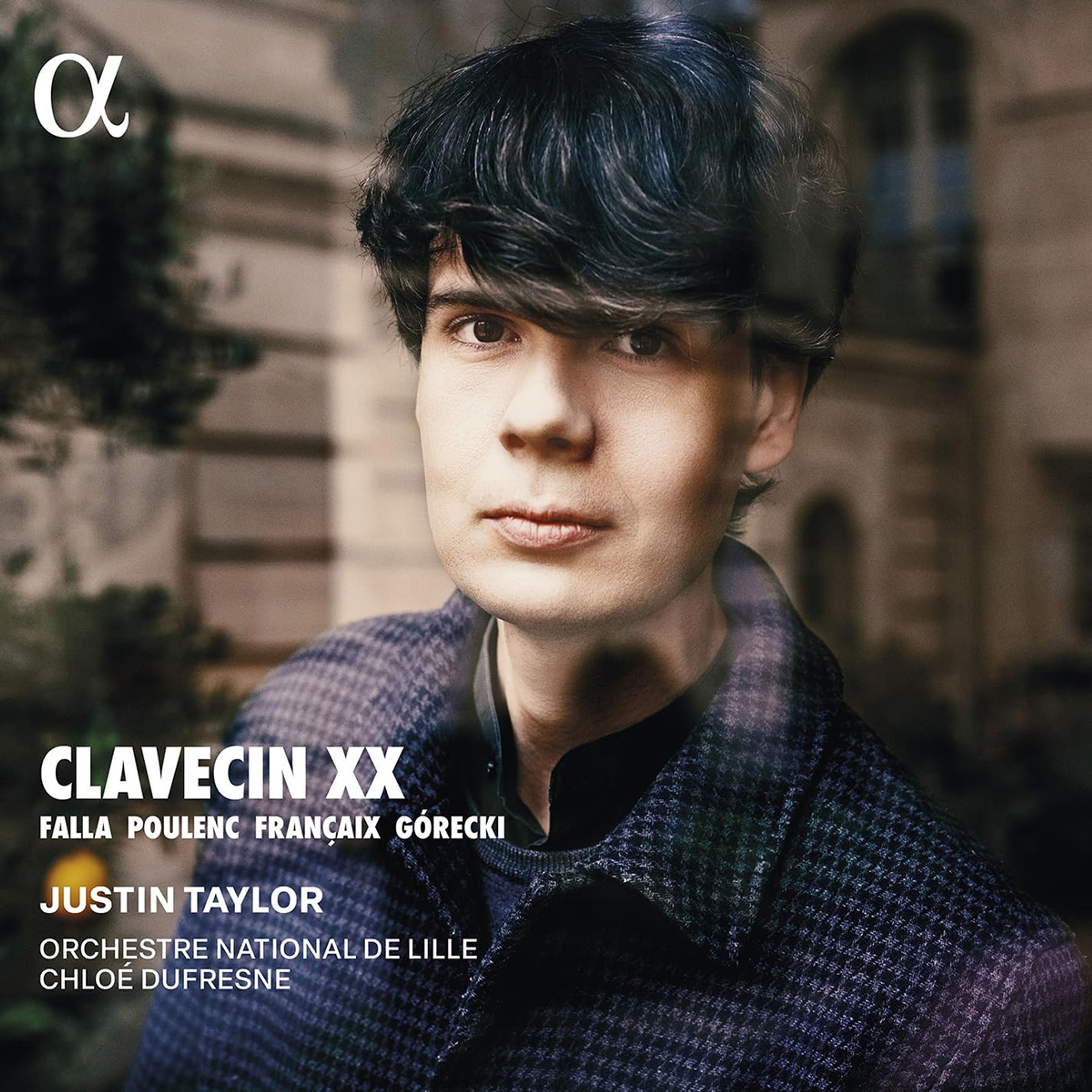
The harpsichord as a museum piece – Justin Taylor wants to forcefully dispel this misconception with this ambitious album. And he succeeds with verve. Clavecin XX has become a personal panorama of an instrument that, despite its strong baroque reputation, has fully found its way into twentieth-century music. Taylor structures his programme around four harpsichord concertos – by Jean Françaix (1912-1997), Henryk Górecki (1933-2010), Francis Poulenc (1899-1963) and Manuel de Falla (1876-1946) – and connects them with solo pieces that serve as both resting points and contrasts. Béla Bartók (1881-1945) and Bohuslav Martinů (1890-1959), but also a world premiere of Stéphane Gassot (°1987) and, as a cheerful finale, Maple Leaf Rag by Scott Joplin (1868-1917): the programming is inventive, coherent and fearless.
The choice to record on a single instrument – a hybrid harpsichord from the 1970s, built by Anthony Sidey, somewhere between the Pleyel tradition and historical instruments – proves particularly fruitful. The instrument possesses a broad palette of colours, from dreamy lute stops to robust sixteen-foot registers, and Taylor exploits every shade with the refinement one expects from him.
The opening work – Bartók's Hommage à J.S.B. from the Mikrokosmos cycle – immediately sets the tone: reverent yet clear, with Taylor allowing the music to breathe without adding unnecessary weight. This is followed by the Françaix concerto, a work full of airy humour and chamber-music elegance. Françaix playfully toys with baroque forms – toccatas, a minuet, a rondo-like finale – and Taylor eagerly joins in this game, ideally supported by fellow musicians such as flautist Philippe Bernold and the Quatuor Zaïde.
Stéphane Gassot's Bluesinuum, recorded here for the first time, is a fascinating and bold tribute to György Ligeti's Continuum that does not displace that famous original but subtly stands beside it, like a blues-tinged echo. It is clear to hear that Taylor and Gassot have been friends for almost twenty years: there is something natural in the way the music seems written for precisely these hands.
The harpsichord and string orchestra concerto by Górecki – written for Elisabeth Chojnacka, who also created the work – is undoubtedly the most overwhelming moment of the album. Under the direction of Chloé Dufresne, the Orchestre National de Lille establishes a sound world that is both mechanical and magnetic: the first movement, Allegro molto, thunders forward like a locomotive without a final destination, while the second movement, Vivace marcatissimo, explores the boundaries of rhythmic repetition. Taylor holds his own in this sonic turmoil with a concentration that commands admiration. The listener is swept along from beginning to end in an uncompromising musical roller coaster.
Poulenc's Concert champêtre – the grand centrepiece of the album – receives here an interpretation that exemplarily reconciles elegance and sharpness. Under the direction of Chloé Dufresne, the Orchestre National de Lille plays with a suppleness that causes this music to continually breathe, while the dialogue between harpsichord and wind instruments unfolds with an almost theatrical naturalness. Poulenc's characteristic blend of wit, melancholy and irony thereby fully comes into its own: the music smiles constantly, but never without a hint of wistfulness.
Taylor clearly approaches the work from the world of Wanda Landowska, for whom the concerto was originally written, without resorting to historicising imitation. His playing possesses precisely that combination of refinement, playfulness and clarity that this score requires. The fact that he has studied Landowska's annotated score is furthermore clearly evident in the phrasing of the slow movement, where every line breathes naturally and never becomes sentimental. In the fast passages, Taylor in turn maintains a remarkable lightness: virtuosic, but never ostentatious, brilliant without affectation.
The de Falla concerto, written for flute, oboe, clarinet, violin and cello alongside harpsichord, concludes the album lightly biting, playful and pointed. De Falla's manner of writing has something deliberately awkward about it, and Taylor embraces that angularity without wishing to soften it. The surrounding musicians too visibly throw themselves with enthusiasm into this capricious, rhythmically charged score.
As a surprising finale follows Scott Joplin's Maple Leaf Rag, a smile at the end of a programme that continually balances between seriousness, experiment and the pleasure of playing. It works wonderfully: not as a gimmick, but as a final testament to the versatility of the instrument.
Clavecin XX is not merely a thematic curiosity. It is a convincing plea, carried by a musician with knowledge, taste and courage. Justin Taylor convincingly demonstrates that the harpsichord still has much to say.