

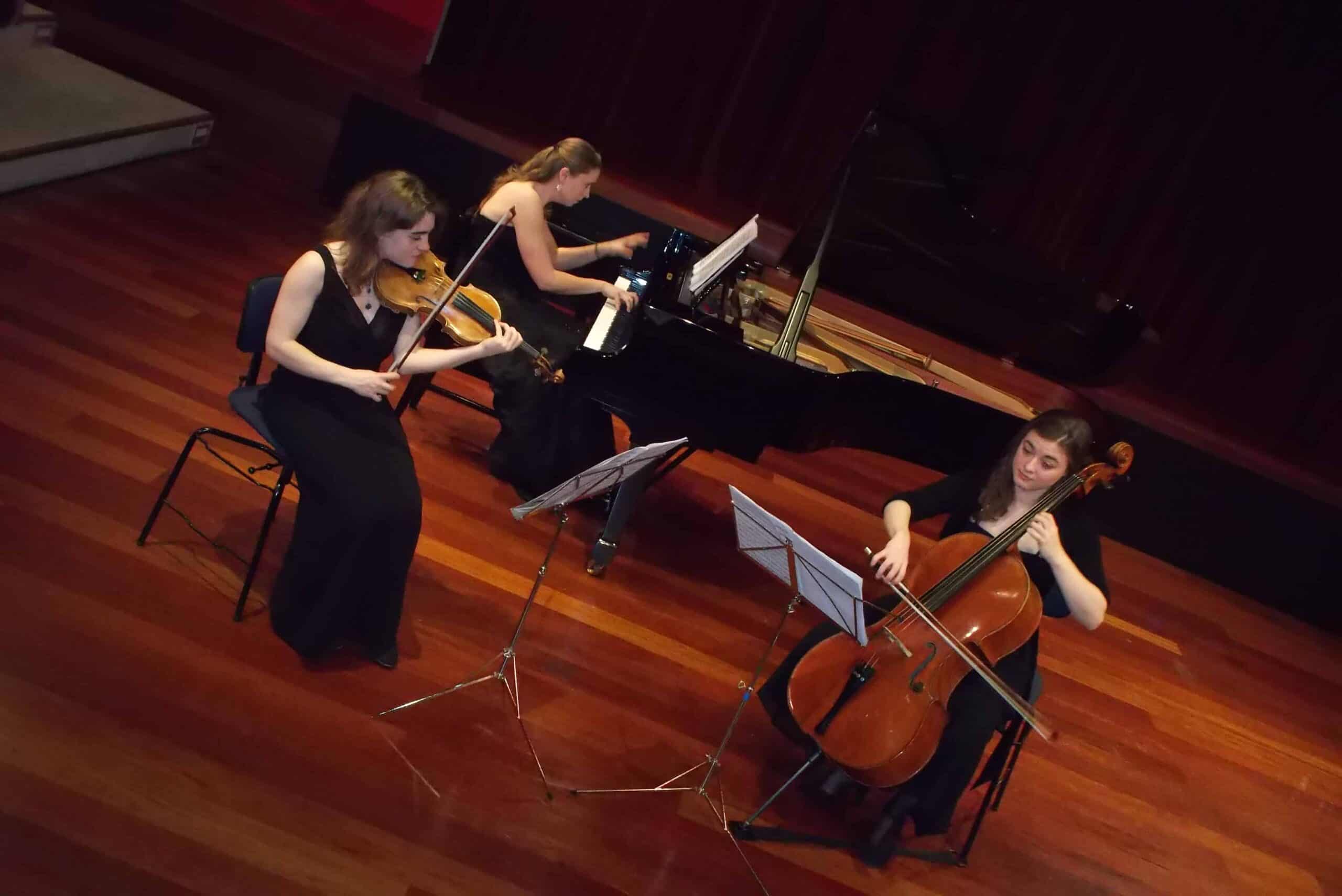
With Smetana and Shostakovich, Ensembl'Arenski opts for Slavic music on their latest CD. So far, that's about the only thing the two composers have in common. Yet the trio proves to be masters of two different worlds.
Bedřich Smetana's Trio in G minor bears a striking resemblance to his well-known Má Vlast. Like Smetana's symphonic cycle, the trio is a musical rollercoaster. This time there are no babbling streams, wild rapids or enchanted forests. The ensemble must contend with stubborn chord progressions, lyrical melodic lines and lightning-fast cascades of notes. But whereas Smetana in Má Vlast neatly changes style with each section, the composer shows us every corner of the room within the three movements of his trio. A lesser musician would soon be knocked down in their corner, but Ensembl'Arenski remains effortlessly on their feet. Through all the chord sequences that ripple from high to low; The rhythmic games that keep the musicians on their toes; And especially the blazing opening of the Finale where Stephanie Proot darts nimbly across the keys.
It is already a remarkable achievement that the three musicians master the different facets of the work so well. But beyond that, there is an incredible unity emanating from the ensemble's performance. Smetana's work is built around minimal melodic material that is therefore repeated frequently. It is when these melodic phrases are passed between the different musicians, ultimately merging together, that the collective strength of this trio reaches its peak.
In that respect, the choice for Shostakovich's trio in E minor is a logical continuation for this CD. Here too, the composer works with a minimum of musical material. To the point that the work is quickly labeled minimalist. Whereas as a musician in Smetana's work you can display your mastery of his many styles, Shostakovich's trio is primarily an exercise in effacing yourself. Brilliant how delicately Aurore Dassesse coaxes the opening notes from her cello. Later the work does open up more, and there is more room for expressivity. Just then, as a musician, you must push your own ego even further aside. Don't get me wrong, there is certainly room in this trio to showcase your own talent. Proot gets the chance to do so in the Allegro con brio, and Claire Dassesse stands in the spotlight at the beginning of the Allegretto.
The beauty of Shostakovich's work, however, lies mainly in the fact that in the end the strength of the trio takes precedence. However brilliantly the solo passages may be performed, you really shine here in ensemble playing. That is exactly what Ensembl'Arenski has understood remarkably well. The Dassesse sisters are more attuned to each other than the Borlée brothers and Stephanie Proot is far from falling behind. The many stars and divas from the world of classical music could learn something from this tremendous team effort.
--
WHO| Ensembl'Arenski
WHAT| Smetana – Piano Trio in G minor, Shostakovich – Piano Trio in E minor
BY| Etcetera Records and Beeldenstorm (production)
PHOTO| Supernova