

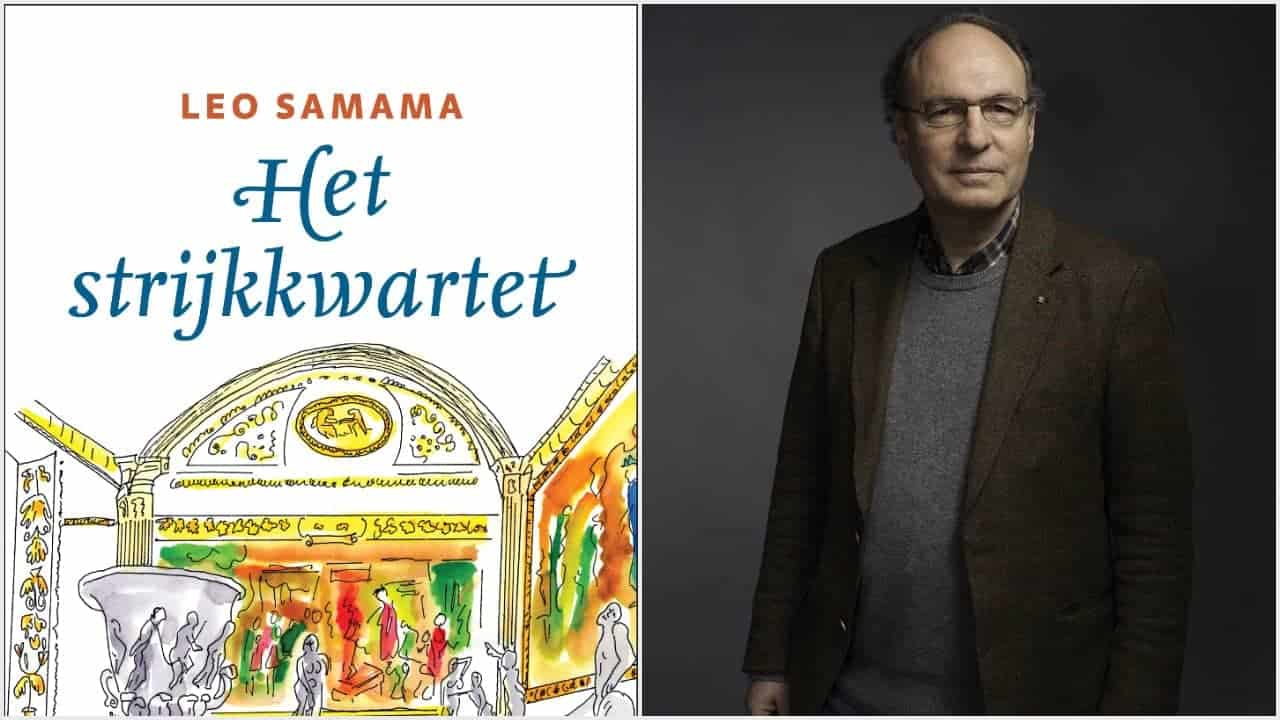
Do you enjoy reading a book about music? And are you a lover of the string quartet genre? Then Het strijkkwartet is just what you're looking for. On some four hundred pages, Leo Samama sketches an inspiring overview of "the cream of the crop" among musical art forms.
The Dutch musicologist and composer is far from making his debut with this new book. His earlier publications also aim to bring (classical) music closer to the general public, and they were well-received by the editorial team of Klassiek Centraal. Thus, De zin van muziek (AUP, April 2014) received a nomination for the Golden Label, and Het soloconcert (AUP, December 2015) was also largely praised. For Home Academy, Samama also lends his voice and knowledge to a series of lectures on the greatest composers (Mozart, Beethoven, Mahler, Debussy, …). But specifically on the string quartet, the author had so far remained evasive. Until now. On the eve of the first edition of the String Quartet Biënnale Amsterdam (January 2018), there was no better moment for Amsterdam University Press to bring this book to market.
With Het strijkkwartet, Samama wants to provide both an overview and a personal account, for all lovers of the genre. And so it was not the intention or desire, as he himself writes, to provide a complete overview of the string quartet repertoire (p. 16). Aiming for completeness runs counter to the desire to also set one's own emphases. Already in the structure of the book, some of those focal points become clear. After a brief introduction to the origin and rise of the string quartet – "a whole world in itself", as our Stefan Hertmans says, and "the playing field on which that great struggle between emotion and reason is fought most purely" (p. 16-17) – Haydn, Mozart, Beethoven and Schubert each receive their own chapter. There is absolutely no dispute about those first three. For although the string quartet was not the invention of a single person, Samama argues with much conviction, and Haydn is therefore not the 'father' of the genre, he was nonetheless "rather the genial uncle and Mozart his heaven-storming nephew" (p. 28). The 'titan' Beethoven also deserves his own chapter, if only because of the mythical late quartets that "many regard as the pinnacle of the repertoire" (p. 122). That the author also has a fondness for Schubert is understandable, and even something to be wholeheartedly agreed with. "His influence on the composing of the later nineteenth century cannot be overemphasized" (p. 155). Yet that influence is based exclusively on the famous last three quartets and the so-called Quartettsatz (D703), which means this section is no more than an intermezzo. After Schubert come two extensive chapters on the string quartet in the 19th century (after 1830). The approach shifts from the individual composer (Mendelssohn, Schumann and Brahms) to a geographical perspective. The focus on German-speaking regions is thus quite pronounced. Other parts of Europe and Russian music receive relatively less attention. On the other hand, this approach also briefly addresses the Belgian composers Lekeu and Jongen, although documentation of music in Belgium "is unfortunately so deficient that a proper overview [...] is scarcely possible" (p. 272). In the last two chapters, the numerous developments of the 20th century are covered extensively, first by country or region and later by movement. As the author of a standard work on Dutch music in the 20th century, it is clear that Samama knows this period very well and therefore treats it far from neglectfully (p. 275-371). It is a welcome observation.
Ambiguous Illustrations
The earlier strict organization of the book shows that the result has become rather more of an analytical overview work than a highly personal exploration and appreciation of what Samama calls the "ne plus ultra of compositional craft" (p. 17). By making his own insights and preferences even more explicit, Het strijkkwartet might have appealed more strongly to the reader's curiosity. As it is, especially in the chapters with a geographical layout, the reader is presented with sometimes long lists of composers and their works. In the section on 20th-century music in France and Southern Europe, Stravinski and the members of the Groupe des Six (Milhaud, Honegger, …) pass by, but also many lesser-known names such as Albert Roussel, Jacques Ibert and André Jolivet, Charles Koechlin, Alexandre Tansman, Alfredo Casella and Francesco Malipiero (p. 292-297). This elaboration quickly becomes somewhat monotonous and after several dozen pages even somewhat tiring. But it also has a occasionally surprising flip side. For with his broad erudition, Samama makes you realize how many beautiful string quartets are not or barely heard on cd or in the concert hall. Thus Roussel wrote "in his later years a true masterpiece, which deserves a permanent place in the repertoire alongside the quartets of Debussy and Ravel" (p. 294). Every string quartet player should therefore pick up this book, and perhaps even must, to find inspiration for a refreshing program.
The string quartet contains, alongside text, very regularly short excerpts from the works discussed. For the reader trained in music, these are undoubtedly clarifying illustrations. But more than once these examples prompt Samama to describe what one reads in the notes. Regarding the third of Beethoven's so-called Razumovsky quartets, this is how it is documented: "In the Quartet in C our attention is drawn by an introduction (Introduzione: Andante con moto) to the actual main form (Allegro vivace) in which the key of C is gradually prepared. To do this, Beethoven begins with the diminished seventh chord fis-a-c-es as the first sonority, followed by f-a-c-es. That first chord suggests a resolution in the dominant G (and from there you could easily move to C), the second, however, seems to want to go to B-flat. But we can also see the descending cello line as a passage to the third chord, the six-four position of the triad a-c-e, the chord of the sixth degree of C. The first period stops on the chord d-f-as-c with the as in the bass, as a preparation for b-d-f-as with the seventh (the same as) in the bass. This chord (in the eighth measure) wants to move harmonically toward C, but does not get the chance. In short, the listener remains uncertain for the first nine measures where the harmony is heading" (p. 117). With theoretical explanations like this, the book unfortunately does not become really more accessible or flow more smoothly. What Samama does accomplish in this way, however, is to reinforce the assertion that the essence is listening itself, as he also claims in the foreword (p. 10).
Despite the sometimes abstract passages, The string quartet generally reads smoothly. It is engaging reading for anyone drawn to chamber music. For a history and overview of the string quartet, one no longer needs to turn to foreign-language publications such as that by Bernard Fournier, but can now also find a thoroughly documented reference work in Dutch.
- WHAT: The string quartet
- WHO: Leo Samama
- PUBLICATION: Amsterdam University Press, January 2018, 380 p.
- ISBN: 9789462988880