

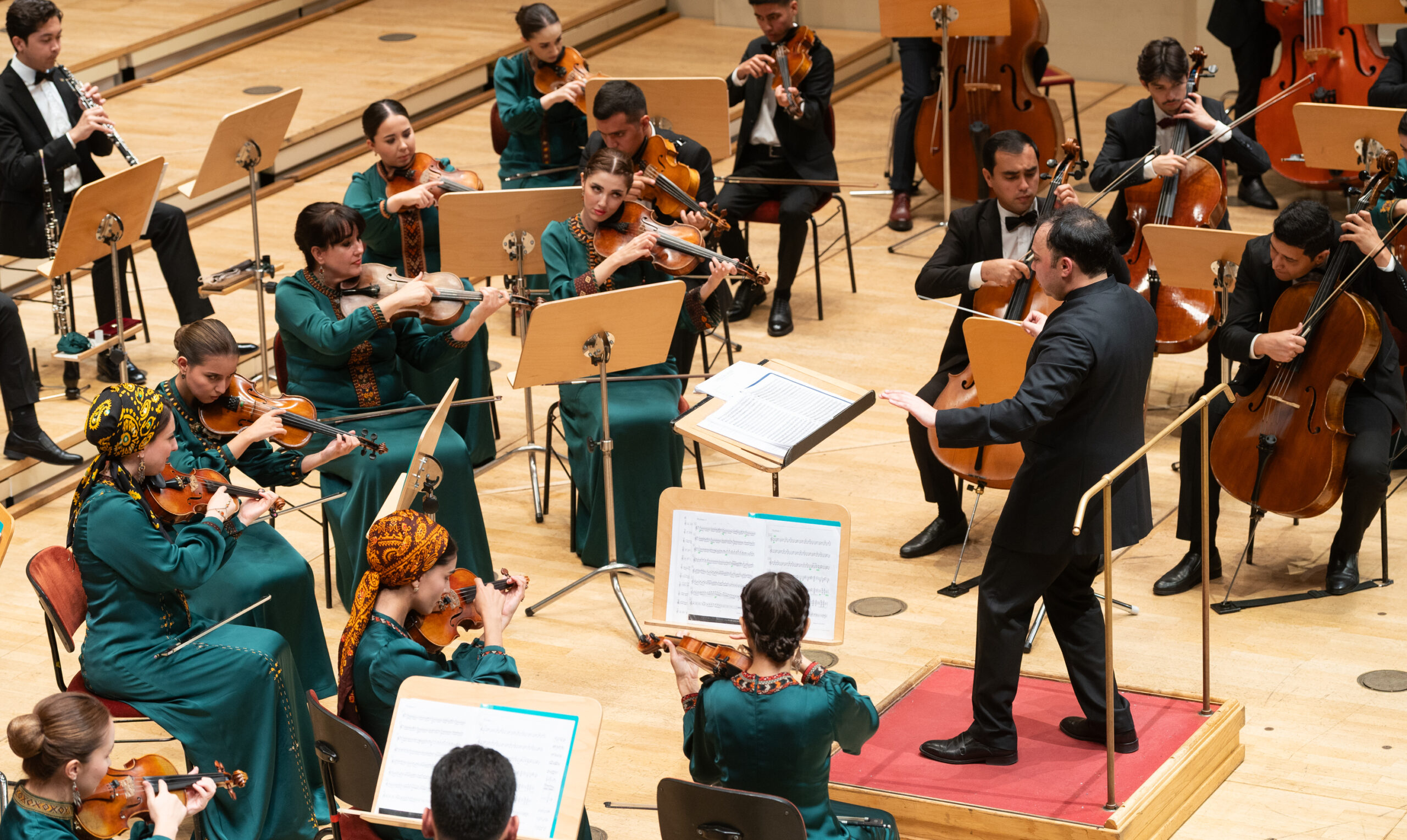
Some concerts bring well-known music back to life. Others open a door to a world about which we as listeners barely know what lies behind it. The debut of the Youth Symphony Orchestra of Turkmenistan at Young Euro Classic on Sunday, August 9 clearly belongs to that second category. In the Konzerthaus Berlin, music by composers who for most listeners are hardly more than names: Chary Nurymow (1941-1993), Weli Muhatow (1916-2005) and Nury Halmammedow (1938-1983). These are names that meant little at the beginning of the evening, but which in the course of the concert increasingly came to represent a musical world. Thus Turkmenistan ceased to be an abstract country somewhere far away in Central Asia, but gained sound, color, melancholy, rhythm and ultimately even something that you could without exaggeration call a soul.
The traditional music culture of Turkmenistan is far removed from Western classical music, but during the Soviet period a strong connection developed with the European instrumental tradition. Composers such as Nurymov, Muhatov and Halmammedow studied in Moscow and subsequently returned to their homeland, where they played an important role in the development of professional musical life. Their music combines European symphonic forms with melodies, stories and subjects from Turkmenistan. It is precisely that encounter that Young Euro Classic brought to Berlin that evening. The festival did not choose an exotic work as a curiosity alongside the familiar European repertoire: almost the entire evening centered on the music of Turkmenistan.
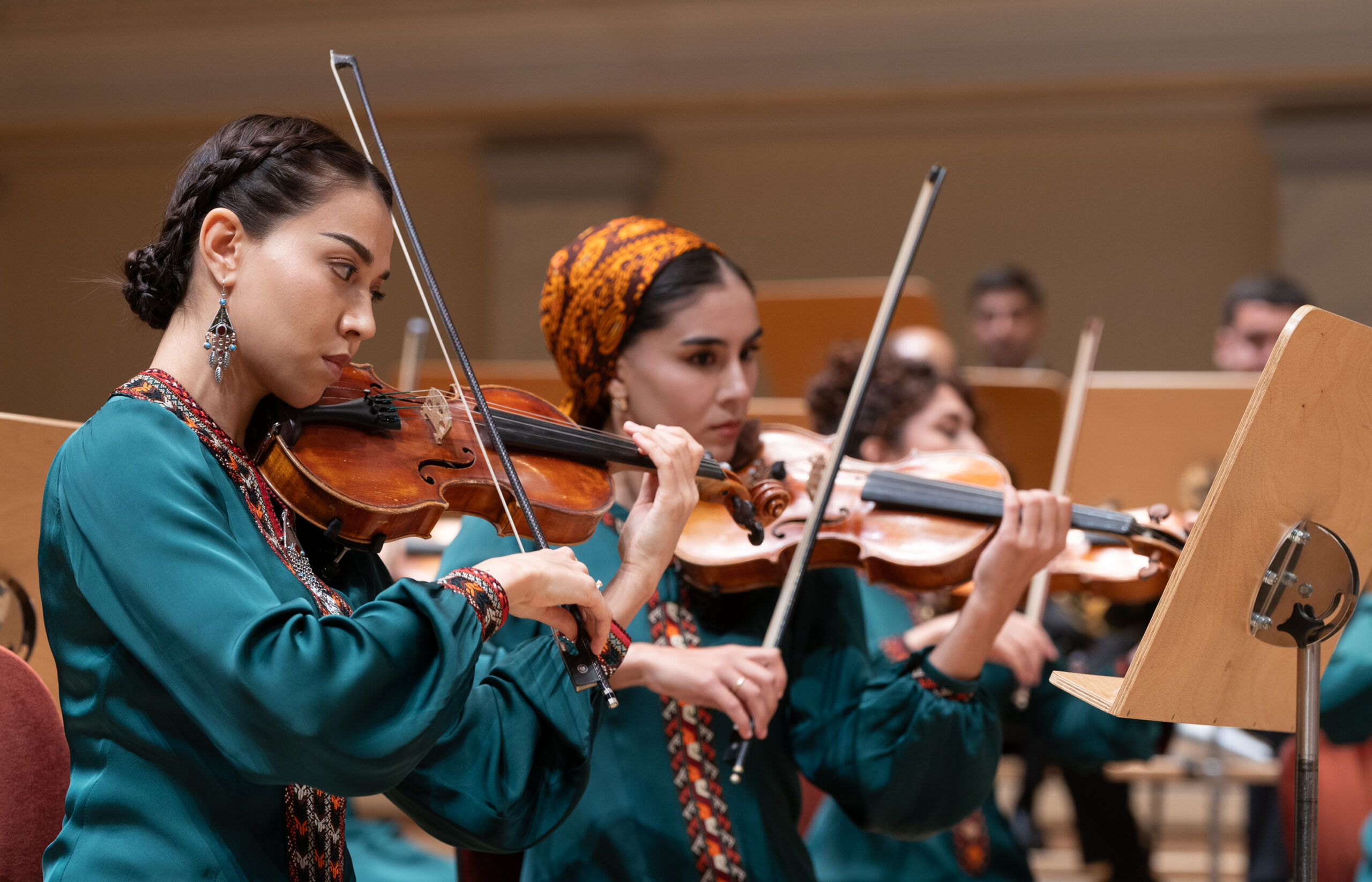
And what an orchestra stood there. On stage sat an ensemble that seemed more like a chamber orchestra than a large symphony orchestra, but as soon as the first sounds rang out, you hardly noticed it. The strings had a warm sound, in which the different voices blended beautifully together, while the woodwinds also featured excellent soloists who were regularly quite challenged in the works of their own homeland. The balance between the different orchestral sections was particularly striking: no section tried to dominate the other, nowhere was a particular group made loud merely for effect. Everything was in a remarkably homogeneous whole, with the individual colors remaining clearly audible. That is by no means a given in a youth orchestra.
Rasul Klychev, who in 2007 was instrumental in founding the ensemble and let it grow from a line-up with a limited number of musicians to the current orchestra, has clearly built up an orchestra culture. In the conversation I had with him that afternoon, he described his goal more broadly than training good instrumentalists: the young musicians should learn to see themselves as artists, people who not only play because it is their profession, but who also love their music and their culture. The distinctions the ensemble achieved in 2024 and 2025 during the World Orchestra Festival in Vienna confirm that this is no chance occurrence.

The Piano Concerto by Chary Nurymov formed a first introduction to a composer who received his professional training at the Gnessin Institute in Moscow and subsequently returned to Turkmenistan. His music demonstrates precisely that cultural interaction: rhythmic power and a pronounced orchestral color alongside lyrical passages in which the melodic world of Turkmenistan shines through. At the piano sat Shaislam Komildjanov, who this year completed his studies at the Turkmen National Conservatory 'Maya Kuliyeva': a nimble-fingered pianist, but fortunately not someone who constantly wanted to show off his virtuosity. His touch was light and when the score called for lyricism, he also knew how to make that side convincingly speak. The interplay between pianist and orchestra was particularly convincing: not a soloist opposed to an orchestra, but musicians who wanted to tell something together. It was also striking that he simply took a seat in the orchestra during the rest of the concert, a nice image of a young talent who clearly saw himself as part of the whole.
This connection with their own musical tradition is, according to the musicians themselves, essential. Violist Merdan Chariyec told me that afternoon that the composers the orchestra performed that evening based their works heavily on the folk music of Turkmenistan and that the young musicians want to make their music heard in Berlin as a way to tell the history of their people. At the same time, they have been familiar with Bach and the European classical tradition from a young age. European music theory is connected in Turkmenistan with their own musical language, with its ornaments and melismas. That perhaps explains why this music sounded so little like a fish out of water: the European tradition is for these musicians not an outside world, but part of their own training.
Weli Muhatov's My Homeland was the next work, and that is a title that makes a reviewer scratch their head for a moment. Muhatov, who as composer and professor played an important role in developing musical life in Ashgabat and also wrote the national anthem of Turkmenistan, composed the work in 1950. The lengthy work begins elegiacally, has lighter episodes and ultimately grows into hymnic proportions, with the influence of Tchaikovsky and Prokofiev clearly audible. The orchestra managed to realize that alternation of moods convincingly, but ultimately the work was too long for me and offered too many musical impressions. Various episodes, moods and ideas followed one another, causing the coherence to become less sharp toward the end. Offsetting this was an impressively built-up finale: the strings drove the tension ever further until a broad climax. In doing so, I inevitably thought of the finale of Shostakovich's Fifth Symphony. That association may be bold, but the musical memory was strong.
With Songs from Turkmenistan by Aidan Gold (°1997) – only the third movement of this percussion concerto sounded in the program, Misterioso: Fantasy on Turkmen Themes – a different perspective on Turkmenistan opened up. Gold received a number of scores from composers of the State Symphony Orchestra of Turkmenistan and was asked to compile a concert for percussion and orchestra from them. The result was pleasant and rhythmically attractive, but I did wonder why the work was presented as a concerto: the solo role of the percussion seemed to me too limited in this movement. More interesting was the distance that became audible in the music. Gold did indeed use melodies from Turkmenistan, but in my ears something of the direct impact that was so self-evident in Nurymov and Muhatov disappeared in the process.
The absolute highlight of the evening came with Nury Halmammedov. His Wind of the Karakum Desert is a remarkable work, built from various symphonic images – Introduction, At the River, Wedding Procession, Tuyduk and Horse Racing – and based on music he originally wrote for films. Here the music seemed no longer to be a description of a landscape, but the landscape itself became audible. The melancholy of the second movement was profound, almost tangible, while in the last movement a fire arose that set the entire orchestra in motion. Halmammedov belongs, together with Nurymov and Muhatov, to the most important composers in the history of professional music in Turkmenistan, but in him the connection between folk melody and symphonic tradition sounded the most natural this evening. It was one of those works you want to listen to again after the performance.
Perhaps it was no coincidence that Chariyev, when I asked him what is typical of music from Turkmenistan, did not speak primarily about musical techniques. He referred to "the Karakum Desert, the caravans, the Silk Road", to the nature and traditions of his country. During Wind of the Karakum Desert you hardly had to make an effort to imagine those words. The desert became no mere backdrop here, but a musical space.

After that intense experience, Diable qui danse by Pierre Thilloy (°1971) built a bridge to Europe. The work, which had its German premiere in Berlin, presents a composer who has clearly found his own language. That language is somewhat too repetitive for me, but the menace that permeates the score from the outset is unmistakable. Thilloy draws from a South Italian tradition in which victims of the bite of a black widow would try to expel the venom from their bodies by dancing endlessly. The Saltarello becomes in his hands not a folkloric dance, but an ever more runaway force, where rhythm begets new rhythm and movement becomes almost compulsive. That came across powerfully: particularly the violas, cellos and double basses built a dark, threatening foundation. Klychev is friends with Thilloy and had received the score from him; Young Euro Classic offered him, as he says, "a perfect opportunity" to present the work to a European audience in Berlin. Thus it formed a natural bridge from Turkmen music to Europe.
Finally, Arturo Márquez (°1950) with Danzón No. 2. I must confess candidly: upon seeing the program, I initially thought this was somewhat of a mismatch. After an evening in which Turkmenistan was so prominently featured, a Mexican danzón seemed a strange finale. I was quickly proved wrong, for it was precisely the melancholy and dancing character of Márquez that surprisingly fit beautifully with what preceded it. During the performance you only had to close your eyes to no longer imagine yourself in the Konzerthaus, but in a dark bar where the music continues deep into the night. The joy of playing radiated from the stage: the musicians let themselves be completely swept up in the rhythm and Klychev gave them all the space to immerse themselves in this music. In retrospect, Danzón No. 2 actually fitted wonderfully into the program: different culture, different melodies, different rhythms, but ultimately the same human need to transform sorrow, longing and joie de vivre into music.
The audience had long since decided what it thought of this introduction. After the final note, a standing ovation followed that lasted well over a quarter of an hour. The Youth Symphony Orchestra of Turkmenistan convinced this evening with a warm, homogeneous orchestral sound, excellent balance between the sections and strong soloists; above all, the great involvement with the music stood out. Klychev is clearly much more than someone who conducts the orchestra on stage: he is the man who has built this ensemble from its origins and taught young musicians to listen to each other.
We did not get a complete picture of the music of Turkmenistan – one concert was far too little for that. We got something much more valuable: a first introduction that arouses curiosity for more, for Nurymov, for Muhatov, for Halmammedow, but also for the composers and music that could not be heard this evening. Klychev hopes that the audience will discover the music from Turkmenistan, that this discovery will stick, and that through the music an interest in the country will also arise. After this evening, I think that has certainly succeeded. For the Youth Symphony Orchestra of Turkmenistan, Berlin was a debut; for the audience a discovery, and for me especially the beginning of a further introduction to this intriguing musical heritage.