

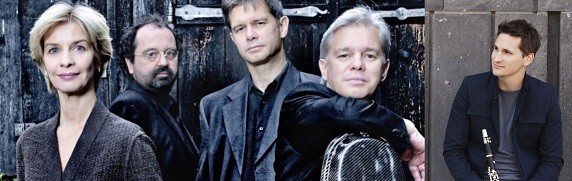
Okay, it's understandable: for Austria's flagship musical ensemble, the Wiener Philharmoniker, BOZAR was packed to the rafters the day before. The next day, for our concert with the equally distinguished Austrian Hagen Quartett, unfortunately this was not the case. String quartets appeal less than symphonies. We know that. Especially when they have to compete with a Dvořák New World Symphony. But this time there was no enthusiastic applause at every turn in the hall, as there was yesterday with that Dvořák. The restrained audience enjoyed, aside from the occasional seasonal coughs, in complete silence and admiration two string quartets by Haydn and Schubert and Mozart's clarinet quintet.
It began with Haydn. Often cited as the inventor of the string quartet, and here with his opus 55/3. And yes, you can get tired of those string quartets (he wrote dozens of them after all). You can even find it boring sometimes. But when a group like this brings out all the nuances, you still enjoy every bit of that wealth of sound. And that is also the right mindset to listen to Schubert's early string quartet D173. And especially to listen in the Andantino to a wonderful interplay between first violin and a magnificent cello. Not the best-known Schubert, rather romantic and even cheerful.
But then came Mozart. The clarinet quintet or Stadler quintet, written for that friend of his and renowned clarinettist of the time. And the Hagen Quartett surpassed themselves. It seemed as if the arrival of clarinettist Daniel Ottensamer, principal clarinettist of the Wiener Philharmoniker, sharpened the playing of the members. In terms of intensity and quality, they shifted into an even higher gear. And their ensemble sounded even more subtle. As soft as the strings was the clarinettist's sound. Not only in the Larghetto, with that famous dragging melody, was his breath control more than professional. His playing was almost breathtakingly beautiful throughout. The first violin duelled delightfully with the clarinet. Perhaps I paid special attention to first violinist Lukas Hagen. Why? During the intermission, I ran into violin maker Thomas Meuwissen. "I'll show off a bit," he said. "I built a violin for him!" When you know that, you listen with a couple of extra ears to that instrument. Lukas Hagen told me about it: "Every violin sounds different. You have to feel good with your violin above all, and I had that from the first moment with this violin: it sounds healthy, powerful, beautiful, and it already has my preference over the many others I've played. From the start it had qualities that are hardly to be found in other newly built violins." What an honor for violin maker Thomas Meuwissen. How did those two get in contact? Thomas Meuwissen: "They've been playing in Brussels for years, and I've often been to their concerts. First I met his sister, the violist Veronika Hagen, and only later Lukas too. I showed him a violin not so long ago and he was so impressed that he invited me to show my work to his students in Salzburg. They were looking for instruments, and he thought it was important that they come into contact with good contemporary violin makers. He organized a test for them and a number of colleagues in the great hall of the Mozarteum. The next day he said he was so impressed that he was considering buying the instrument. And to my great surprise, he did so the following day!"
Renowned dynasty
The clarinet quintet is of course Mozart at his best, with that beloved instrument that fascinated him greatly: playful as he himself was, but with a romantic depth equally characteristic of him. It is perhaps already too popular and well-known, but performed by these musicians you hear it as if for the first time. Almost immediately you realize: I've never heard it like this before. Is it because of that brilliant Viennese clarinettist Daniel Ottensamer? When you ask him, he answers with wonder: "Does it sound new? Not for me, I always play it like that. For me it was especially special to play this evening with the colleagues of the Hagen Quartett. It was the first time we brought the quintet, and that ensemble playing with them was really a special and beautiful experience for me. Perhaps that's why it sounded so good."
He also comes from a renowned dynasty of clarinettists. His father also played as principal soloist with the Wiener Philharmoniker and his brother does so with the Berliner Philharmoniker. Then you have to become an outstanding player of course. Together they formed The Clarinotts, until the death of the father. Daniel is in any case a top-class musician. And after such a performance you are once again forever sold and devoted to that 'hackneyed' masterpiece.
- WHAT: Joseph Haydn (1732-1809) - string quartet opus 55 no. 3 in B-flat (Hob.III:62) | Franz Schubert (1797-1828) – string quartet no. 9 in g (D173) | Wolfgang Amadeus Mozart (1756-1791) - quintet for clarinet and strings in A (KV581)
- WHO: Hagen Quartett [Lukas Hagen and Rainer Schmidt (violin), Veronika Hagen (viola), Clemens Hagen (cello)] and Daniel Ottensamer (clarinet)
- WHERE: Henry Le Boeufzaal, BOZAR, Brussel
- WHEN: Saturday 1 December 2018
- PHOTO: © myrios classics & Julia Stix