


Sober and somber, a suggestive setting
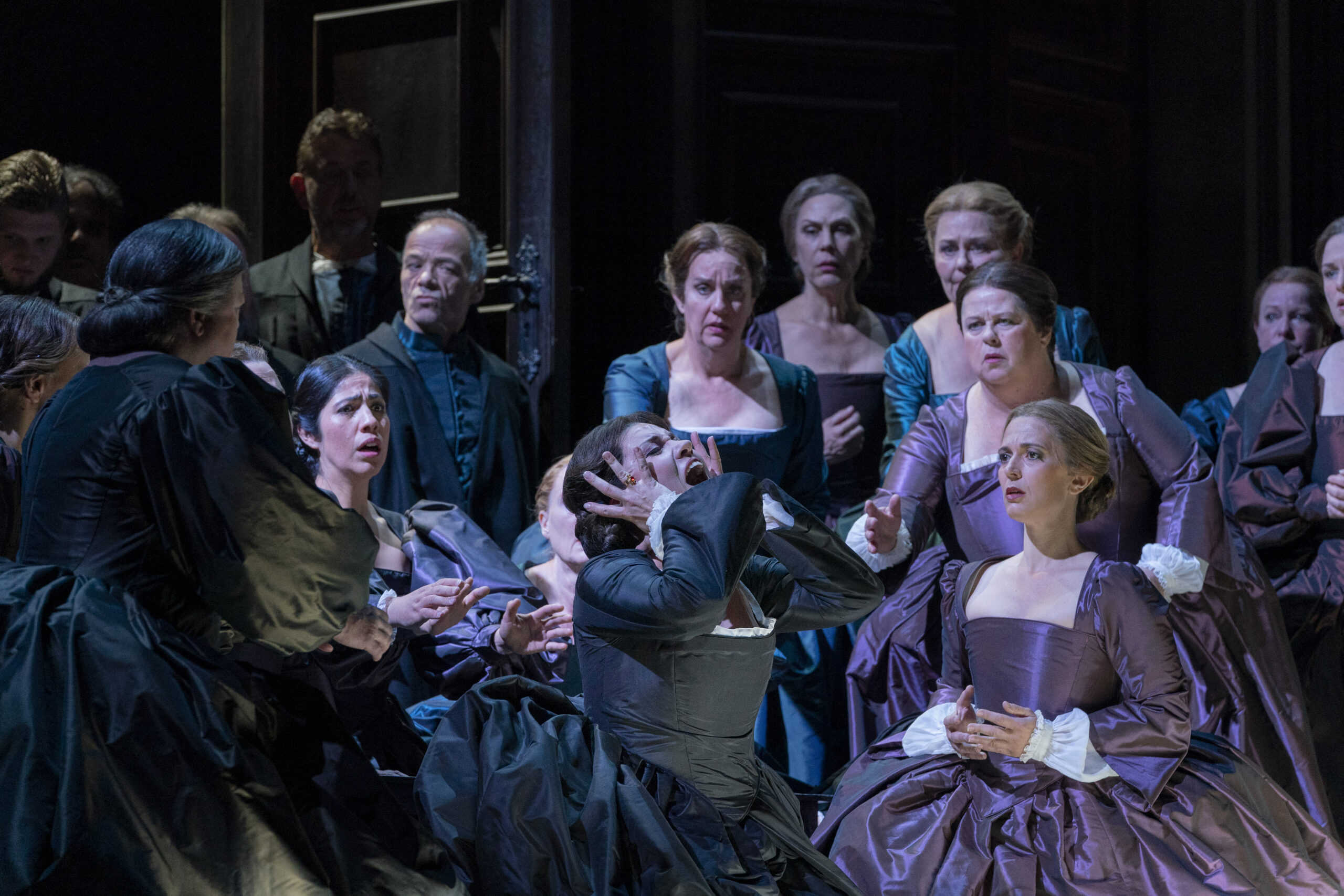
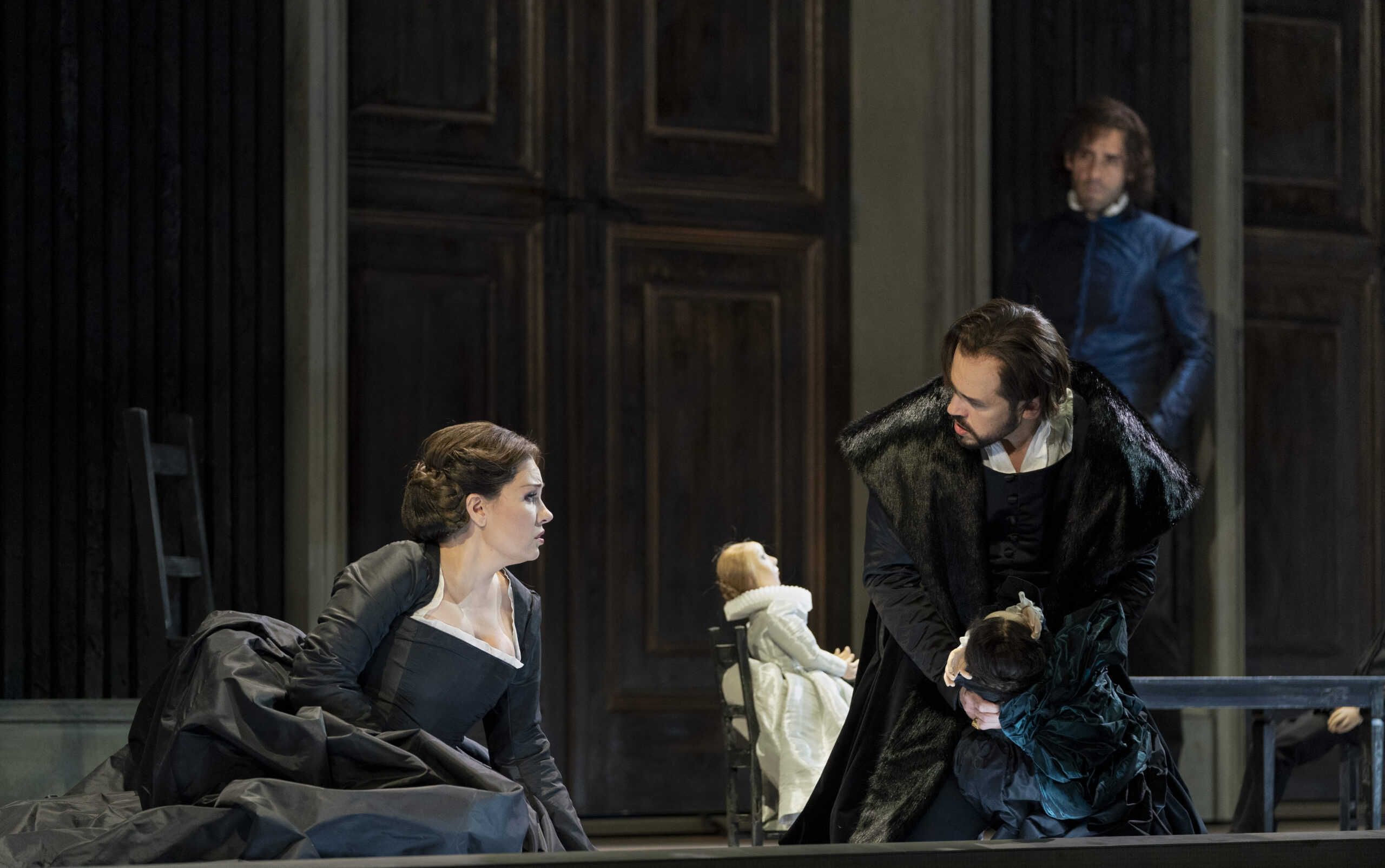
The first thing that strikes you as the curtain rises is the desolation of the stage. Anna Bolena sits there completely alone on a bare wooden chair: you are immediately confronted with the tragedy that unfolds over the course of the opera and ends with the solitude in which she walks off the stage at the end of the opera, toward death. Jetske Mijnssen opts for an abstract and very sober setting (Ben Baur). On the vast stage of De Nationale Opera, a large white frame is created like a tableau with somber gray walls and without props, except for the occasional simple wooden chair and table. There are tall doors in the left and right walls and on the back wall the number of doors alternates depending on the scene while the wall shifts. The focus is thus entirely on the interaction between the characters and the set does not distract anywhere, on the contrary it only reinforces the relationships. The director does allow herself a freedom in the appearance of the little princess Elisabeth, who brings a certain playfulness to the story and even shows a softer facet of the otherwise stubborn and cruel king Enrico. Her little bed offers the convenient place where Smeton (Anna's page) can hide so that he witnesses the secret meeting between Percy and Anna. The return of the king's hunting party and his retinue is, however, a passage that with the fussy dragging of the deer and the "carnal" treatment of his trophy by Enrico, is distasteful. The condemnation, on the other hand, of Anna by the judges who sit backwards next to each other on chairs in the large space, cuts to the bone. The door openings that display bloodied prisoners as dungeons also evoke a real horror at the cruel events. The final scene is the only one that brings about a reversal of the atmosphere: like a Midsummer Night's Dream the stage bathes in spotless white for Enrico's wedding to Giovanna, in sharp contrast while Anna – in her black dress - walks toward her death.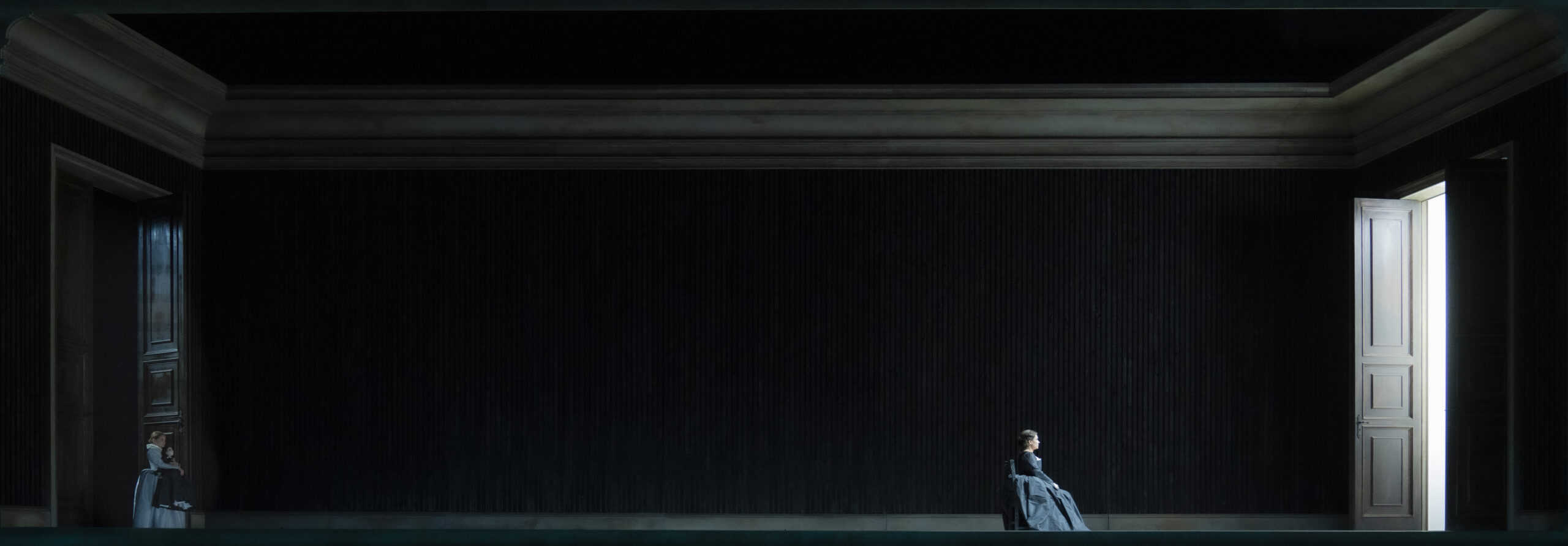
Key scenes
Donizetti drags us into his authentic bel canto opera in a succession of dizzying virtuosic arias, duets and ensembles that each lay another link in Enrico's unstoppable plan. He accuses his wife Anna of adultery and wants to repudiate her in favor of his new lover Giovanna Seymour. On the virtually empty stage, the focus is entirely on the expression of the protagonists and on their vocal sparring with each other. This is evident in the confrontation between Giovanna Seymour and Enrico, which evolves from Giovanna's almost resistance – not wanting to betray her mistress and friend – to surrender to Enrico's perfidious intention. Also in the two passages between Anna and her former lover Percy, the protagonists stand before each other with all their emotional powers of persuasion. In the first act, the memory of their former love is carefully touched upon and in the second, Percy wants to take the blame for Anna's condemnation upon himself. Enrico's malicious challenge to Anna to force her to confess her adultery with Percy – and even Smeton - testifies to a boundless and almost unbearable brutality. The scene of Anna's madness begins with the repeated image of her lostness on the vast empty stage as if the circle is complete. There is indeed no way out or salvation, for Anna's drama culminates in her walking alone away from the revelers, toward her death.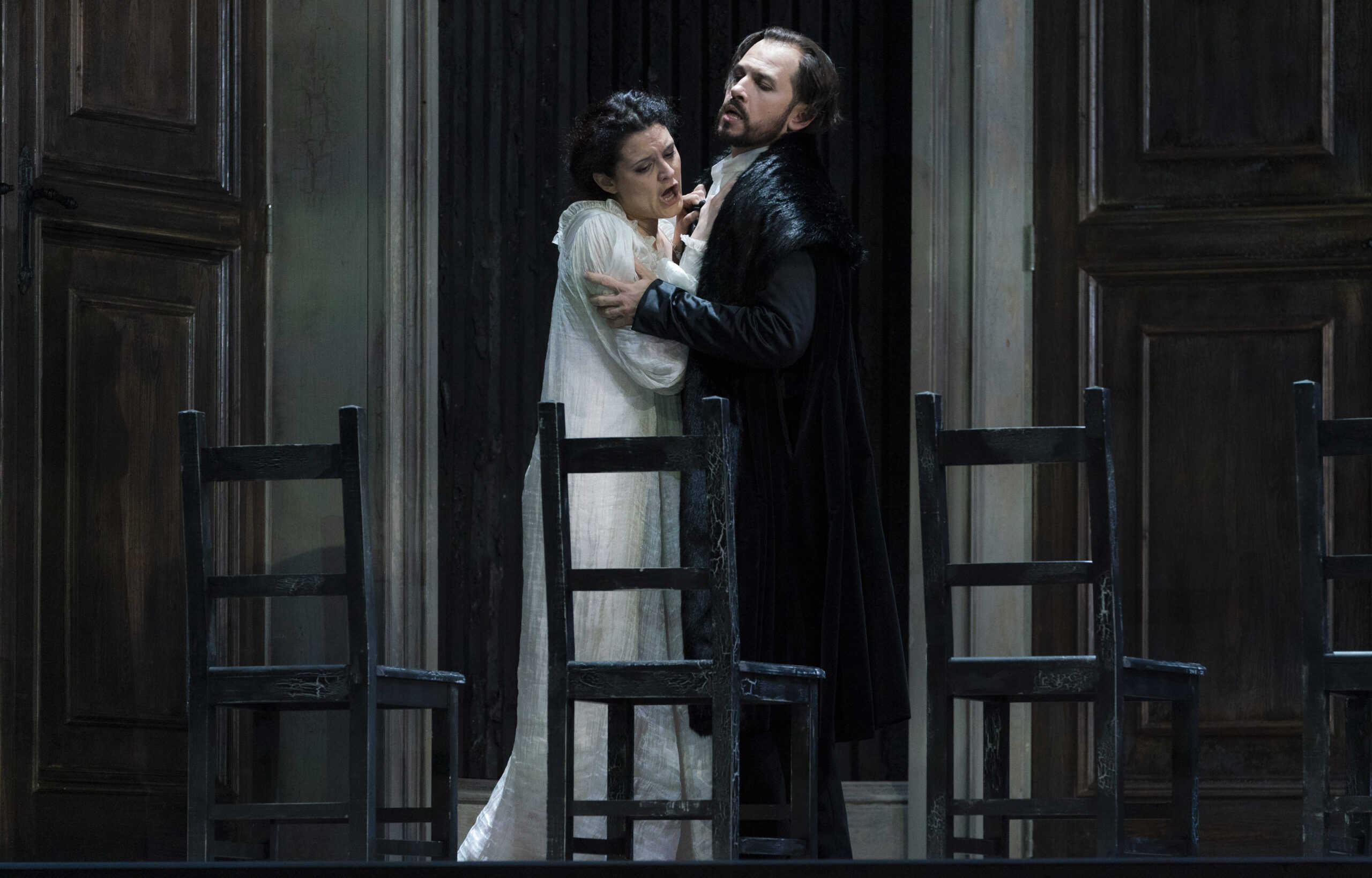
Wealth of voices
The production is furthermore supported by high-quality musicianship. The vocal top performance we naturally attribute to Marina Rebeka. In her sober black yet elegant dress she not only looks royal-elegant, but she sings with effortless virtuosity and rich coloratura. Only one could wish she would occasionally, especially in the melancholic moments, modulate her voice to a softer volume. By consistently using her full power, she risks becoming monotonous at times. But it is an incredible achievement to maintain the role flawlessly to the very end. She is almost continuously on stage and furthermore has to tackle that extremely demanding long mad scene which is hauntingly moving. She even reaches the extremely high tessitura in her cabaletta "Coppia iniqua". Her rival Rafaella Lupinacci sings with fluid and equally uninhibited mezzo her role which wavers between loyalty to her friend and ambition to become queen. Her hesitation at the difficult role the king imposes on her comes across authentically. The high and agile tenor voice of Ismaël Jordi as Percy provides a beautiful arioso in their duet in the first act. His fear for what happens to Anna and his commitment to her evolve into fierce dramatic tones in the prison scene. The applause made it clear that the tenor, who had already been heard before at the National Opera, has become a public favorite. The voice of Romanian bass-baritone Adrian Sâmpetrean goes through your very soul. He has no real aria but in his duets and ensembles his deep voice sounds authoritative and menacing. Sparing nothing he pursues his goal and the ensemble at the end of the first act confirms his perfidious scheme to use Percy as a trap to accuse Anna of infidelity.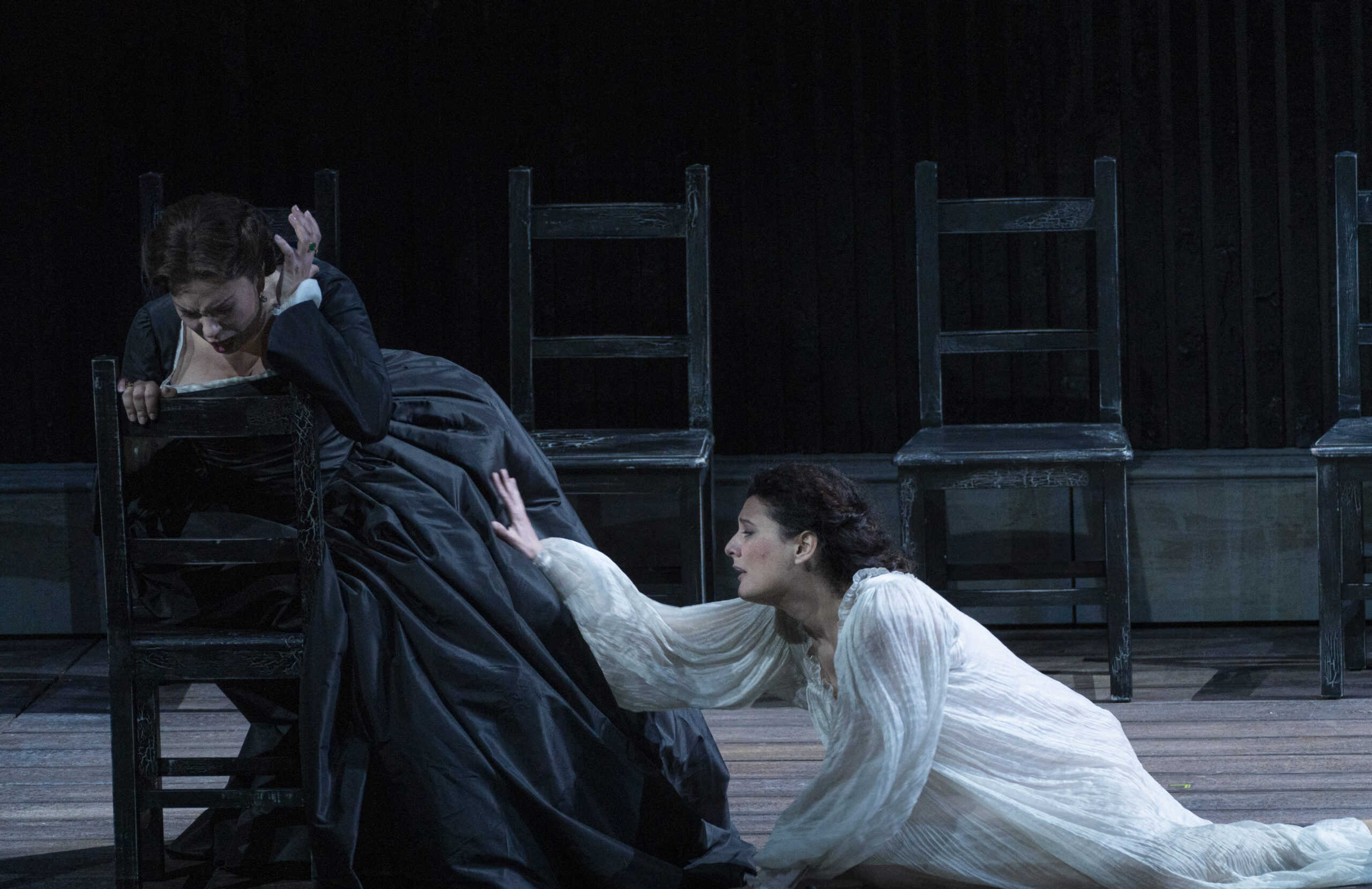
Orchestral finesse
The enthusiasm of conductor Enrique Mazzola for this bel canto music shines through. The Dutch Chamber Orchestra serves him with concentration and enthusiasm. Both the vocal parts and ensembles with energetic broken rhythms in the dialogues and the flowing lyrical melodies, typical of Donizetti's rich bel canto score, are supported efficiently by the orchestra. For example the beautiful introduction by the horns in the duet of Anna and Giovanna at the beginning of the second act or the beautiful English horn that introduces Anna's long final aria. The Choir of the National Opera, prepared by Klaas-Jan de Groot, also makes the production a particularly successful affair. The thunderous applause was therefore well deserved all around. WHAT: Gaetano Donizetti: Anna Bolena (1830) WHO: Jetske Mijnssen [director], Enrique Mazzola [conductor] Klaas-Jan de Groot [chorus master] VOICES: Marina Rebeka, Rafaella Lupinacci, Adrian Sâmpetrean, Ismaël Jordi WHERE: Nationale Opera Amsterdam WHEN: Sunday 15-5-2022Performances until 29-5-2022