

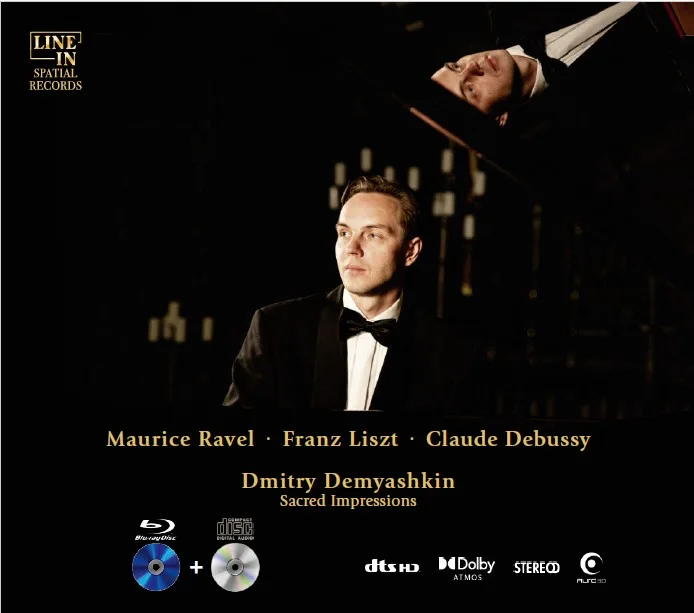
When you put this cd on without having read all the background information, you immediately feel that something special is going on here. Dmitry Demyashkin chooses not to present his programme chronologically: Ravel opens, Liszt follows, Debussy closes. On paper a remarkable choice, but the logic of it works perfectly, especially when the works of the three composers flow seamlessly into one another.
The three movements of Gaspard de la nuit by Maurice Ravel (1875-1937) immediately breathe the right atmosphere. The acoustics of the Hofkirche St. Leodegar in Luzern prove to be no obstacle at all: despite the reverberation, everything remains clear, every note is audible. Ondine moves and glimmers, albeit sometimes rather explicitly, Le Gibet receives the necessary tranquility, and Scarbo carries the tension further with its capriciousness, though the playing at moments of high speed loses some of its sharpness. The cd booklet explains that more explicit, harder touch: Demyashkin wanted to conquer the church acoustics, so to speak, not let his sound be absorbed by the space. An understandable approach, but in my view this method becomes regularly disturbing. It even made me somewhat nervous at times.
In the Sonata in B-flat minor by Franz Liszt (1811-1886), he brings his playing with considerable bravura. For half an hour follows an intense journey that never bores and draws you in from the first note. Where the harder touches are indeed disturbing, he treats the lyrical passages with careful restraint. There is no precise moment or measure to pin it down to – rather a recurring feeling that the touch here and there gets just a bit too much force for what the moment calls for. The heavenly melodic lines that seem to reach for another world do sound convincing and touching, and the rhythm has clearly been thought through: accelerations are built up organically, not simply introduced for effect. Yet no entirely positive impression remains. It makes me wonder whether these works would not have been better recorded in a regular studio. In any case, I'm curious how this interpretation would come across during a concert.
Then Liszt flows organically into Debussy – one of the stronger moments of the cd. Where Liszt still departs strongly from movement and tension, Claude Debussy (1862-1918) opens another listening world: lighter, more transparent, more colourful. In Reflets dans l'eau, those tints fill the space in a quite different way than in Liszt, with beautifully built-up moments of quietude and a sure touch in register choice. Hommage à Rameau brings a bit more weight and sounds particularly convincing here, with a restraint that feels just right. In Mouvement, however, the closing piece, that too explicit touch returns disturbingly: where this part should lightly and rhythmically lift with wit, Demyashkin occasionally pushes too hard, and that detracts from the fine, transparent ending that Debussy actually calls for here.
That the space plays such a large role is no accident: the recording was made at night in the Hofkirche, when the church was completely at rest, and a conscious choice was made for natural recording without artificial spatial effects. The cd comes in luxury format: in addition to the regular cd you also get a Pure Audio Blu-ray, with among other things stereo, 5.1 DTS-HD MA, Dolby Atmos and Auro-3D. Nice gadgets for those who enjoy them, but personally I would have found a video recording much more interesting – if only to see how those powerful touches look live in that church space.
What further bothers me is the limited playing time of barely three quarters of an hour. For a release that so emphatically profiles itself on the atmosphere of the night – through the chosen repertoire itself, but also through the nocturnal recording session in the church – a supplement with other nocturnal piano repertoire would have been obvious: think of Chopin's nocturnes, Grieg's Nocturne from the Lyric Pieces, or Schumann's Nachtstücke.
A fascinating recording nonetheless, which works as a concept and manages to appeal to me from beginning to end despite my reservations. Yet the great names are not dethroned here: think of Michelangeli's legendary Gaspard de la nuit, of Argerich or Zimerman in the Liszt sonata, or of Michelangeli and Gieseking in Debussy's Images. For that, Demyashkin sometimes lacks that little extra passion, fire and restraint that lifts a performance from the exceptional to the unforgettable.
