

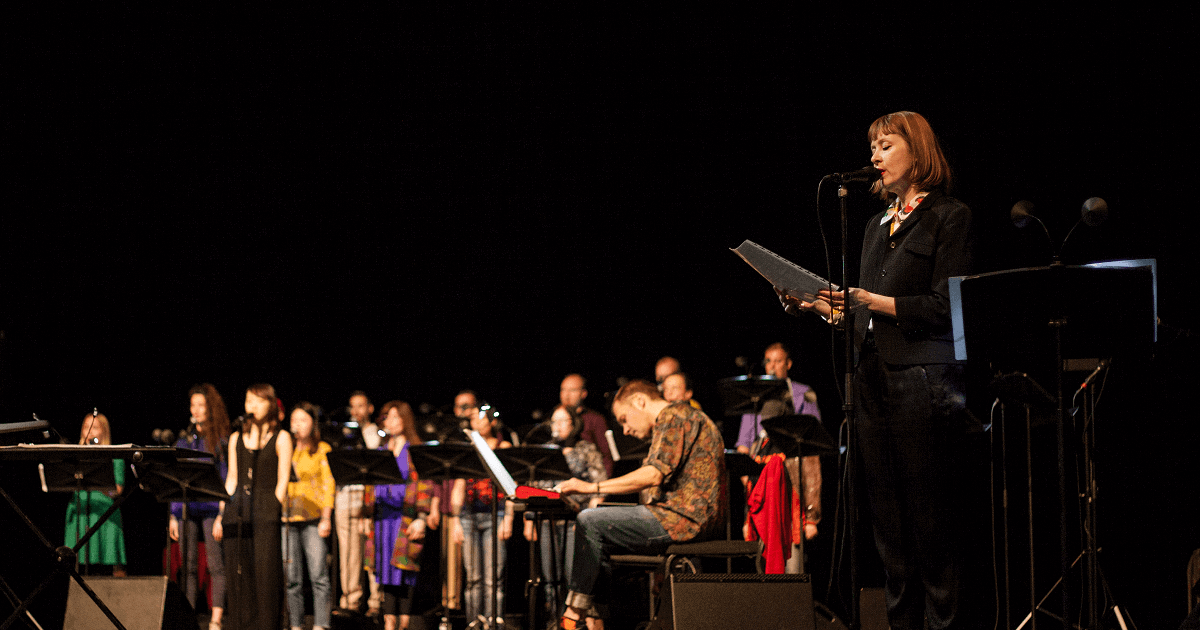
Philip Glass' Einstein on the Beach (1976) is an outstanding example of minimal music: trance-like loops, text with fluid content, and constantly recurring circular passages. Sometimes lasting 4 to 5 hours, this opera is a challenge for the senses of both performers and audience. Ictus, Collegium Vocale Gent and Suzanne Vega, conducted by Tom De Cock, brought a strong concert interpretation of Glass' endless musical non-plot. Whether there was much Einstein is debatable, but there was certainly plenty of sensational sound!
Einstein?
Einstein on the Beach is a non-plot opera, which means there is no specific storyline. Any references to Einstein occur in the numerical repetitions in the text, and the division of passages into sections related to his major theories – the latter perhaps being less clear in the concert version. The loosely related content form – held together by five knee jerk plays (a kind of spoken interlude) – is a result of the collaboration between Glass and theater producer Robert Wilson. Minimal music strives for an infinity in music, something where a fixed narrative is a risk factor (because you can become fixated on it). When you as an audience feel completely focused – and even physically and mentally drawn in – by the electronic loops and vocal repetitions, then you know you are listening to minimal music.
The minimal audience
Movement – entering and leaving – during minimalist performances is nothing new. It gives the audience the chance to create their own personal listening sections. During this concert performance, this option was no different. Spending hours in a musical trance is of course a challenge for everyone, including for this reviewer (I am a great fan of the feeling). But there are also disadvantages. In the case of this concert, for me, as a reviewer, the first 15 minutes – and the fantastic opening by Suzanne Vega – were largely lost due to masses of audience members still arriving, searching for their seats, and starting to converse loudly in the meantime. Moreover, you can be unlucky and end up in a row where laughing, talking – and especially not engaging with the music – were the norm. Here my compliments go to BOZAR, who took these remarks to heart and provided me with a new musical bubble.
A musical trance bubble
Because I measure a good minimal music production not only by the quality of the sounds and technical musical achievements, but especially by how "one" I become with the music. I can only praise this production, because at the best moments I heard only the music, or Vega's syllabic sound and speech play. That Vega was the right choice, with her beautiful, clear, but also deep-colored voice, was evident. And anyone who says that singing is not equivalent to top sport was proven otherwise that evening. Compliments to Collegium Vocale Gent – they were lightning-fast lip movements (I was in an excellent position to follow this) with the difficult repetitions always coming through clearly.
The transitions were seamless and smooth – which contributed to the infinite feeling of repetition. The multidisciplinary talents of the musicians were admirable - from conducting to piano, to suddenly participating in a vocal or spoken passage. It is also quite amusing to watch the conductor(s) during these kinds of compositions, because minimal composition structure is anything but easier. Especially with several musicians, choir singers and speaking voices together! The fingers moved at a relentless tempo across keyboard keys or violin strings – and this for hours. Remember, there are few musical breaks in minimal composition pieces. At no point did there seem to be a dip in performance quality. For this marathon, the performers certainly constantly gave their best.
To conclude briefly, it was certainly a successful performance. Compliments should be given to Ictus, Collegium Vocale Gent and Suzanne Vega for this tour-de-force. Glass' work came to life for hours, creating an enchanting, mathematical trance – something that is due to the high quality of the production. Everyone should experience a performance of Glass' at this level at some point – it opens new, infinite musical sensation worlds!
WHAT: Einstein on the Beach (1976) by Philip Glass (concert performance).
WHO: Tom De Cock [conductor], Ictus [ensemble], Collegium Vocale Gent [choir], Suzanne Vega [speaking voice], Michael Schmid [assistant conductor].
Coproduction: BOZAR / Ictus / Ars Musica
WHERE: BOZAR (Brussels)
WHEN: Wednesday 30/11/2022.