

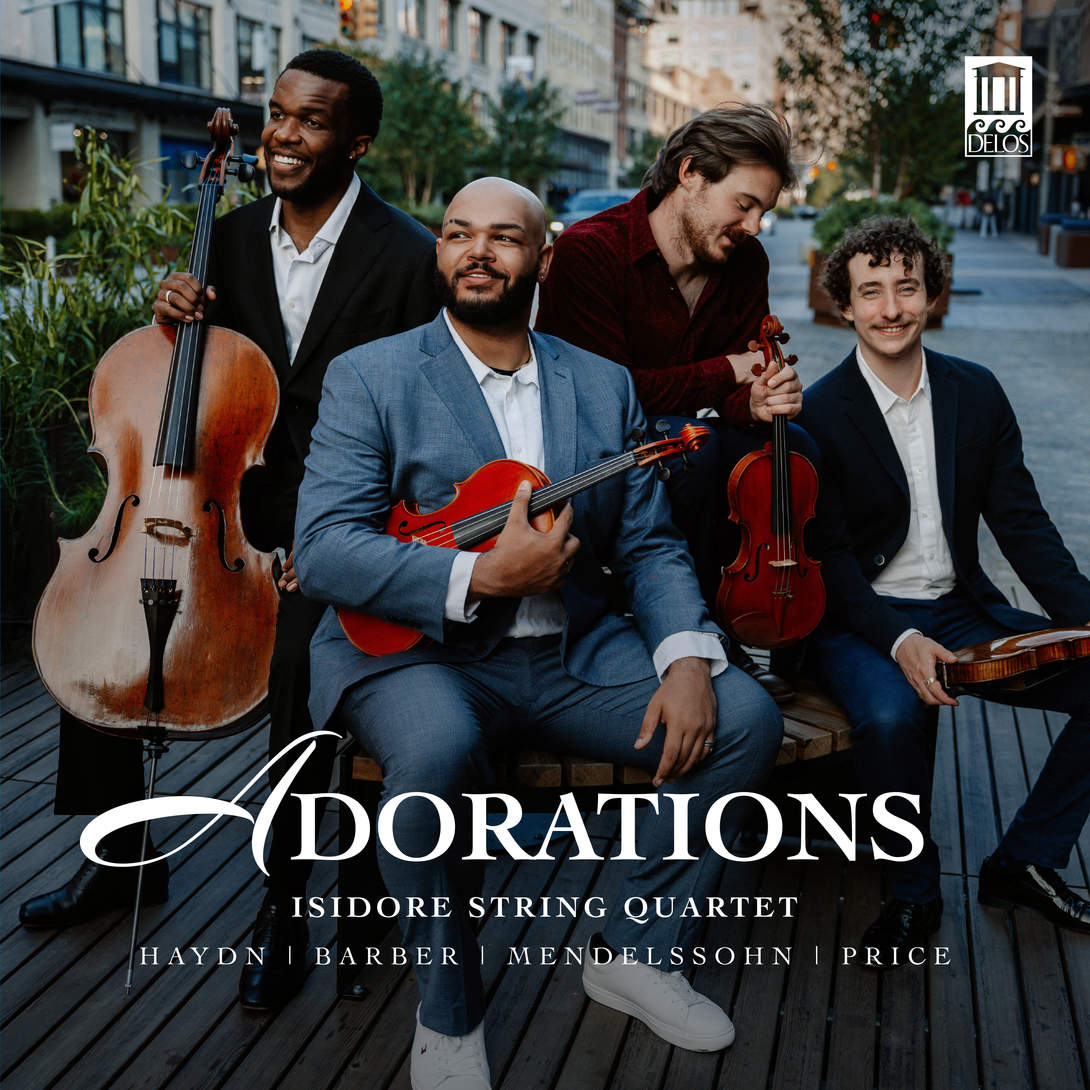
A debut album is always something of a profession of faith. The Isidore String Quartet – violinists Phoenix Avalon and Adrian Steele, violist Devin Moore and cellist Joshua McClendon – chooses with Adorations a programme that carries both an artistic vision and personal meaning. The cd is dedicated to the memory of cellist Joel Krosnick (1941–2025), long-time member of the Juilliard String Quartet and a formative mentor for this young ensemble. That dedication is no empty gesture: it colours the entire recording.
The name "Isidore" honours the legendary violinist Isidore Cohen, an early member of that same Juilliard Quartet. From the very first note on the cd, however, you notice that this connection with a glorious tradition does not weigh as a burden on the quartet, but rather functions as a compass: the musicians approach the familiar as new and the new as familiar – precisely the Juilliard heritage they were given.
Architectural starting point
The String Quartet in C major op. 20 no. 2 is one of the most ambitious quartets by Franz Joseph Haydn (1732–1809) from the so-called "Sun" series (1772). In particular, the closing fugue – Fuga a 4 soggetti – is a tour de force that at the time pushed the boundaries of the genre. The Isidore Quartet plays this opening movement with a remarkable combination of structural clarity and narrative gift. The Moderato breathes space; the melodic lines are passed on as in an animated conversation. The Capriccio: Adagio is given the necessary expressive freedom, without losing sight of the structure. The Menuetto: Allegretto brings welcome lightness of foot: the musicians take their time with the elegant dance steps without overdoing them, and the trio breathes restrained grace. And that closing fugue? Sharp, rhythmically tight, but never mechanical – the four musicians sense with hair-raising precision when a voice may come to the fore and when it must retreat into the fabric.
Central breath
The Molto adagio from the String Quartet op. 11 by Samuel Barber (1910–1981) – in the well-known orchestral version become a byword as a collective moment of mourning at national grief – sounds here in its original form, intimate and poignant. The Isidore Quartet lays down this work as one long held breath. That the musicians recorded this piece after the death of their mentor, you hear, but it translates not into a hint of cheap sentimentality, but into musical concentration with a long, hanging phrasing that lights up from restrained intensity.
Rapture of happiness
The String Quartet in E-flat major op. 44 no. 3 was written by Felix Mendelssohn (1809–1847) in 1838, shortly after his marriage to Cécile Jeanrenaud. The music radiates vitality and emotional fulfilment, and the Isidore Quartet seizes that tone with both hands. The Allegro vivace opens with a sparkle that immediately sets the tone: light, elegant, full of confidence. The Scherzo: Assai leggiero e vivace is one of those moments when you realise you are listening to musicians who are enjoying what they do, and who also share that enjoyment. The Adagio non troppo has a restrained, refreshing intimacy that sounds just slightly different from the heavy seriousness that some ensembles bring to bear here; the final section Molto allegro con fuoco is also brought with drive and precision without the music sounding hard or hurried.
Stilling
The cd closes with Adoration by Florence Price (1887–1953), arranged for string quartet by Samuel Araya. Price, a pioneer among Afro-American composers and one of the first whose work was performed by an American symphony orchestra, wrote this modest and deeply beautiful piano piece in 1951. The arrangement is serene and respectful: warm harmonies, quiet phrasing, an intimate, almost religious calm that fits perfectly as the closing statement of an album that – despite all its diversity – constantly returns to the question of what music can give us in times of both loss and joy.
An ensemble to cherish
Adorations is a debut that immediately presents the calling card of a mature ensemble. The Isidore String Quartet plays with a sound that is both refined and open, with an ensemble balance that rarely shows itself off but always sounds natural.
With this album, the Isidore String Quartet has spoken its first word – and if you listen carefully, you already hear in it the contours of a voice of its own.