

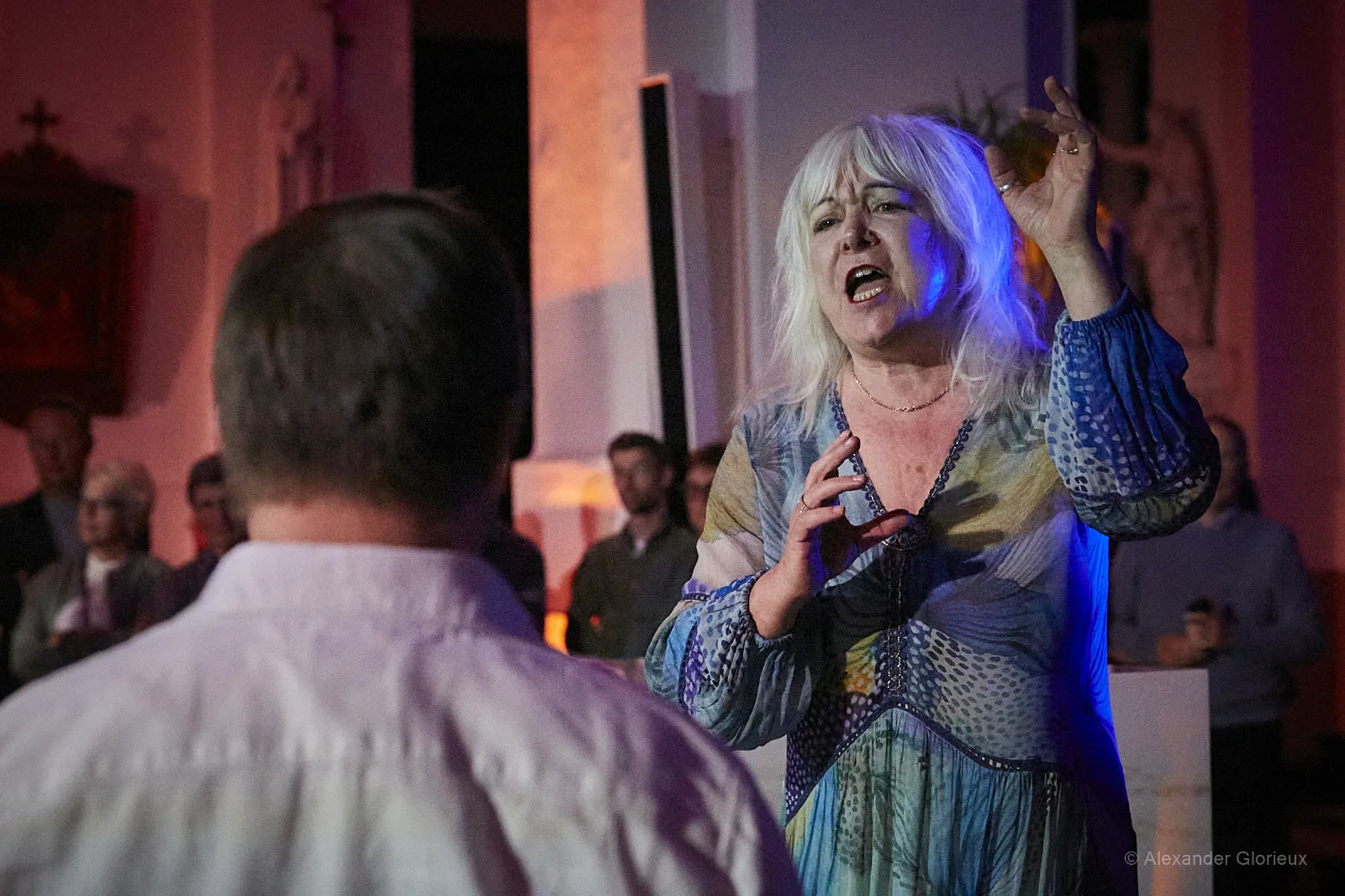
On Saturday 26 September, the Sint-Salvatorkerk in Harelbeke becomes the setting for Vibrations, a special musical route in which old and new music, electronics and improvisation flow into one another. The audience does not necessarily remain seated: the music spreads through the church, up into the historic bell tower, and invites listeners to move among the musicians. Composer Diederik Glorieux, who curates the evening, sees Vibrations primarily as a laboratory for co-creation.
“Essentially, the whole evening is devoted to different forms of co-creation,” Glorieux tells me when I speak with him a few days before the concert. It is the second edition of an initiative he hopes can return every year. At its core is the encounter between professional musicians and the inclusive stads[K]oor, but equally the question of how composing, improvising and creating together can interlock.
The starting point is not necessarily a fully fixed score. Musical ideas, fragments, textures or harmonic frameworks can serve as the point of departure from which musicians continue to search. “We start from a number of musical ideas, a number of cells, and these become the impetus for the improvisation,” Glorieux explains.
This principle runs as a common thread through the evening. Composer and sound artist Jorrit Tamminga, who worked closely with Wim Henderickx for many years, opens the route with acoustic and electronic sounds. Ludo Geloen likewise enters into dialogue with Henderickx's work on carillon and organ. Later, together with the vocal ensemble Huniyāgar, he performs motets by Peter Benoit.
The musicians of HERMESensemble also each find their own way from existing musical material. Violist Marc Tooten departs from Henderickx's RAGA, while soprano Mireille Capelle builds on his 2 Mantra's. Peter Merckx, in Unfolding Sound, investigates how acoustic sounds and live electronics can influence one another.
With The Cold Song by Henry Purcell, sung by countertenor Pieter De Praetere in an arrangement by Dimitri Andreas, a very different sound world emerges. Andreas, who is also active as a DJ and producer, then premieres his new work Pelican, in which electronic rhythms and organic percussion spread through the church space.
The high point of the evening is Vārāhī, a new composition by Glorieux himself, in which stads[K]oor, HERMESensemble, Dimitri Andreas and Pieter De Praetere come together. Here too, not every note is fixed in advance. The musical contours, textures and successive sections are prepared, but within that structure there is room for the performers.
Glorieux will conduct the stads[K]oor himself for the first time. “I indicate when we move to a new section. The musical idea is described, but what exactly will happen, we'll see on the day itself.”
For him, this openness is not an end in itself. It is connected to an important premise of the project: the various participants must be able to contribute in an equal way. Not everyone has the same musical experience or skills, but every participant must be able to make their own voice heard within the whole. “Not in an identical way, but in an equal way,” Glorieux stresses.
The audience, too, occupies a different position than during a traditional concert. It stands among the musicians and can listen and walk around at various points. As a result, the spatial experience itself becomes part of the music. Glorieux hopes the audience will above all open itself to this journey of discovery: not everything needs to be explained or understood in advance.
Perhaps this is precisely where the meaning of the title Vibrations lies: it is not only instruments and voices that set things trembling. Musical traditions, professional and non-professional musicians, electronics, space and audience are also brought into resonance with one another. What emerges from this is not entirely determined in advance.
Vibrations takes place on Saturday 26 September in the Sint-Salvatorkerk, Gentsestraat 4 in Harelbeke. There are two routes: at 20:00 the audience remains on the ground floor; at 20:30 the route also leads up to the bell tower. Both performances last just over an hour and a half. The project is an initiative of Musica H. in collaboration with CC het SPOOR and the research group Labo XIX&XX of the Royal Conservatory Antwerp. Tickets are available via CC het SPOOR.