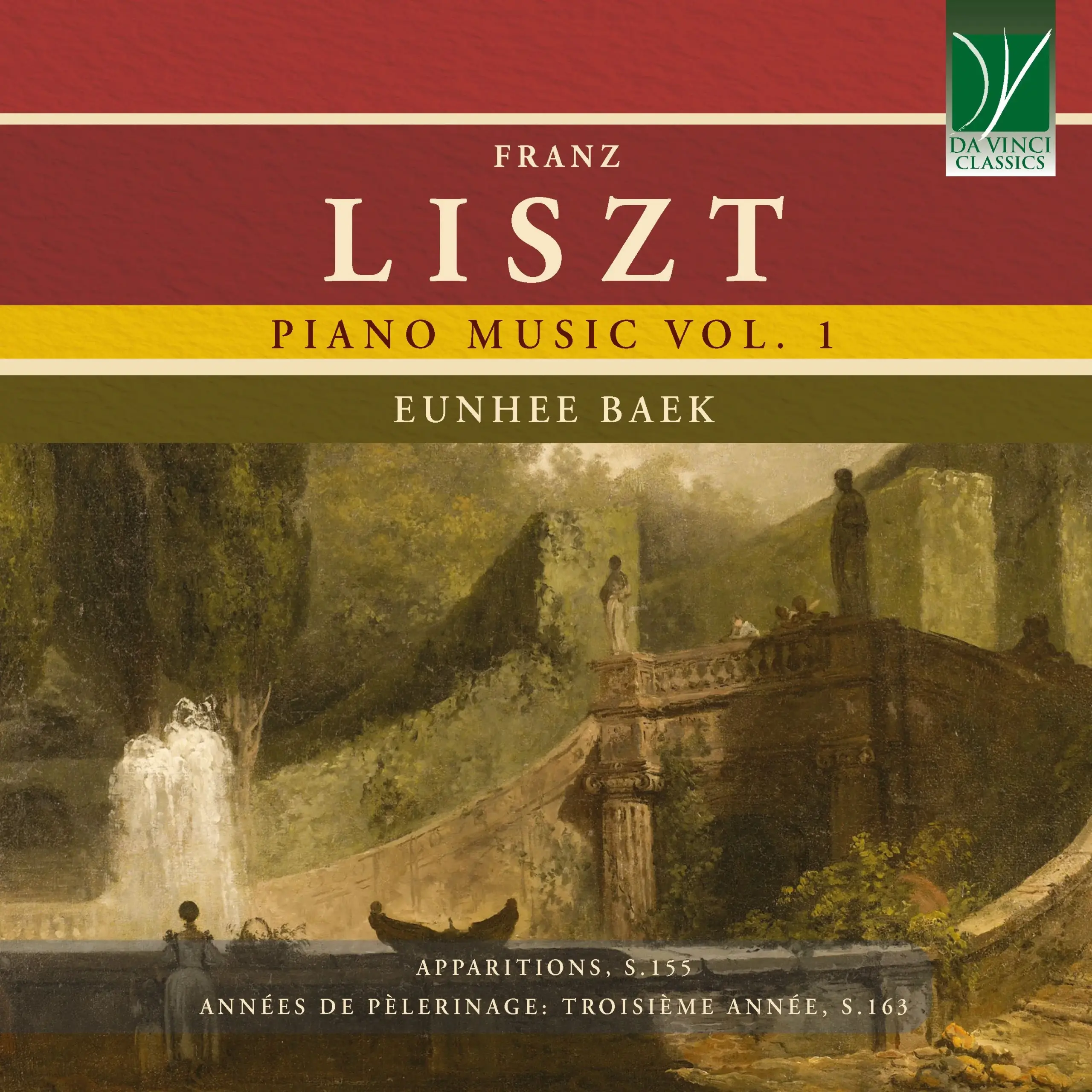
There are recordings you don't simply play, but enter, the way you enter a church where the lights are already dimming. Franz Liszt: Piano Music Vol. 1 by pianist Eunhee Baek is such a recital: not a program aimed at dazzling virtuosity, but a carefully constructed journey through forty years of composition. She draws an arc from the Three Apparitions from 1834, in which the young Franz Liszt (1811-1886) claims for the first time a wholly original poetic language of his own, to the Third Year of the Years of Pilgrimage, completed in the shadow of Wagner's death and barely three years before Liszt's own. Between these two poles lies not only a composer's lifetime, but also a love: that for Marie d'Agoult, who made her entrance in 1832 as "a strange apparition" into the life of the twenty-three-year-old Liszt, and whose death in 1876 definitively closed an era.
Baek, born in Seoul and trained at Berlin's Universität der Künste, the Mozarteum in Salzburg, and the Accademia in Imola under Boris Petrushansky, has devoted herself for years to Liszt's complete piano works. You can hear that devotion. Where many Liszt interpretations get stuck in outward display – the virtuosic brilliance that reduces the instrument to a spectacle – Baek consistently chooses the interior of the score. Her touch is never obtrusive; she lets the music breathe rather than shine. Her technique is exceptionally refined; from the opening measures you feel that here is a pianist who doesn't want to impress the listener, but to take them along in a carefully told musical story. Remarkable too is how effortlessly she overcomes the notorious technical difficulties. The virtuosity is constantly present, but is entirely subordinated to the musical thought.
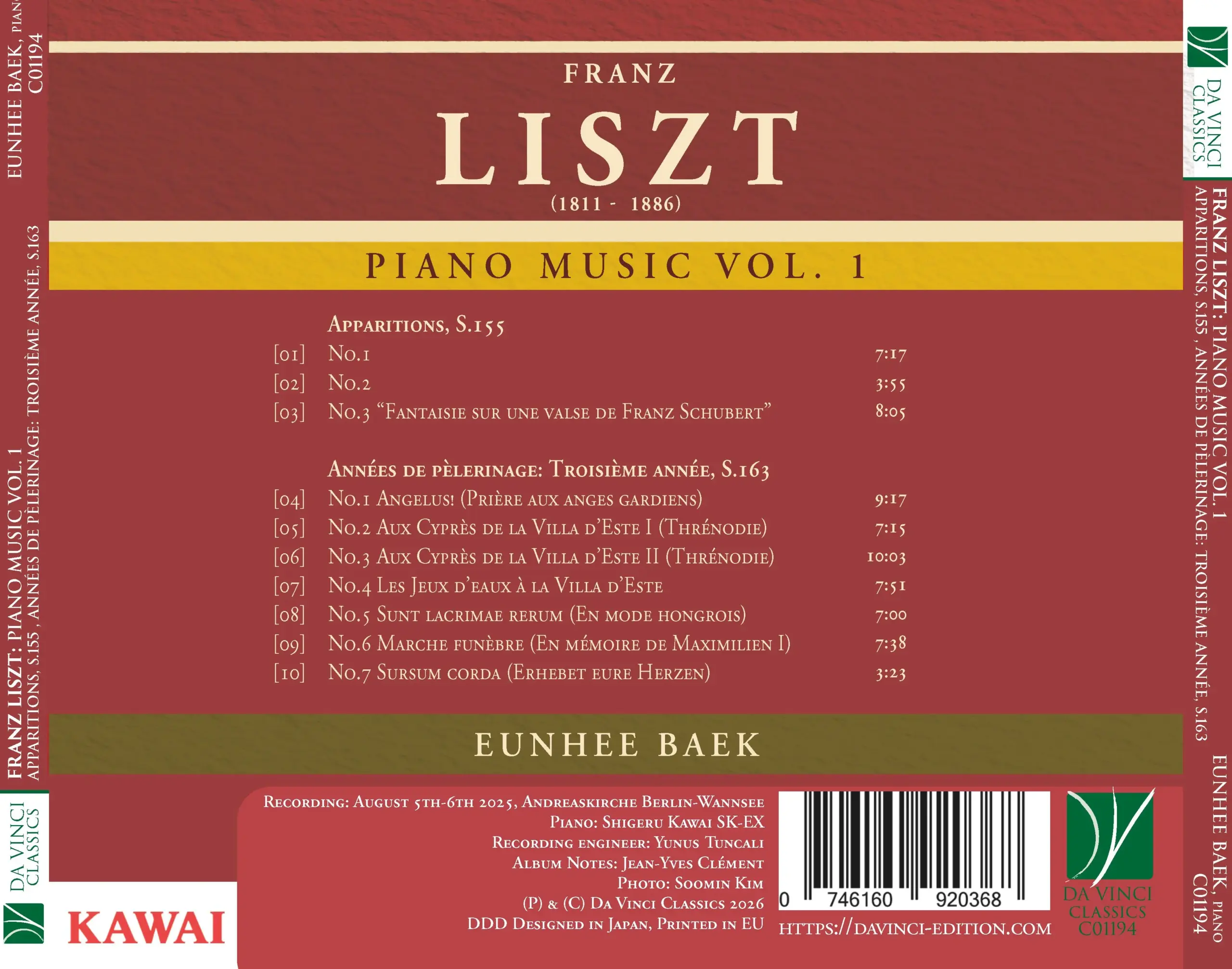
This approach is immediately apparent in the opening Apparitions. The first, really little more than a recorded improvisation, unfolds in this reading as a dream still inventing itself: vaguely outlined, almost impressionistic, until an Italian-tinged barcarole melody suddenly steps forward clearly, only to dissolve again into harmonic mist. The second Apparition, a fleeting musical fantasy of barely a few minutes, tumbles past like a surge that cannot be held back. Only in the concluding Schubert fantasy does Baek really let her fingers loose, without ever betraying the capricious, improvising spirit of the whole.
Forty years later – and that is the true journey this CD undertakes – little remains of that sensual surrender. The faith, shared with Carolyne von Sayn-Wittgenstein, pervades the late Liszt, and Baek senses that infallibly without ever laying it on thick. In There are Tears for Things and the Funeral March – two meditations on death, one dedicated to the fallen Hungarian patriots of 1848-49, the other to the murdered Emperor Maximilian of Mexico – her playing sounds austere, almost ascetic, as if every superfluous note would be a betrayal of the mourning beneath it. It is Liszt at his darkest, and Baek resists the temptation to make that darkness more beautiful than it is.
Between this darkness stand the two Cypress-pieces and the Jeux d'eaux à la Villa d'Este, and it is precisely there that this recording shows its heart. The Cyprès pieces, inspired by the centuries-old cypress trees of the Villa d'Este, sound here like weathered, singing trunks – the chords lie open and wounded, as if they were already pointing ahead toward Wagner's Tristan. It is precisely on these pages that Liszt reveals himself to be most modern. The harmonic daring, the open chords and the unresolved tensions already open a window onto the musical world of Debussy, Scriabin and even Bartók, without Baek wishing to flaunt that modernity. In contrast stands the Jeux d'eaux à la Villa d'Este, one of the late, monumental high points in Liszt's pianistic oeuvre. In Baek's hands it becomes an absolute ray of light: the water ripples, sparkles and splashes apart, while the famous reference to John 4:14 – about the living water that wells up unto eternal life – becomes almost audible. Salvation rarely sounds so natural, so unstudied or sought.
L'Angelus and the concluding Lift Up Your Hearts, which frame the album, reveal a Liszt who has shed all excess. Baek lets the distant bells of L'Angelus fade away with a restrained emotion that does not tend toward sentimentality, and in Lift Up Your Hearts she finds precisely the right balance between trumpet fanfare and inner conviction – not triumphant fireworks, but a quiet, almost timid faith that nonetheless knows how to rise up.
The recording quality also contributes significantly to the persuasiveness of this recital. Da Vinci Classics opts for a warm, natural piano sound in which no detail is lost. The dynamic nuances of Baek's playing remain completely intact, while the hushed passages are also given ample space to retain their tension.
The programmatic concept is perhaps the greatest merit of this CD: the selected works form no mere anthology of familiar Liszt pages, but a carefully constructed spiritual biography in which the listener witnesses step by step a composer who increasingly directs his gaze inward – from the unrestrained ecstasy of the young lover to the resigned introspection of the old master. It is a journey that demands attention, silence in the room, the switching off of everything that distracts – but those who make that effort are amply rewarded. An intense, thoughtful and genuinely moving homage to a composer for whom the piano, as Jean-Yves Clément aptly writes, remained a confessor to the end.