
When leek stumps are used to perform a little dance, we know we're dealing with nothing less than contemporary classical music. Add video technology, artificial intelligence, alternative instrumentation, minimalism, and a generous helping of gender issues, and the contours of new classical music come sharply into focus. An overview of a Transit weekend in Leuven, where listeners also became spectators.
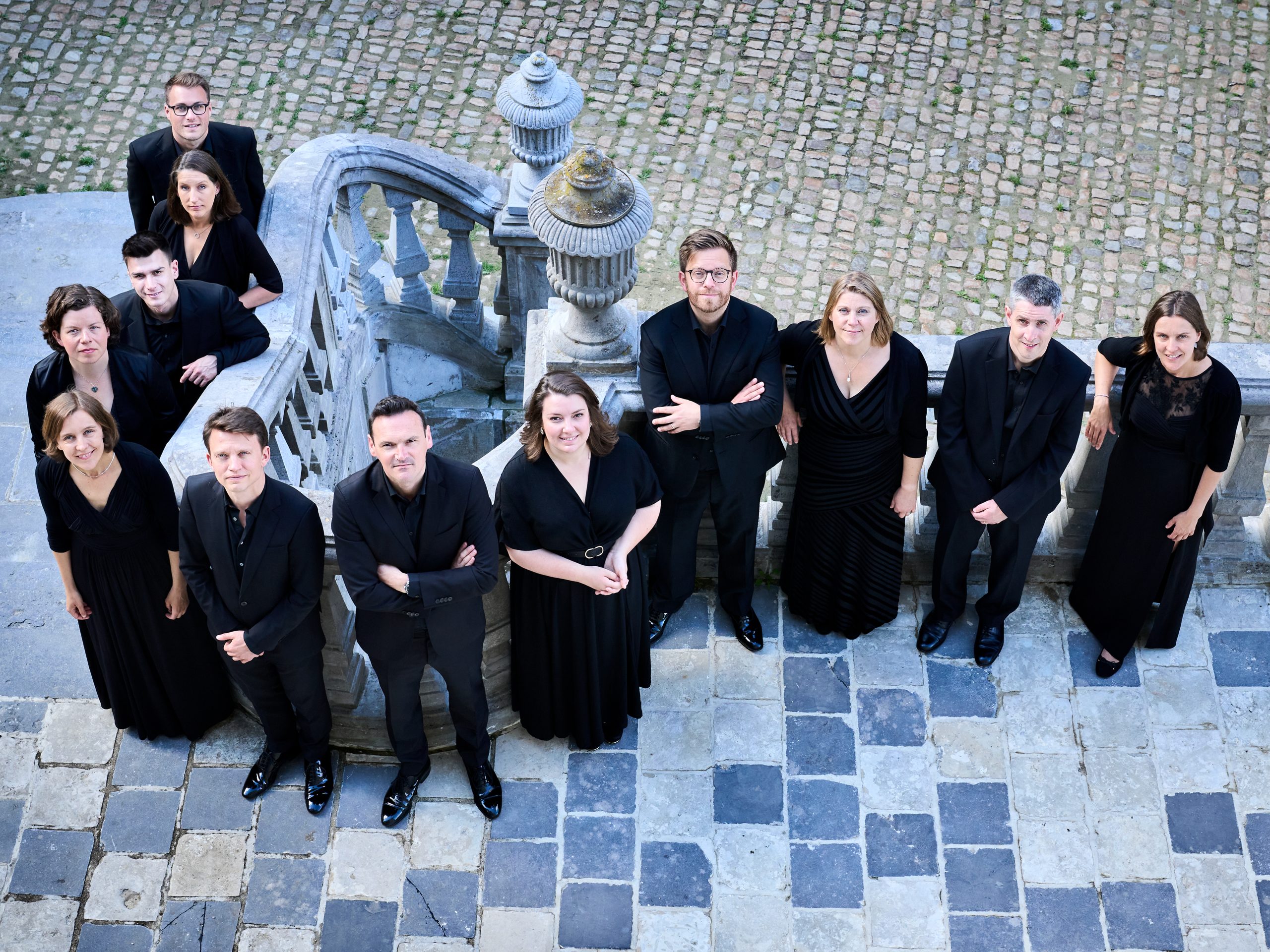
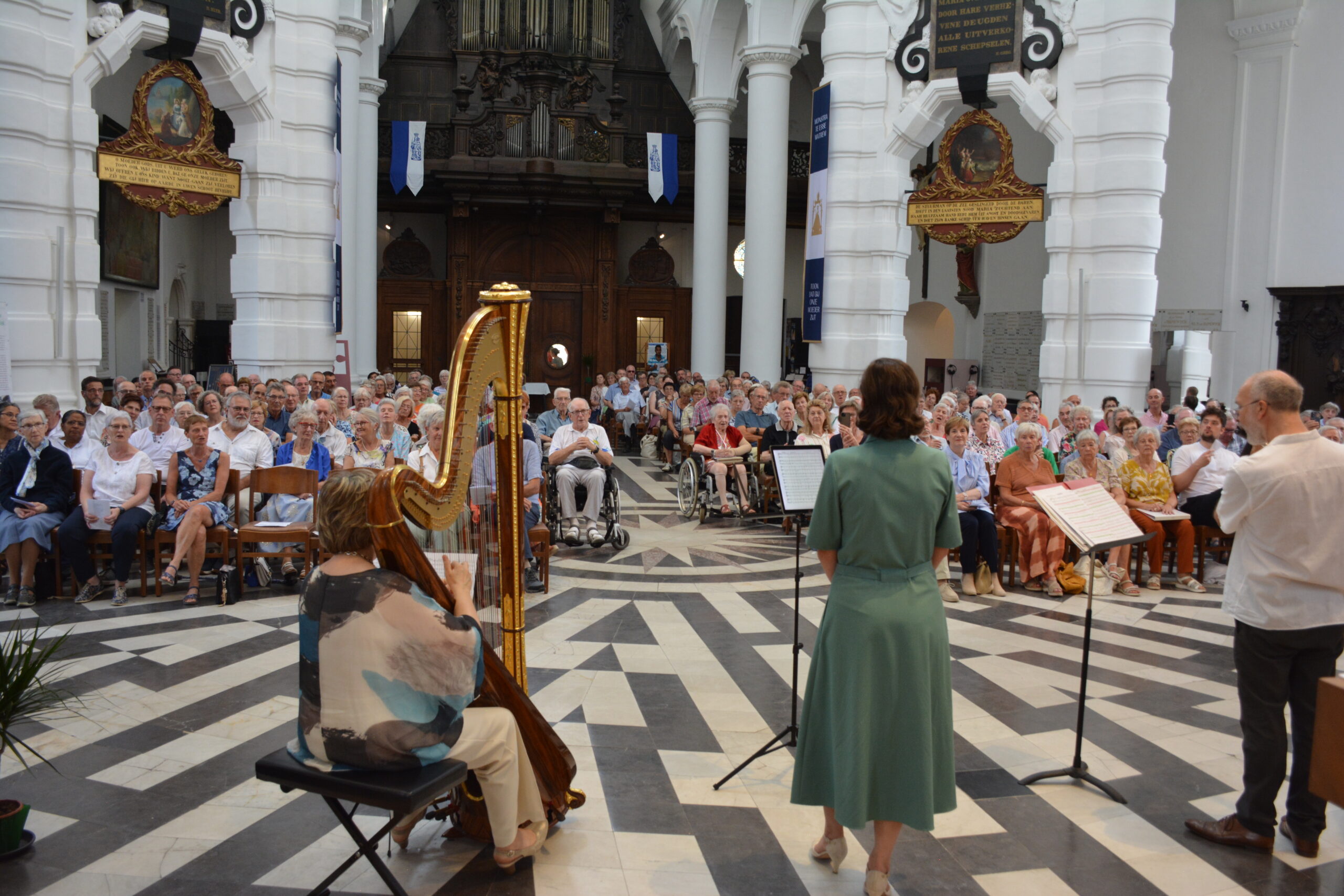
German composer Michael Beil surprised with his painterly composition Hide to Show in which a fairy tale is told about the paradoxical roots of loneliness – communication technology and social media. Beil's compositional technique steers clear of musical development. His structure consists of scrolling through a nervous sequence of scenes and memes that constantly repeat, reformulate, vary, circulate, and mutate. A stroke of genius is the staging. Eight musicians (from Nadar Ensemble) are arranged in a row of six blindfolded (changing) booths. When the blinds are open, spectators see how they play – each on their own, yet in harmony. And they dance, change costumes, let loose, freeze. When the blinds are closed, they serve as projection screens for recordings made by two (live) video cameras. And sometimes the blinds are only half-closed so that reality and virtuality merge. The result is called hyperreality. The burning question is what is hidden and what isn't. That constant confusion perfectly mirrors communication on social media, where it's equally unclear who or what you're dealing with.
The richness of Beil's composition lies in a colorful fairytale-like cross-pollination of video and music. This means that listeners are also spectators. The music is both acoustic and electronic with tape, all with a light texture, under Japanese, Russian, American, and European influences. He also makes functional jokes like dancing with fresh leek stumps. The costumes feature childlike patterns in bright colors. The wigs are blonde or turquoise. Sometimes all the musicians wear glasses, sometimes they don't. It's a costume party in which adults enthusiastically hop back to their childhood. The atmosphere is mostly playful, sometimes clubby or hip, and then challenging and yearning, as in a midsummer night's dream. Nadar Ensemble, for whom Beil wrote this piece, and Hide to Show seem like two hands on one belly. They sense each other perfectly. The fact that a combination of music, movement, mimicry, and gesture almost naturally clicks together doesn't happen often. That can only come off after an intense rehearsal process that results in playing from memory, as Nadar demonstrated. It was a convincing concert that offers perspective on further development of a new musical style in which video and technology provide concrete and balanced added value. That this combination can meet a need was also evident from the presence of families with children. There were even groups of children who tried out a few of the dances after the concert on a windy courtyard. So there is hope.

© Evy Ottermans
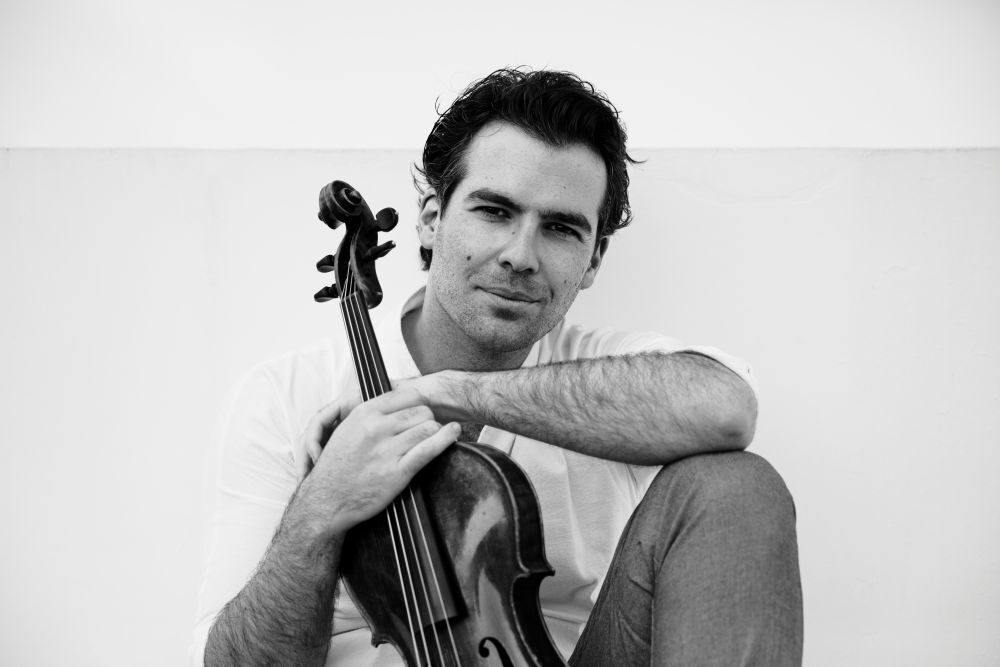
But the success of Hide to Show doesn't mean that the use of fixed structuring elements has had its day. Ancient and ever-new are the attempts to capture music in mathematical models. Since Aristotle laid the foundation of harmonic theory with his theory of the planetary spheres, the desire for systematicity has never let go of us. American composer Tom Johnson (b. 1939) has been busy for years with mathematical block designs in which counting is central. Pianist Daan Vandewalle played his composition Solutions (9, 3, 2), a world premiere. Johnson unpacks 36 systems of nine notes and puts them back together, albeit with variations like descending sequences, open and closed chords, bare melodic lines, note reduction, very slow to slightly faster tempi, long and short rests, louder and softer, fugal, sharp, legato, or bone-dry. Vandewalle is a master of nuance. As the tempo drops and fewer notes are played, a slip in the touch or a microsecond too long a rest is audibly punished mercilessly. Despite these risks, Vandewalle proved to be on solid ground – it certainly didn't sound mathematical, thankfully.
© Evy Ottermans
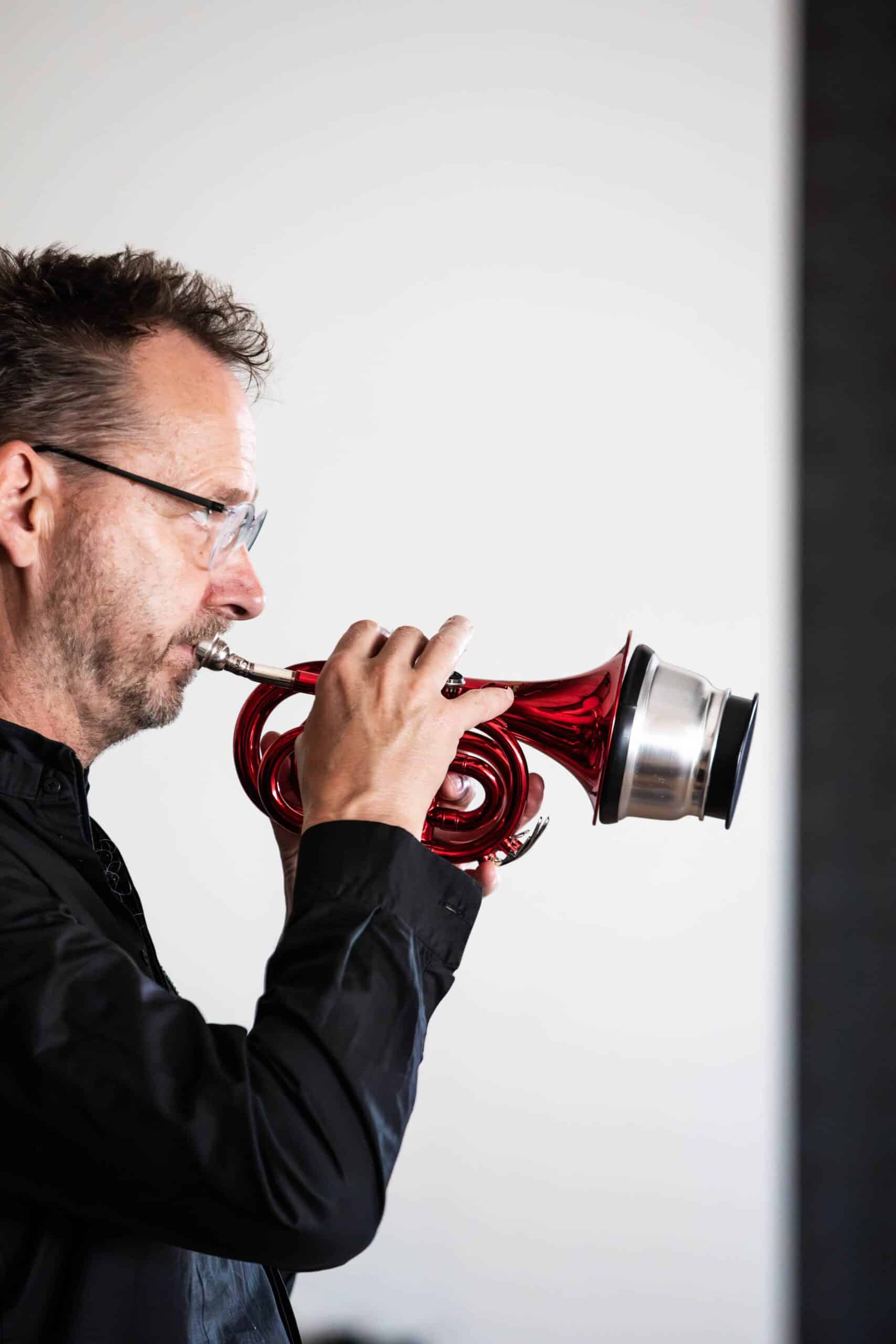
On the instrumental front, Dutch brass player Marco Blaauw brought a refreshing innovation. In the composition O.M. Rising by British composer/cellist/activist Ayanna Witter Johnson, he used a bright red pocket trumpet with a matching pocket megaphone to both muffle and amplify. A striking piece in which a single voice speaks out against racial and gender inequality – sober, thought-provoking and therefore effective. Gender issues also came up in the premiere of Counterforces by Flemish composer Frederik Croene. To a text by Dominique De Groen, Amina Osmanu, Lore Binon and IKRAAAN sang about the earthly and social power of women, mirrored against the dubious role that men have played in bringing about change in the world. Background was provided with repetitive interventions by composer Frederik Croene on piano and with tape (monotone motorcycles and grinding wheels). On the instrumental side, not much happened in Counterforces. That doesn't need to happen either, especially since the piece is carried by the text. However, the balance between the sung and instrumental sections was largely off, which meant much of the text was lost. Moreover, there were no surtitles.
Another line is the continuation of the rehabilitation of tonal writing. At Transit there were two examples of young composers writing in (expanded) tonality. For several years now, tonality is no longer a taboo. The days when a composition student wouldn't dare leave the house because he was working on a tonal piece are at least a decade behind us. Ensemble Klang, a sextet of musicians that plays without a conductor, ventured into two new pieces by Maya Verlaak and Jesse Broekman. By Verlaak was Conditions performed, a composition of floating harmonies, with the musicians distributed across the ends of the hall. This shifted the perspective from the traditional static one-way traffic from the stage to a spatial experience, comparable to a journey through the cosmos. With this, Verlaak seems to have embarked on a new path. She is known for playful compositions in which technology and auditory humor play a leading role. With Conditions she now adds a contemplative element to her oeuvre.
Klang also performed will it last like this for a long time, you askeda striking creation by Jesse Broekman. In this meditative piece, the leading role was played by percussionist Joey Marijs. With his tender treatment of specially cut aluminum plates, he brought a quiet power of Asian scents and textures into the hall. Sometimes his plates sounded like a gamelan, sometimes like bells. Pianist Saskia Lankhoorn referenced with her prepared piano John Cage, who wrote much of that genre around 1940. She caressed the incense sticks placed between the strings so smoothly that it approached a drone . With their new compositions, Verlaak and Broekman have found a tonal language that, as it turned out, feels quite at home via saxophones and electric guitar in a non-classical setting.
© Evy Ottermans
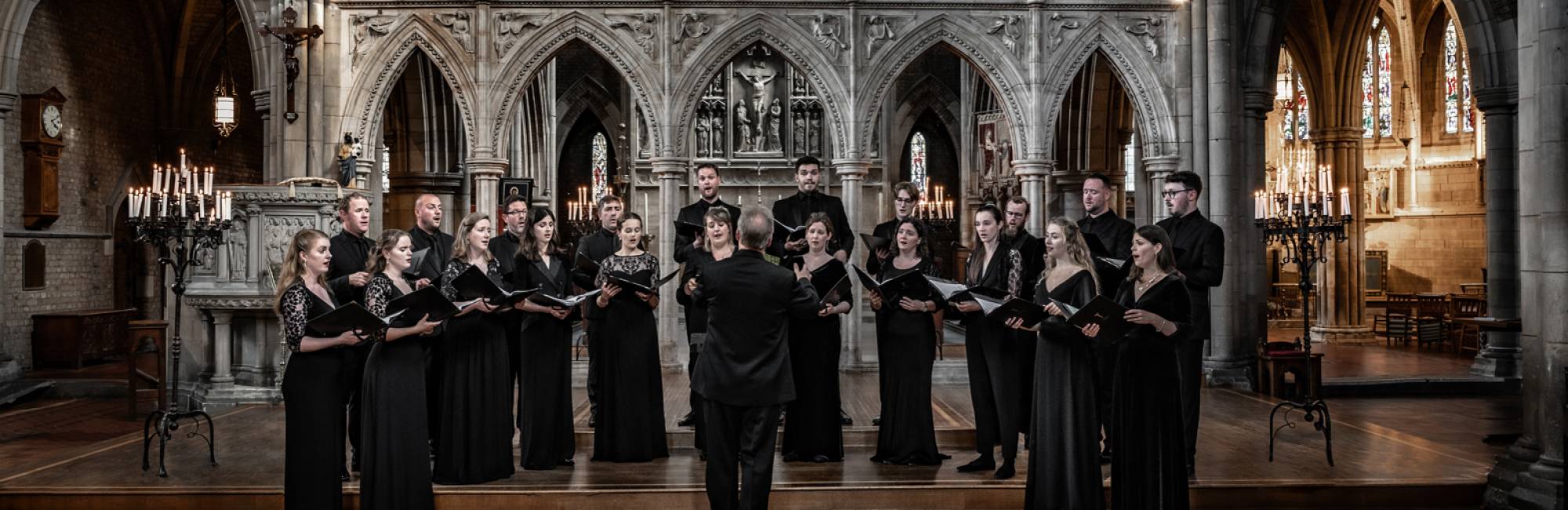
That listeners had to take on a dual role as spectators with much new music became evident in the composition They are not gods, those made by hand for six voices and six musicians from the Italian duo Mauro Lanza and Claudio Panariello. There was plenty to see in the performance by Spectra Ensemble and HYOID Voices. After a long opening drone texture, the vocalists proved themselves versatile, whistling through bottle openings, playing recorders and deploying harmonicas. The title ("They who are made by hand are not gods") refers to artworks created by artificial intelligence—thus not by human hands. This composition draws on passages from one of the iconic masses by Guillaume Dufay (1397-1474), of which ten different versions were used to create algorithms that generated new material. All of this resulted in a solidly constructed vocal and musical narrative, beneath which lay a virtuosically woven tapestry of AI art.
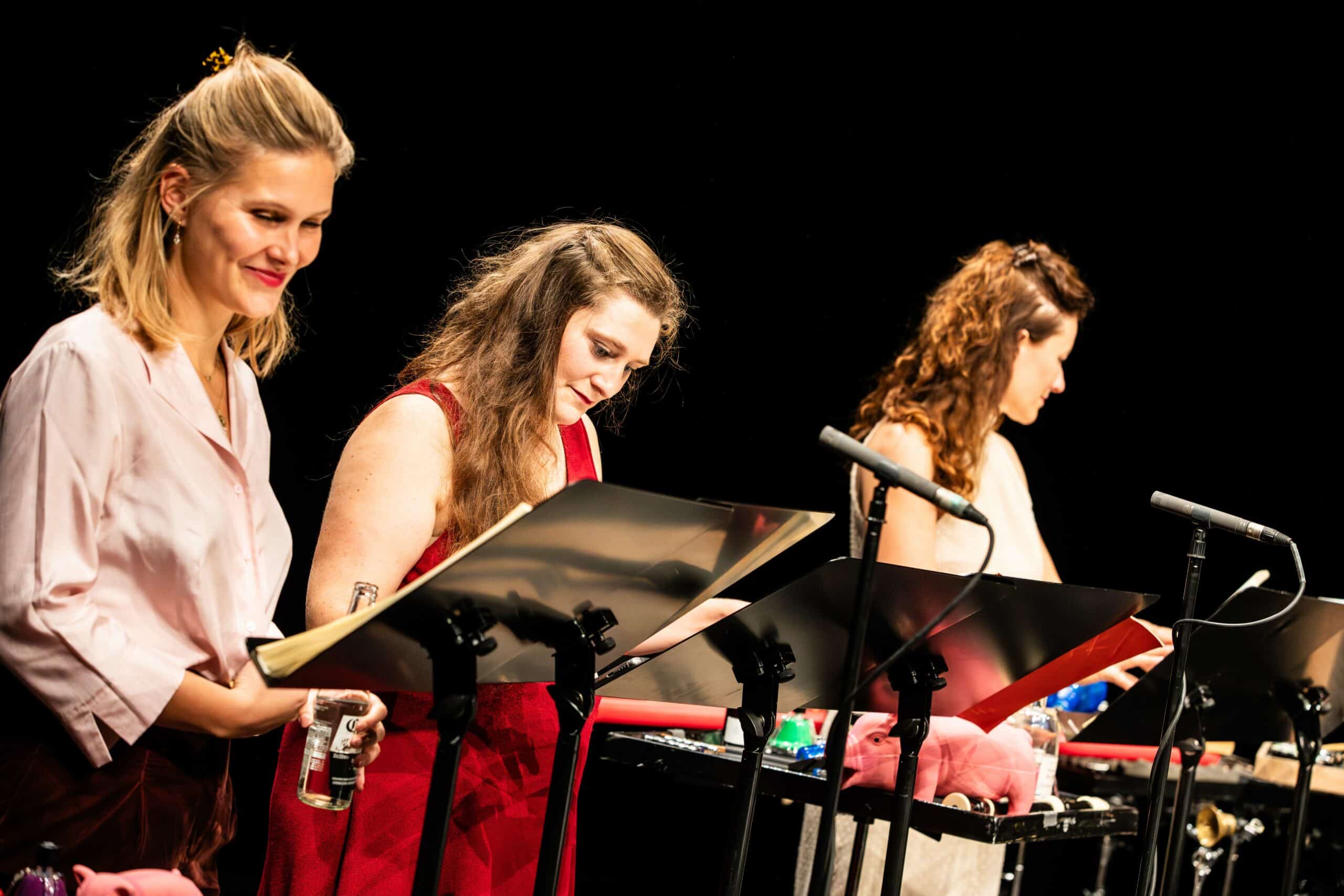
Disjecta Membra ("scattered limbs") by Mauro Lanza for six voices, alludes through quotations to the catalog of limbs in the seven cantatas by Dietrich Buxtehude (1637-1705) but is now connected with a parody about slaughtering a pig. Here too, the vocalists regularly colored outside the lines: a tissue of vowels was alternated with jabs on the harmonica or squeaks from a plastic toy pig. Whistled tunes transported the spectator to the routine of the slaughterhouse. The broad and elegant arm gestures of conductor Filip Rathé and the expressive way the singers turned the pages of their scores completed the visual spectacle.
WHAT: Transit – open mind, open ears
WHERE: STUK, Leuven
SEEN: October 20-22, 2023