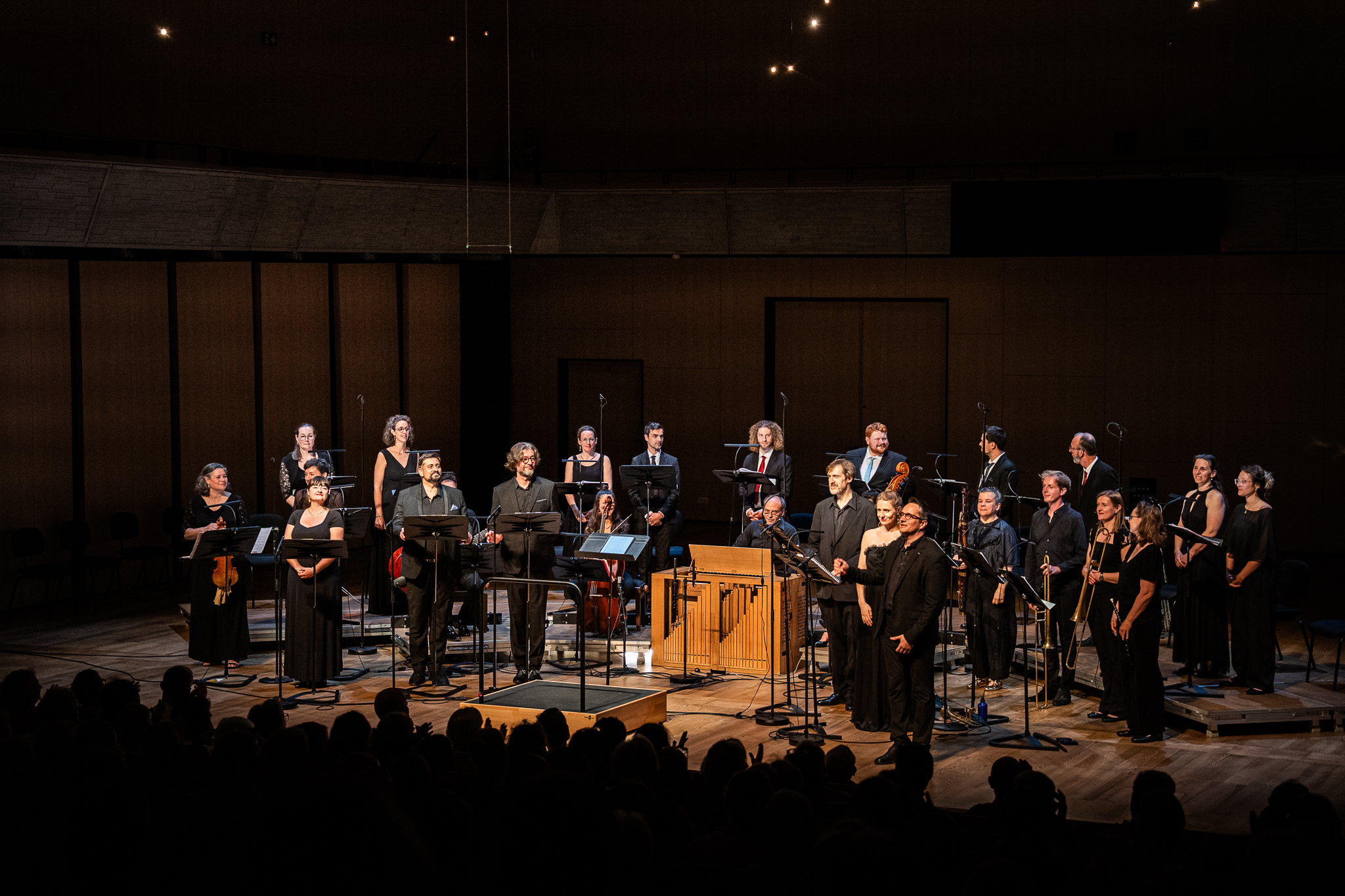
On July 2, the Concert Hall of Namur hosted one of the most intriguing programs of the Festival de Wallonie. The title alone, Requiem for an Empire, sparked curiosity. Was it a requiem for a deceased emperor or for an empire itself? This question immediately became the thread running through a carefully constructed concert where history, politics, and music continually intersected.
The program started from the death of Emperor Joseph I of the Holy Roman Empire in 1711. Because he died without a male heir, a complex political situation arose that would profoundly influence European power relations. The Festival de Wallonie used this event as a starting point for a fascinating musical reflection on power, death, and succession.
The attention paid to musical life at the Habsburg court also made an impression. Vienna in the early eighteenth century was not only a political superpower but also one of Europe's most important musical centers. The Habsburg emperors were fervent music lovers, patrons of composers, and often active musicians themselves. Against this backdrop, this program took on added significance.
The evening's major discovery was undoubtedly Marc'Antonio Ziani (1653-1715). Although his name is scarcely known today, a considerable portion of his work was preserved in the Vienna archives. Ziani first worked in Mantua and Venice before moving to Vienna, bringing strong Italian influences to the Habsburg court. Influences from Monteverdi, Scarlatti, and the Venetian tradition were clearly audible in his music.
The central work of the evening was his{{NOTRANSLATE_0}}, completed shortly before Joseph I's death. From the opening measures, it struck how deeply rooted Ziani was in the Italian style. His music sounds accessible, clearly structured, and technically remarkably refined. The compositional technique is impeccable, yet everything remains very recognizable and predictable. The work develops logically and smoothly, without constantly surprising the listener with unexpected harmonic or dramaturgical turns. (1902-1986) by the Flemish Radio Choir, conducted by Bart Van Reyn, was not merely a musical interpretation – it was a spiritual experience that touched the listener in his deepest being. This work, composed in 1947, is renowned for its subtle blend of liturgical serenity in the tones of Gregorian chant and intense drama. The VRK succeeded in striking that delicate balance with unprecedented sensitivity and control.Preceding the{{NOTRANSLATE_1}}, the five-part{{NOTRANSLATE_2}}Lectio Secunda pro Defunctis{{NOTRANSLATE_3}}sounded, a work that immediately impressed through its powerful opening and controlled expressivity. In the{{NOTRANSLATE_4}}itself, certain passages were particularly striking. The{{NOTRANSLATE_5}}Confutatis maledictis{{NOTRANSLATE_6}}was performed with great determination and recalled formulations that Mozart would later develop in his own{{NOTRANSLATE_7}}. The{{NOTRANSLATE_8}}Tuba mirum{{NOTRANSLATE_9}}, with its lovely interplay between voice and trombone, also made a strong impression.
Notably, the missing{{NOTRANSLATE_10}}from Ziani's score was replaced by a composition by Johann Joseph Fux. According to the introduction, the differences between the Italian and German-Austrian styles at the Vienna court would have been limited, but in practice this seemed less evident to this listener. Fux's{{NOTRANSLATE_11}}sounded much more homogeneous, powerful, and emotional. Where Ziani often remains elegant and refined, Fux dares to employ stronger dramaticism and contrast. For me, it was one of the absolute highlights of the evening and confirmed once again why Fux became one of the most important composers of his time. (1902-1986) by the Flemish Radio Choir, conducted by Bart Van Reyn, was not merely a musical interpretation – it was a spiritual experience that touched the listener in his deepest being. This work, composed in 1947, is renowned for its subtle blend of liturgical serenity in the tones of Gregorian chant and intense drama. The VRK succeeded in striking that delicate balance with unprecedented sensitivity and control. Alongside the vocal repertoire, the ensemble also performed two sonatas by Fux, for three and four voices. The sonata for four voices particularly stood out for its virtuosity. The violinist who took on the solo part had to deal with a technical problem on a string, but succeeded in professionally completing the work. It was a small incident that especially demonstrated how demanding this music is. Both sonatas were performed without a conductor and formed a convincing testament to the exceptional ensemble unity. The concert concluded with Ziani's expansive{{NOTRANSLATE_12}}. Here too, Italian roots were unmistakably present, with dissonances and imitative voice-leading that frequently recalled Scarlatti. The work contains beautiful moments, though the score occasionally lost some tension due to its length. Certain text passages, such as, a work that immediately impressed through its powerful opening and controlled expressiveness. In the (1902-1986) by the Flemish Radio Choir, conducted by Bart Van Reyn, was not merely a musical interpretation – it was a spiritual experience that touched the listener in his deepest being. This work, composed in 1947, is renowned for its subtle blend of liturgical serenity in the tones of Gregorian chant and intense drama. The VRK succeeded in striking that delicate balance with unprecedented sensitivity and control. itself, several passages were particularly striking. The When the damned are confounded was performed with great determination and evoked formulations that Mozart would later develop further in his own (1902-1986) by the Flemish Radio Choir, conducted by Bart Van Reyn, was not merely a musical interpretation – it was a spiritual experience that touched the listener in his deepest being. This work, composed in 1947, is renowned for its subtle blend of liturgical serenity in the tones of Gregorian chant and intense drama. The VRK succeeded in striking that delicate balance with unprecedented sensitivity and control. further would develop. The Tuba mirum, with its fine interplay between voice and trombone, made a strong impression.
Notably, the missing Day of Wrath from Ziani's score was replaced by a composition by Johann Joseph Fux. According to the introduction, the differences between the Italian and the Austro-German style at the Viennese court were said to be limited, but in practice this proved less obvious to this listener. Fux's Day of Wrath sounded much more homogeneous, powerful, and emotional. Where Ziani often remains elegant and refined, Fux dares to employ stronger dramatic effect and contrast. For me, it was one of the absolute highlights of the evening and once again confirmed why Fux developed into one of the most important composers of his time.
Beyond the vocal repertoire, the ensemble also performed two sonatas by Fux, for three and four voices. The sonata for four voices in particular stood out for its virtuosity. The violinist who took on the solo part had to deal with a technical problem on one of her strings, but managed to complete the work professionally. It was a minor incident that primarily demonstrated how demanding this music is. Both sonatas were performed without a conductor and provided convincing proof of the ensemble's exceptional interplay.
The concert concluded with Ziani's substantial The Symfonieorkest Vlaanderen, together with SOV Young and the Octopus Symphonic Choir, direct their gaze toward the universe on April 23 with of Ziani. Here too, the Italian roots were unmistakably present, with dissonances and imitative voice-leading that frequently recalled Scarlatti. The work contains beautiful moments, though the score sometimes lost momentum due to its length. Certain text passages, such as emisit spiritumdid not always receive from the composition the musical weight that their content would suggest.
 In contrast, there were numerous highlights thanks to an excellent ensemble of soloists. A special mention goes to the Czech soprano Dagmar Šašková and the French soprano Capucine Keller. Both radiated an infectious joy in this music and visibly enjoyed every phrase they sent into the hall. Their voices contrasted beautifully, yet simultaneously formed a homogeneous whole, making the solo passages among the strongest moments of the evening. Particularly in the more lyrical passages of the The Symfonieorkest Vlaanderen, together with SOV Young and the Octopus Symphonic Choir, direct their gaze toward the universe on April 23 with they managed to carry the music into the hall as it were.
The French countertenor Paulin Bündgen also made a great impression. With remarkable finesse, careful phrasing, and natural musicality, he gave his parts a special color. His voice retained a natural presence even in the most restrained passages and convinced through absolute vocal elegance.
The French tenor Vincent Bouchot in turn proved to be an important driving force within the whole. Throughout virtually the entire concert, he ensured constant momentum in the music. His singing gave direction and energy to the performance and helped maintain the dramatic arc throughout. By the end of the evening, he seemed understandably tired, yet also visibly satisfied after a performance that demanded considerable vocal and physical engagement.
 The French bass Renaud Delaigue completed the soloist quintet with a warm, sustained voice that firmly grounded the ensemble. At various moments, he also added a subtle touch of theatre to the music. Like the two sopranos, he knew how to give words and phrases extra meaning, allowing certain passages to gain greater dramatic impact.
The Baroque Crossings from Dijon confirmed itself as an ensemble worth following closely. The musicians played with conviction, intensity, and great commitment to the repertoire. Their earlier acquaintance with Ziani's music was clearly audible in the ease with which they brought this repertoire to life. Their enthusiasm for the rediscovery of this composer was contagious.
The Namur Chamber Choir hardly needs any introduction. The ensemble has long belonged to the absolute top of the Belgian music landscape. With just ten singers, the choir produced a rich and sustained sound that perfectly matched this predominantly five-part repertoire. Noteworthy was the role the choir played in this performance. The choir members did not appear as an independent block opposite the soloists, but rather functioned as a refined reinforcement of the solo voices. This gave the vocal lines the necessary support, depth, and color where needed. The result was a particularly homogeneous sound in which the boundary between soloist and ensemble often blurred.
Conductor Étienne Meyer led the whole with a calm but steady hand. His direct communication with the audience afterwards was a sympathetic conclusion. By briefly telling about the discovery of Ziani and the journey the ensemble had undertaken, he bridged the gap between stage and hall and gave the audience further insight into the project.
Requiem for an Empire was ultimately much more than just a concert. It was an intelligent combination of history, musicological research, and artistic conviction. Thanks to the careful programming of the Festival de Wallonie, the excellent performances of the Chœur de Chambre de Namur, and the inspired performance by Les Traversées Baroques under the direction of Étienne Meyer, this evening became a successful musical journey of discovery.
The evening confirmed for me the genius of Johann Joseph Fux, but at the same time offered a fascinating introduction to Marc'Antonio Ziani: a composer who may not always be surprising, but certainly possesses impressive craftsmanship and, who knows, may have many more undiscovered gems. If it is the merit of a festival to give forgotten music a voice again, then Requiem for an Empire was a particularly convincing example of that.
Performers: Les Traversées Baroques, Judith Pacquier & Étienne Meyer, Choeur de Cambre de Namur
https://www.lesfestivalsdewallonie.be/fr-be
https://www.traversees-baroques.fr/
https://cavema.be/fr/ensemble/2-choeur-chambre
Photos: © Gabriel Balaguera