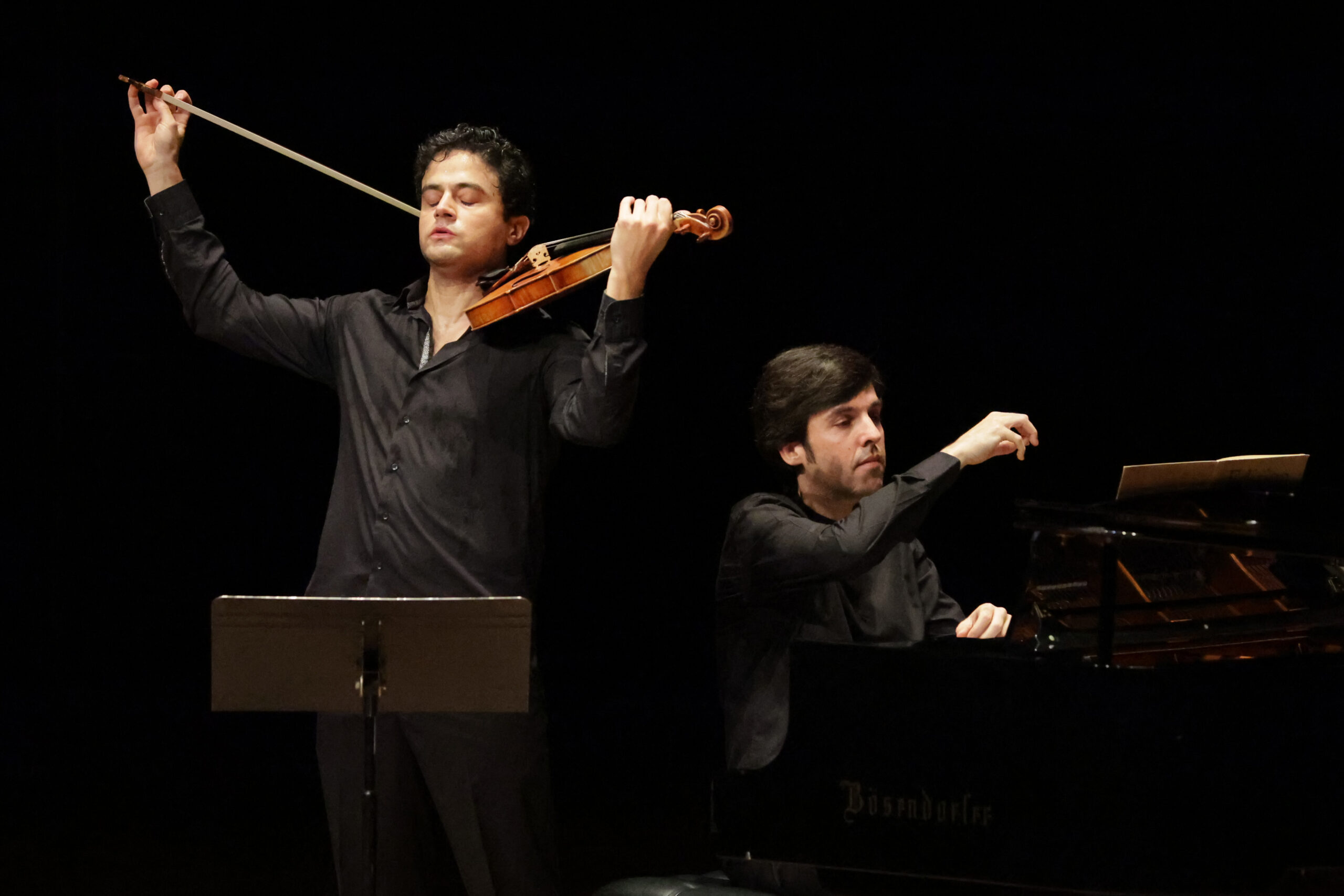
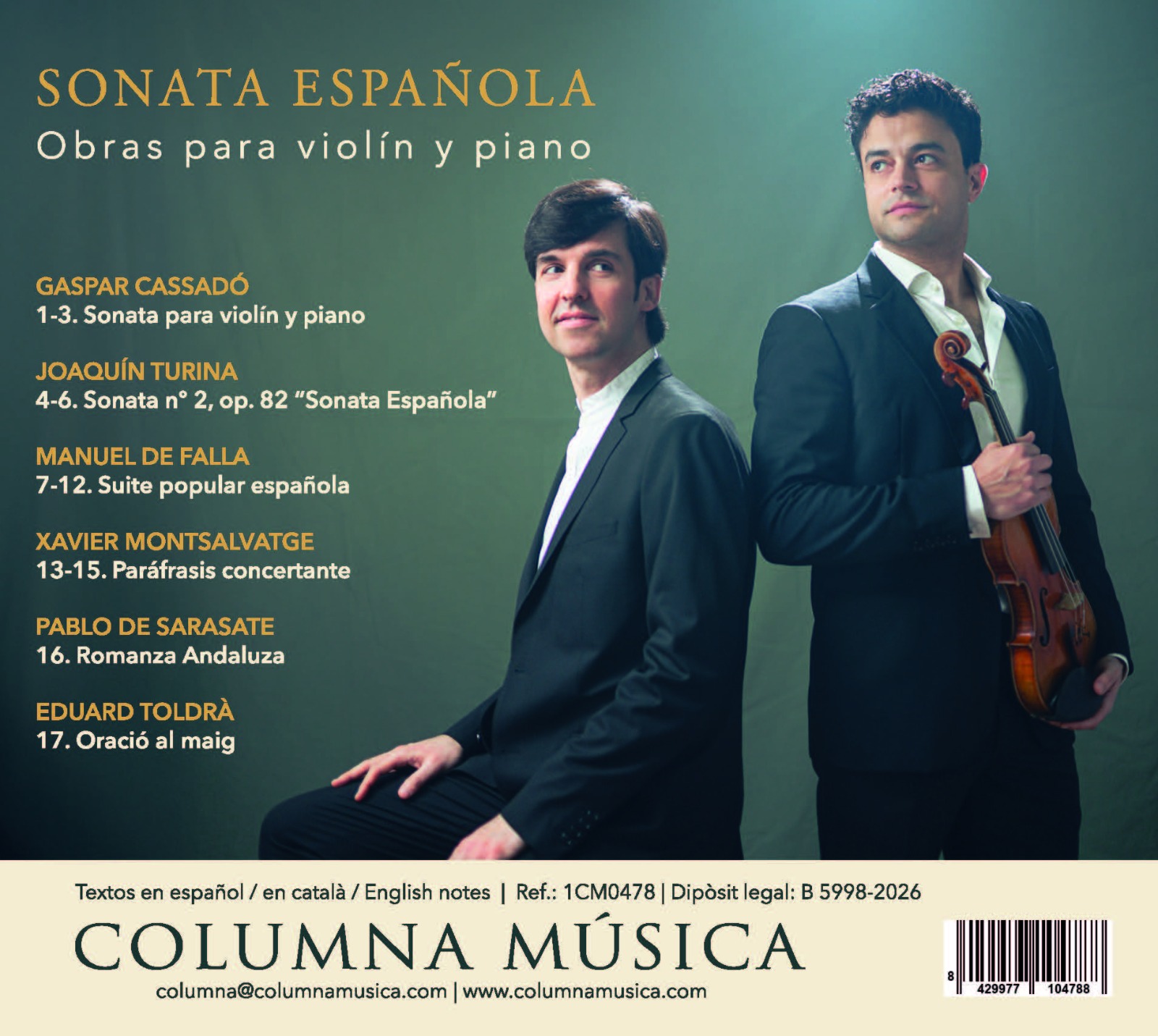
With Spanish Sonata violinist Alberto Reguera and pianist Marc Piqué present not a sunny collection of Spanish clichés, but a carefully constructed musical portrait of a country that knows as much shadow as light. In works by Cassadó, Turina, de Falla, Toldra, Sarasate, and Montsalvatge, a richly nuanced world unfolds in which folk music, modernism, melancholy, and refinement continually flow into one another. The album breathes Mediterranean warmth, but equally introspection and dramatic tension. For Klassiek Centraal, Werner De Smet spoke candidly with Alberto Reguera and Marc Piqué about the artistic vision behind the project, about beauty as an artistic necessity, and about the search for an authentic Spanish sound beyond folkloric trappings.
A musical affinity
The collaboration between Reguera and Piqué arose almost by chance. Both musicians had been moving in the same professional circles for some time, but only during their first joint session did they discover how naturally their musical dialogue felt. "From the very first moment we felt a strong musical affinity," Reguera explains. "We share not only a passion for the violin and piano repertoire, but also a similar way of thinking about music." However, this naturalness does not mean that the creative process unfolds without tension. Quite the opposite: it is precisely in the search for balance between expressive freedom and technical discipline that the duo finds its own identity, without losing their individual personalities. This understanding evolved remarkably quickly into a form of intuitive communication in which words became increasingly unnecessary. For them, it is precisely this intense listening to each other that is the essence of chamber music.
Spain beyond the cliché
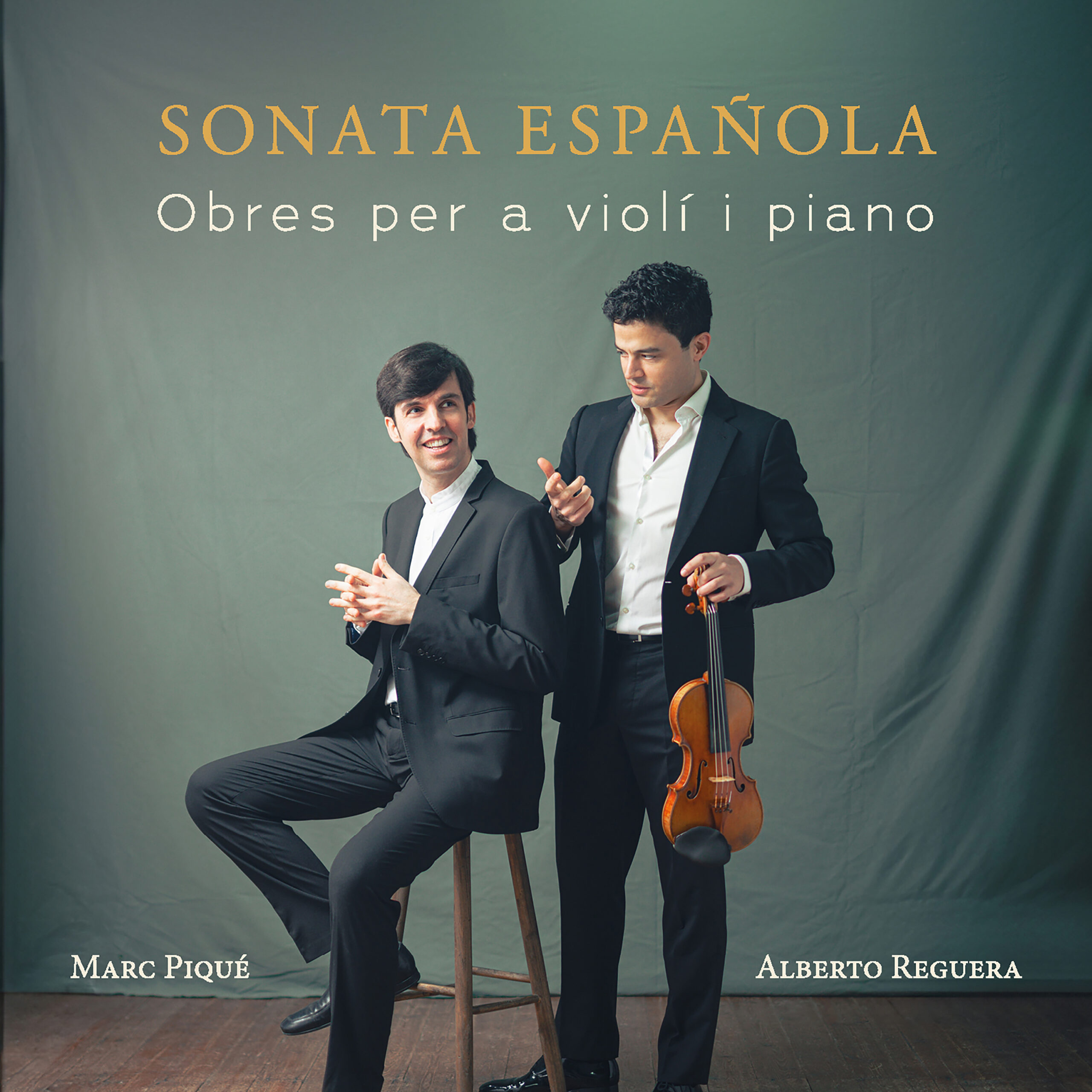 The idea for Spanish Sonata arose during a concert project in Cádiz in early last year. Together with programmer Pedro, Reguera and Piqué selected works that could form a coherent whole not only stylistically but also dramatically. What stands out is how consciously the duo distances itself from the stereotypical image of Spanish music. No casual folklore or touristic romanticism, but a far more complex musical landscape.
"Simply by choosing the works, we discovered how versatile and nuanced this music really is," says Piqué. "Each composer certainly starts from folk musical roots, but then transforms them into a very personal musical language." This constant tension between tradition and innovation forms the red thread of the album. Cassadó, Turina, de Falla, Toldra, Sarasate, and Montsalvatge belong to different generations, but according to Piqué share the same instinct: the ability to elevate folk music into a refined art form without losing its original soul.
For both musicians, the project meant even more than a discovery—it was a reaffirmation of Spain's enormous cultural richness. According to them, these composers, despite their diverse styles, share a common sensibility that stems from the same geographical and cultural foundation.
Between precision and freedom
What is striking about the interpretations on the album is the combination of technical control and great lyrical freedom. Piqué does not see this as a contradiction, but as the essence of this music. "The Spanish repertoire allows for enormous contrasts," he explains. "Those typical melodic turns, the alternation between major and minor, the Andalusian cadences: they create space for spontaneity and color." Yet the score always remains the starting point. The duo continually seeks the right balance between vitality and refinement, between rhythmic force and transparent sound culture.
The lack of an extensive recording history also played an important role. Some works, such as Cassadó's sonata, are rarely performed and have few reference recordings. Precisely because of this, Reguera and Piqué could approach this music with greater freedom, without fixed interpretative models, but always from great respect for the score and the composer's intent.
Silence also plays a crucial role. "In silence, the music breathes," says Reguera, "more than that: the drama intensifies there. Music arises not only from the notes themselves, but also from the relationship between the notes and the silence around them." This vision aligns closely with a statement by Pablo Casals, who argued that technique only gains meaning when it serves expression. Reguera fully endorses this: "Technique without musical intent ultimately remains nothing more than a coordination exercise. The desire to truly sing, to honestly communicate something, must be central. Technique is necessary to achieve freedom, but should never become an end in itself. The best technique is ultimately the one that remains invisible."
A chamber music breathing
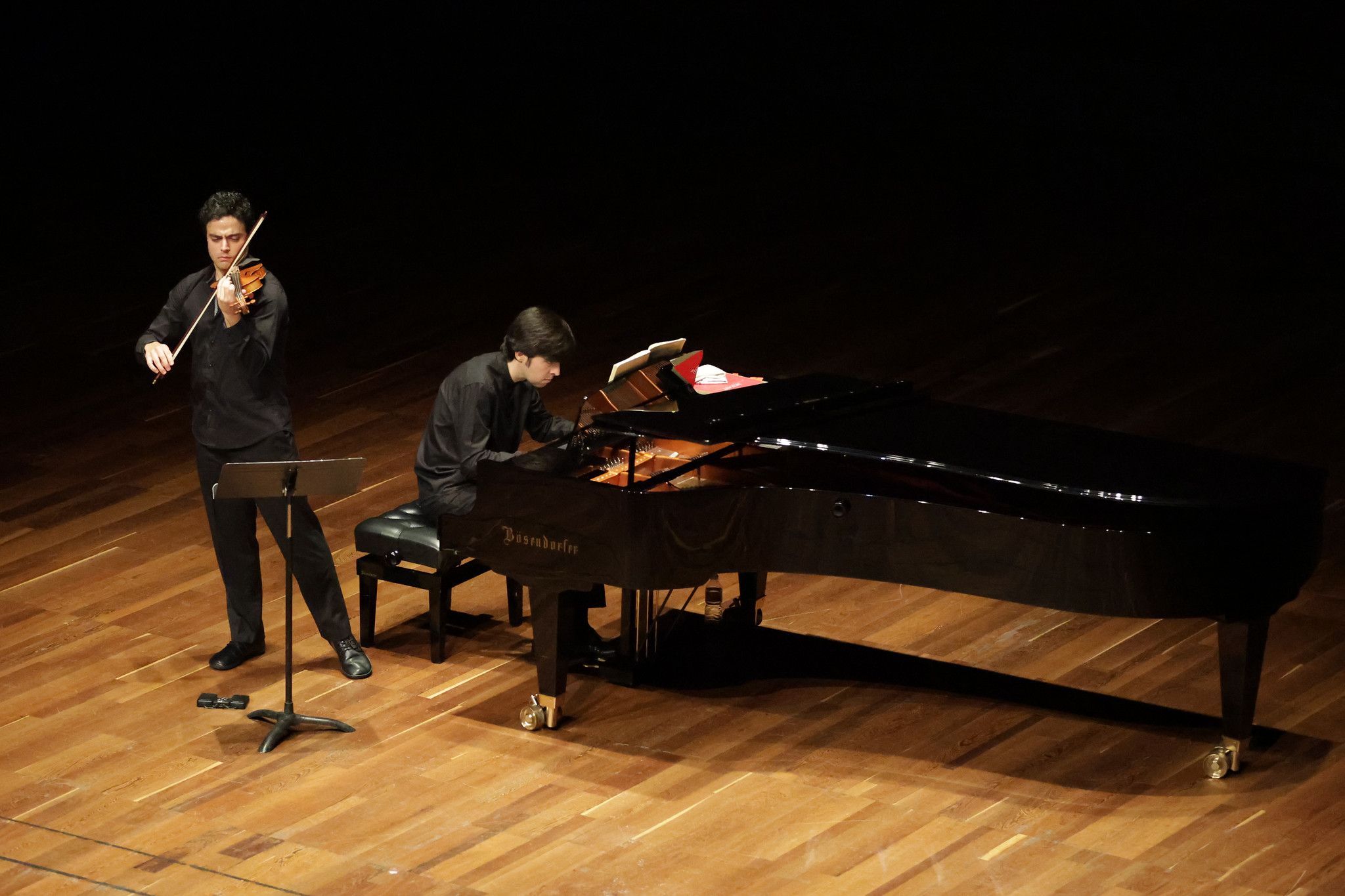 This intense listening to each other forms the core of their collaboration. According to Reguera, an almost intuitive communication developed during the album recording. "We work very intensively on the scores, but once we play together, something happens that barely needs words." The recording conditions helped considerably. In the studio of sound engineer Albert Moraleda, the duo had sufficient time and access to a Steinway grand piano of exceptional quality.
Especially during the recording of Gaspar Cassadó's sonata (1897-1966), the musicians experienced how the studio made a new balance possible. "In a concert hall, that balance is harder to achieve," says Piqué. "Here we could create an almost orchestral grandeur without losing the transparency between violin and piano."
From the beginning, the duo also consciously thought about how this music would sound in different spaces: in a small hall, a large concert hall, or a studio environment. This search for ideal acoustic balance partly determined their approach to the repertoire. At the same time, a recording process remains a mental challenge. Concentration, fatigue, and time pressure are constant concerns. "The biggest danger is that you lose freshness and spontaneity," he admits. "You have to learn to pace yourself."
Piqué emphasizes that their relationship with Cassadó's sonata evolved further during the recording process itself. Where they initially approached the work rather cautiously, gradually a greater freedom and conviction in the interpretation grew.
The Mediterranean Light of Toldràn
Within the program, Eduard Toldràn (1895-1962) occupies a special place. Outside Spain, his music is rarely performed, something Reguera finds particularly regrettable. "Toldràn possesses an exceptional instinct for lyricism," he says. "In Prayer to May you hear how a simple melody grows into an almost spiritual experience. It's as if the Mediterranean light itself becomes music."
Gaspar Cassadó also fascinates him precisely through that combination of emotional intensity and virtuosity. "His music constantly balances between fiery passion and deep melancholy," Reguera says. "Sometimes it even seems as if he wants to show too much, but that's exactly what makes his language so human." With Manuel de Falla (1876-1946), he admires the ability not only to preserve folk music, but also to transform it. "Falla is the great alchemist of Spanish music," he says. "He elevates the folk musical tradition to something universal."
Sarasate as a Bel Canto Composer
One of the most striking insights from the conversation concerns Pablo de Sarasate (1844-1908). Too often his music is reduced to mere virtuosic fireworks, whereas Reguera emphasizes precisely its vocal quality. "I see the violin tradition first and foremost as a form of bel canto," he explains. "Sarasate was a master of melody. His music has something distinctly operatic about it." In doing so, he refers to his former teacher Gonçal Comellas, who constantly repeated during lessons: "Sing, sing!"
"That quest for beauty of sound fascinates and haunts me daily," Reguera confesses. "What is nowadays sometimes called 'old school,' I prefer to call the great school."
Montsalvatge and the Modern Horizon
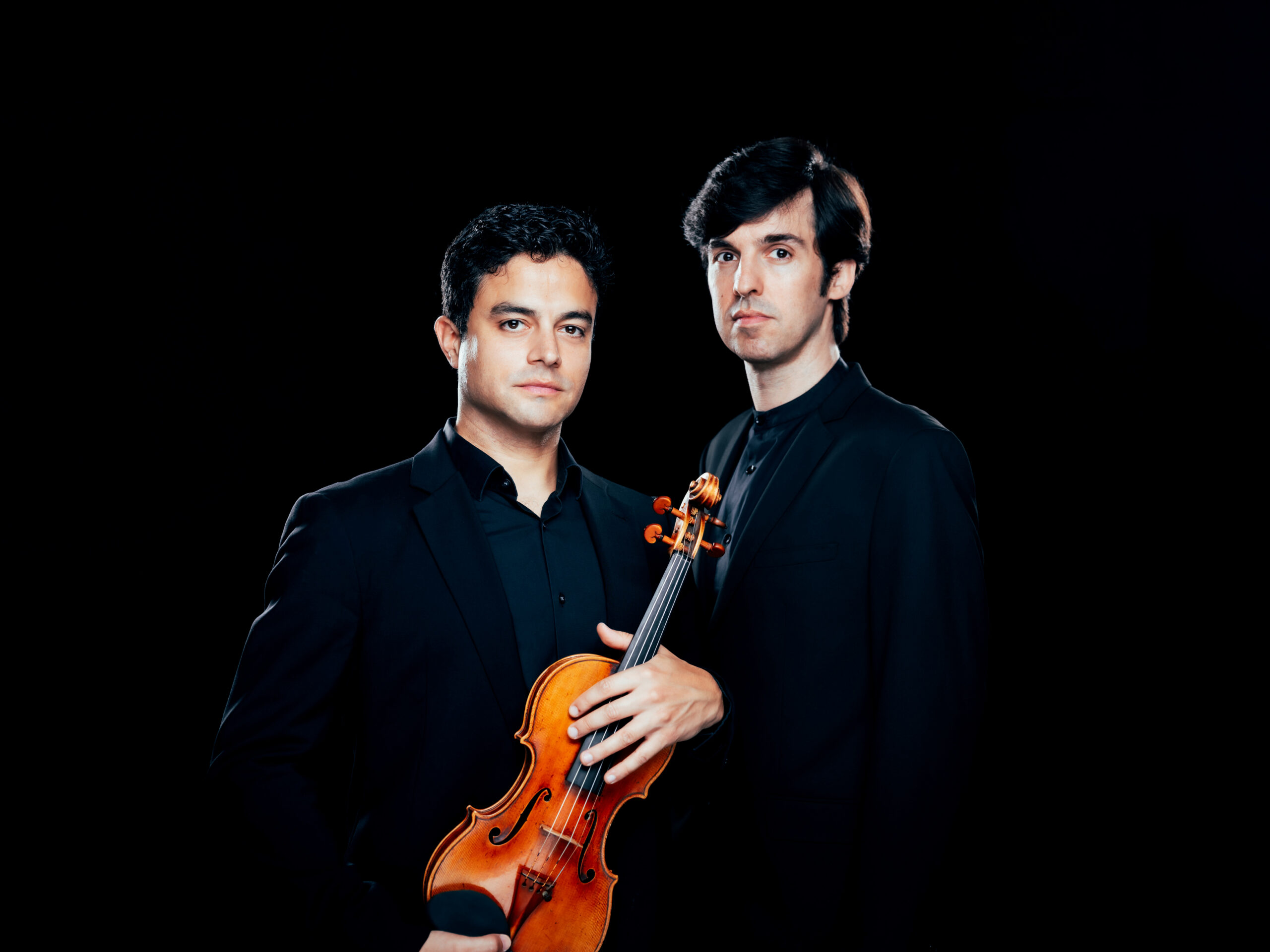 Within the dramaturgy of the album, Xavier Montsalvatge (1912-2002) functions as a kind of window onto a more modern musical world. His style brings asymmetrical rhythms, bitonality, and French harmonic influences into the program. "He is perhaps the most eclectic composer on the album," Reguera says. "But despite that modernity, there's always a Mediterranean clarity present." This makes Montsalvatge an essential part of the musical narrative he Spanish Sonata wishes to tell: a Spain that is simultaneously rooted in tradition and open to international influences.
Piqué hears in Montsalvatge, moreover, a form of refined neoclassical clarity that sometimes recalls Stravinsky or Les Six. Precisely through this, his music opens a new horizon within the album where Spanish identity and international modernity meet.
Spanish Music on the International Stage
According to Piqué, this repertoire deserves a more prominent place on international concert stages today. He refers to musicians such as Alicia de Larrocha, who were crucial to the international recognition of composers such as Albéniz, Granados, and Mompou. At the same time, he notes that increasingly more international top musicians, including Daniil Trifonov and Yuja Wang, are including Spanish music in their programs. For Reguera, this proves how recognizable and unique the character of this music remains, even within an ever more global concert landscape.
Beauty as Artistic Necessity
Striking is how often the concept of beauty returns during the conversation. For Reguera, beauty remains a fundamental artistic principle, even if it seems to come under pressure today. "The quest for beauty is often devalued nowadays," he says. "Of course, beauty is subjective, but at the same time, humans possess a kind of intuitive ability to recognize beauty: in forms, in proportions, but also in sound." He fears that musical intuition is sometimes all too easily sacrificed to rationality today. "When that balance is lost, artistic expression ultimately suffers."
He does not view that quest for beauty as nostalgia, but as an essential part of musical communication. Especially within the violin tradition, the ideal of bel canto remains central for him: the desire to make the violin truly sing.
Further Deepening of the Repertoire
 For Reguera and Piqué, this project has not radically changed their view of the violin-piano repertoire, but it has deepened it. Working on lesser-known or rarely performed pieces repeatedly confronted them with unexpected compositional solutions and new ways of communicating musically. The repertoire thus doesn't feel like a closed canon, but as a continually evolving field of possibilities.
When the duo looks ahead to how they want to remember the album in a few years, they express it simply but meaningfully: "We hope that this recording continues to define us as musicians, and that this repertoire continues to inspire us as it does today."
Music as Attention and Presence
In a time when music is consumed ever faster, Reguera sees this repertoire choice almost as an act of resistance. "The world around us barely leaves room for contemplation," he says, "but music creates its own time. It forces us to be present in the moment." According to him, there is no shortcut to essence in music. "If you force it, something breaks."
For Reguera, music is moreover a kind of parallel reality, a form of meditation in which complete attention becomes necessary. In that sense, it asks not only for listening, but also for a conscious being in the moment itself, as if time in music follows a different logic than in everyday life.
Perhaps that very thought captures the essence of Spanish Sonata together: an album that doesn't aim for immediate effects, but for attentive listening. Not an exotic postcard from Spain, but a deeply breathing musical space in which light and shadow continuously meet each other.