On Opera, sound and a remarkable story
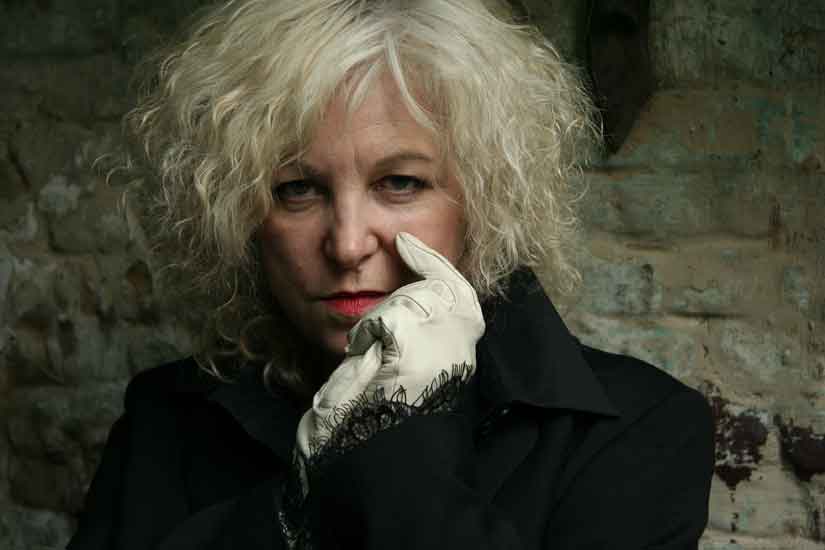
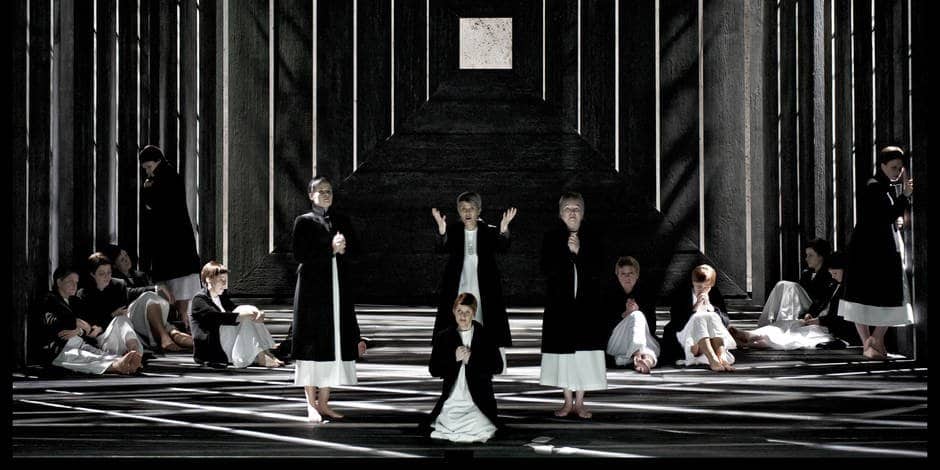
Poulenc's opera Dialogues of the Carmelites, produced by De Munt at the end of 2017, receives from Klassiek Centraal the Golden Label Opera (see Veerle Deknopper's review) for the 2017/18 season. Soprano Mireille Capelle, who performed the role of Mère Jeanne de l'Enfant in December of that year in this very production at De Munt under the musical direction of Alain Altinoglu and directed by Olivier Py.
As part of the Passages festival, organized by the renowned Goeyvaerts Trio, I interview one or more singers or musicians. This time it's Mireille Capelle. For Passages V, the diva created together with soprano Esther Elisabeth Rispens a surprising and sparkling original work[1]. The following text could already be read in the thick illustrated festival program booklet – at least if you were there.
That Saturday in Antwerp
The soprano switches between French and Dutch, which gives her stories a special flavor. I pick her up at her house in Antwerp. Actually, she would have liked to take me to the HERMES ensemble studio in Wijnegem, but she grabbed the wrong keys in Brussels. She's staying there for the De Munt production Dialogues of the Carmelites by La Voix humaine & Sinfonietta (1899-1963) and Georges Bernanos (1888–1948). The neighborhood bistro is packed to the gills. Mireille suggests driving to Wijnegem instead because of the location and the bakery. In the car we talk like old friends even though we've just met. In Wijnegem we settle at the long table in the dining hall of the French bakery. We get coffee, tea, and fresh croissants like you rarely find in Belgium. Mireille Capelle tells me the story of the bread and its Parisian baker who opened a branch here last year. The bakery is a constant coming and going. I place my mobile phone between us. Now that I listen to it again, I realize I've recorded a conversation, not an interview.
The Carmelites[2]
The evening before I enjoyed the Munt production in which she sang. Mireille probes. So I tell her about the two things that struck me: Blanche's fragility and the relativity of 'freedom'.
The naturally anxious Blanche de la Force enters the order of the Carmelite nuns at the beginning of the French Revolution. Although the strict convent rules give her a sense of security, her existential anxieties persist even within the cloister, especially after she witnesses the agonizing death of the prioress. When the convent order is dissolved during the Revolution, the sisters swear they want to die a martyr's death for their faith. In the tumult, Blanche flees home, but her father has meanwhile fallen victim to the Terror and been guillotined. When she learns that her fellow sisters have been sentenced to death, Blanche overcomes her fear of death: at the moment of their execution she voluntarily steps out of the crowd, joins her sisters, and is the last to mount the scaffold. (De Munt)
The Munt production holds up a mirror to us. Liberté, chalked on one of the walls, takes on its own meaning. It becomes 'Liberé' with a scraped-out 't' (and God). Indeed, in the name of our freedom and our rights, we do strange things. In Poulenc's opera, virtually everyone dies. The marquis de la Force (libre en soi), the Carmelite nuns (liberté en dieu), the brother and the fugitive priest (libre en fuite) and the novice Blanche de la Force frees herself from her fears and dies for the love of God. Finally – as history teaches us – the revolution itself died some time later. Freedom is nothing more than the free choice to bind oneself.
Binding oneself to another (a person or a worthy cause) as liberation shone through the direction. The image of Blanche's psychological fragility also stood out. Today she would probably cut herself or starve herself. Concerned parents would take her to a psychologist to hopefully cure her or at least give a name to her behavior. Perhaps today psychiatry offers solace. Cloisters lost their magic just as so much meaning has lost its way. The Munt presented a rather accurate picture of the fragile Blanche without the voyeuristic quality of contemporary reality TV.
Mireille points out the risk that
Patricia Petibon took in singing the role of Blanche: she chose to go beyond classical 19th-century bravura and public expectation to give voice to the character's fragility as well. The stylized beauty of the production contrasted with the human striving for freedom and the girl's pain in a bittersweet way. Bravo! About opera, De Munt and its directoreWhen you step into the shoes of a character and share a situation with others, you get a blend between real life and the world of theater. The portrayed Blanche, so aptly so, with the feeling and insight of Poulenc and Bernanos. It's as if you're stepping into real life, but it's happening on stage.
The direction of the house is very important.
Peter de Caluwe
needs a deep, 'profound' interpretation. Perhaps part of the audience experiences the director's style as extreme or provocative. Peter de Caluwe searches for the essence: what are we telling and how are we telling it? He wants people to enjoy the music, the beauty, and the entire spectacle of an opera. He also sends the audience home with a question, an inquiry into something. Then you can still say whether you like it or not. It gives the opera more depth, just a bit more than simply 'beautiful'. When we meet, at the first read-through of a libretto, he invites everyone: the director, the conductor, the singer but also the technicians, the costumiers. You know that we're working toward something together. That creates mutual respect. For every singer the first meeting is always a bit nerve-wracking. You don't know what your colleagues feel or think of you. If you have a big role you have a big responsibility. If you have a small role you think about the place you can take here. The small roles support the progression, the building of the piece. Actually we're all insecure but we laugh and act big: "Hello! How are you? Ah, I just came from Rome…" [Mireille mimics a jovial meeting]
Peter de Caluwe comes in and with one word he makes sure we set our egos aside. "I'm so glad you're all here together. We're trying to do a reading of Poulenc together."
He has a nice word for every singer by way of introduction: "I know Mireille from Amsterdam. She's sung Poulenc there too". He knows a story like that about everyone. It brings us together, c'est extraordinaire!
He's known that world since he was a young assistant to Gerard Mortier. He has composure and knows his craft. He goes after his goal but remains spontaneous and fun. I once sang Offenbach with him.
In any case: opera has a soul you don't find elsewhere. Everyone transcends themselves: the composer, the librettist, the management, the performers. I think you experience this, even as a listener.
From Monteverdi to Strauss
But here's the thing: opera has a soul you won't find anywhere else. Everyone transcends themselves: the composer, the librettist, the management, the performers. I think you experience that, even as a listener.
From Monteverdi to Strauss
You experience music; it's a way of understanding someone else. One of my grandchildren, five years old, changes when he hears classical music or singing: he sits differently. He listens as if someone is telling him a story. He doesn't understand the words, but he feels it. Incredible, right?
A lot of music is nothing more than pretty, but then it lacks substance. In that case, I'd rather have the raw and honest side of metal or punk. That's also a form of contemporary art with expression and feeling – extremely interesting. It's worth your while! Heavy metal is often rhythmically very interesting. And what energy! I'm convinced that Mozart in our time would have played around with it too. The intense expression seems to me to be part of who we sometimes are. Think of anger or helplessness.
Over the years, I've evolved. I discovered Baroque music through {{NOTRANSLATE_1}} Jos van Immerseel {{NOTRANSLATE_1}}. He was my mentor and Monteverdi my idol. I sang laments and traveled the world with them. Then my repertoire expanded. I sang a lot of Romantic music: Kundry from Wagner's Parsifal and Salome from Richard Strauss's opera of the same name. These are all characters who 'break': roles that stretch you emotionally as a singer; I found that to be a fantastic world.In between, I performed the classics with Mozart, among others. I usually played the more comedic characters. That was fun, but after a while I noticed that this aesthetic imposed limitations. It's either Baroque or Romantic. You have to sing within a certain technique and use your voice in that way. As a singer you have to handle it obediently, even though within those constraints you can color freely with expression. Vibrato in Mozart resonates differently than in Monteverdi. In Romanticism, on the other hand, you open everything up and let yourself go in the sound. You essentially turn off your brain to let the sound resonate in your body, as pure emotion.
Meeting Contemporary Music
After 30 years I wondered how I sound and how sound works. I remember meeting {{NOTRANSLATE_2}} John Cage (1912-1992) {{NOTRANSLATE_2}}. He told me I fit well in what he was exploring and feeling. He wanted to move away from music that was confined in the 'straitjacket' of notation. He wanted to give responsibility to whoever interprets the composition. So he composed a minimum so that the performer could do something with it that makes sense to them: that's my idea in your version. Listen to what sounds between the notes.
I began listening to music from all over the world. How do the indigenous peoples sing? What does a Persian song sound like? This is how I met composers from our Western tradition who also listened beyond this tradition. One of the most important was the recently deceased {{NOTRANSLATE_3}} Klaus Huber (1924 - October 2, 2017) {{NOTRANSLATE_3}}. I owe him a great deal. He taught me so much.
"Mireille," he began, "If you want to break free from the 'straitjacket' of what we consider classical music in our time and language, then you must understand that a tone distance, for example between do and re, is just a concept." "If you listen to Arabic music, you hear that the tone [sings while her voice slides downward] consists of thousands of tiny shifts. We don't hear that, Mireille," he explained, "because we can't recognize it. But they, the people from the Arabic tradition, hear it. Just like we recognize do and re. So they hear when a quarter tone or half tone is sung too high or too low. To us it sounds unusual or even out of tune. You have to learn that." When I worked with him for hours on end, he was already an old man. But what vision! He wrote music with two commas above the semitone; a quarter tone became a quarter tone plus 1 or a half tone plus 1, plus 2, plus three… And I had to sing it… Reading and interpreting such a score was hard labor. I lost myself in it. I felt the distances between the tones, the expression and the color. That freed me from my musical training.For me, the world of the voice and vibration was no longer colored only by the West, but by the 'human.' Partly because of that, I became interested in sonic architecture. Not only does music fascinate me, but also the sounds of rain, a thing, a voice, a mass… you name it. When you listen, it moves you emotionally.
I met {{NOTRANSLATE_4}} Karel Goeyvaerts (1923-1993) {{NOTRANSLATE_4}} as a young singer. He was extraordinary and had a stunning vision. Goeyvaerts asked me to come to his center and then he worked with my voice spectrally – before the term was even coined. Unfortunately, I never found the recording again, but it's probably in the sound archive. And now, through my 'sound obsession,' I encounter not only musicians but also physicists, engineers, and philosophers. I read constantly and love metaphysics and numbers. The engineers and their electronics put your idea into practice. You can't do it yourself. {{NOTRANSLATE_5}} Pierre Boulez (1925-2016) {{NOTRANSLATE_5}} didn't try it himself either. A computer can "metamorphose" that sound, change it. It can open it, stretch it, or visualize the vibrations and let me hear and see what's inside. The computer lets me hear everything that my two-dimensional ears cannot perceive.
My new CD straitjacket of what we consider classical music, in our time and language, then you need to understand that pitch distance, for example between C and D, is merely a concept." "When you listen to Arabic music, you hear that the note [tibetitpetie… sings Mireille as her voice slides downward] consists of thousands of tiny shifts. We don't hear that, Mireille", he explained, "because we can't perceive it. But they, the people from the Arabic tradition, hear it. Just like we recognize C and D. So they hear when a half-tone or quarter-tone is sung too high or too low. To us, that sounds unusual or even out of tune. You have to learn that."
When I worked with him for hours at a time, he was already an old man. But what a vision! He wrote out music with two commas above the semitone; a quarter-tone became a quarter-tone plus 1 or a half-tone plus 1, plus 2, plus three… And I had to sing it… Reading and interpreting such a score was hard labor. I lost myself in it. I felt the distances between the notes, the expression and the color. That freed me from my musical training.
For me, the world of the voice and vibration was no longer colored only by the West but by what is 'human'. Through that, I became interested in sonic architecture. Not only music fascinates me but also the sounds of rain, an object, a voice, a crowd… you name it. If you listen, it moves you.
Karel Goeyvaerts (1923-1993) I met as a young singer. He was extraordinary and had a stunning vision. Goeyvaerts asked me to come to his center and then he worked with my voice spectrally – ahead of its time – in a way. Unfortunately, I never found that recording again, but it's probably in the recording archive.
And now, through my 'sound obsession,' I meet not only musicians but also physicists, engineers, and philosophers. I read constantly and love metaphysics and numbers. The engineers and their electronics bring your idea to life. You can't do it yourself. Pierre Boulez (1925-2016) didn't try to do it himself either. A computer can "metamorphose" that sound, transform it. It can open it up, stretch it out, or visualize the vibrations and let me hear and see what's inside. The computer lets me hear everything my two-dimensional ears cannot perceive.
My new album[3] It's a collaboration where the end result belongs to all of us. By searching together with musicians from different traditions and engineers, a new sonic world emerges. This form of music is still embryonic, but I'm certain that in 50 years, everyone will understand this language. That goes even further than my first liberation.
Many years later, at the French bakery, soprano Mireille Capelle thought back to that long-ago afternoon when her father took her to meet the musical note.[4]
Before I could even write, I had learned to read music… That's quite a beautiful story in itself.
I don't know where the idea came from to learn music. When I was 5 years old, I told my father: 'I want to go to music school.' 'It's too early,' he said, 'you're still too young.' I kept pestering him because I really wanted to do it. He took me to the academy where the director said to me: 'Girl, you're far too small. As you know, you must first learn music theory to learn an instrument. That's still too difficult for you. You can't even read yet. First you have to learn to read.' I cried so much that the director decided: 'Let her come anyway. She'll realize after two or three lessons that it's too difficult.'
But that's not how it went; I understood the music. I found music theory magical. I could learn the notes I heard and enjoyed the abstraction of theory. Later the director took me to his office to listen to Beethoven. The symphonies passed by one after another. I cried and wanted to listen again! He told me who that was. You know, back then Beethoven was the composer.
Actually, music became my salvation. It became a way to survive in a world that wasn't always kind. I come from a half-Italian, half-Belgian family, settled in Charleroi—there were many of us in the working-class neighborhoods. My mother migrated to Belgium because of the war. She came from Veneto, between Verona and Venice. My father, a man from Namur, studied with the Jesuits and was meant to become a priest. But bitten by socialism, like so many intellectuals of that time, things turned out differently. His idealism to help improve the lamentable conditions of the workers brought him to Charleroi. We lived in a gray neighborhood near the steel mill in a house with a beautiful sunny and colorful garden.
My grandfather was a gifted musician, an organist. He had traveled the whole world. Because we lived next to the factory, we witnessed a lot. I can still see the riot police charging against the workers—all those horses. And I still remember the night my father had to go to the factory because a man had lost his legs: caught in a machine. Another time we had to leave our homes in the middle of the night. People were afraid of an explosion at the steel mill. I remember the arms of my mother, carrying me as we waited outside. You know, I can still feel that special quality of that moment. All those Italian families, the neighborhoods of Charleroi were part of my family. The underground, the mine, was an extended tragedy.
At our home there was a piano and many guitars. Every evening my grandfather demanded that we wash ourselves. We had no shower. We dressed nicely before we came to the table and then: music. My uncles all played guitar and my father played piano. In that way our family thought we were rich and that everything was going well. We would have a beautiful life. And I felt that very, very, very strongly: I understood it as if I really was rich and beautiful and had everything. I was even allowed to dance on the table after dinner! I imagined myself a princess. As a teenager I got a big shock. Suddenly I saw through the situation. We were poor and had nothing. I realized that everyone around me was so much more beautiful… Anyway, that's how I felt.
When I was small, there were cafés for Italians. At the others hung a sign 'Italians not allowed.' In that one café where my grandfather and I always walked past, there hung an enormous crystal chandelier. One day I asked to go inside but he said: 'No, no, no!' I wanted to have something so beautiful someday. I'm telling you this because it's a form of longing. Yet I felt that my wealth was so much greater than that through my family: the warmth, the music, the faith, the big garden with the chickens in it… The world of opera is a bit like the splendor of that forbidden café. And in that splendor we put the spirit of Poulenc: that's genius. You can bring those two worlds together: the greatest spectacle, the panache and the intimate fragility of a girl like Blanche.
Career begins at the conservatory
Even at the conservatory I experienced my working-class background. They accepted me because I had talent but I constantly had to hear: 'Ah, coming from the background you come from.' 'If you come from such a background, your chances are very small. How are we going to extract the essence from you? Your nature is a hindrance. You'll never be able to play a great character in theater or opera.'
You have to picture the 1960s. At the conservatory there were only rich people. You didn't qualify if you came from Charleroi, from a vulgar background 'like that.' 'How can we remove your vulgarity? That can never work.' I assure you!
I was also lucky. During my first major concert at the conservatory, a critic was in the audience. He wrote about who was good, who had talent or who would never get far. I sang my piece too. Later in the newspaper you'd read about the one who was good or not but… there was someone who knocked us out of our seats: Mireille Capelle. From that moment on, the professors started to believe in me.
I answered my family's dreams. Those Italian working-class families where one person sang better than the other and who all knew all the operas by heart. And you see, from that evolution came a need for freedom.
When I'm in the opera like now, I enjoy it and love them all. But I'm also very happy that I also find my language in that other world that is my research and expression.
It's something of mine, it's an idea, an inspiration that they give to each other.
You don't quite know what you're giving to each other but you do it.
Like love, I'd say.
Yes! You put it perfectly; that's it.
Post Scriptum
Autumn and winter meanwhile melted into an early mild summer. The presentation of the golden labels will soon take place in Geel. Hopefully the opera production will receive the deserved label and in turn, retrospection. Dialogues of the Carmelites Hopefully people will continue to think of the story and the way it was told, performed. Fixed on our own freedom, we sometimes forget what we so gladly bind ourselves to…
Mireille, thank you for the interview and your lovely impromptu on Passages.
'The sound will unfold like a lotus…,' you said when I asked what you would bring. The (re)sounding of your story and the mint production as well.
"The sound will unfold like a lotus…", he said when I asked you what you would bring. The (re-)sounding of your story and the minting production as well.
You see...
- WHOMireille Capelle; La Monnaie; Passages V festival organized by Goeyvaerts String Trio and CC Sint-Niklaas
- WHATInterview
- WHEREWijnegem, Brussels La Monnaie, Sint-Niklaas STEM
- WHENInterview December 16, 2017; Dialogues of the Carmelites December 2018; Passages V February 18, 2018
[1] Previous years: tenor Guy de Mey (2017, read on Klassiek Centraal), saxophonist Robin Verheyen (2017), Mezzo-soprano Euredike De Beul (2016), countertenor Leandro Marziotte (2015) and pianist Thomas Nobels (2015).
[2]DIALOGUES DES CARMELITES by La Voix humaine & SinfoniettaOpera in 3 acts and 12 scenes, text by Georges Bernanosbased on a novella by Gertrude von le Fort; screenplay by Philippe Agostini and Fr. Brückberger.
This La Monnaie production was conducted by Alain Altinoglu directed by Olivier Py, with took in singing the role of Blanche: she chose to go beyond classical 19th-century bravura and public expectation to give voice to the character's fragility as well. The stylized beauty of the production contrasted with the human striving for freedom and the girl's pain in a bittersweet way. Bravo! as Blanche de la Force; Guy De Mey as L'Aumônier and Mireille Capelle as Mère Jeanne de l'Enfant Jésus.
From the press kit: Mezzo-soprano Mireille Capelle has sung countless roles at La Monnaie. From her debut as Clorinda (La Cenerentola) through her portrayal of Rychtarcka (Jenůfa) to her recent appearance as Pani Páskova in Foxie! The Cunning Little Fox: Mireille Capelle brings unmistakable authenticity to each of her characters, which also suits her interpretation of Mère Jeanne de l'Enfant Jésus.
[3]Mireille Capelle with HERMESensemble – DO'UN صوت; AudioMER. – audioMER.019.CD; 2017
[4]Based on the opening line from One Hundred Years of Solitude (1967) by Gabriel García Márquez.