
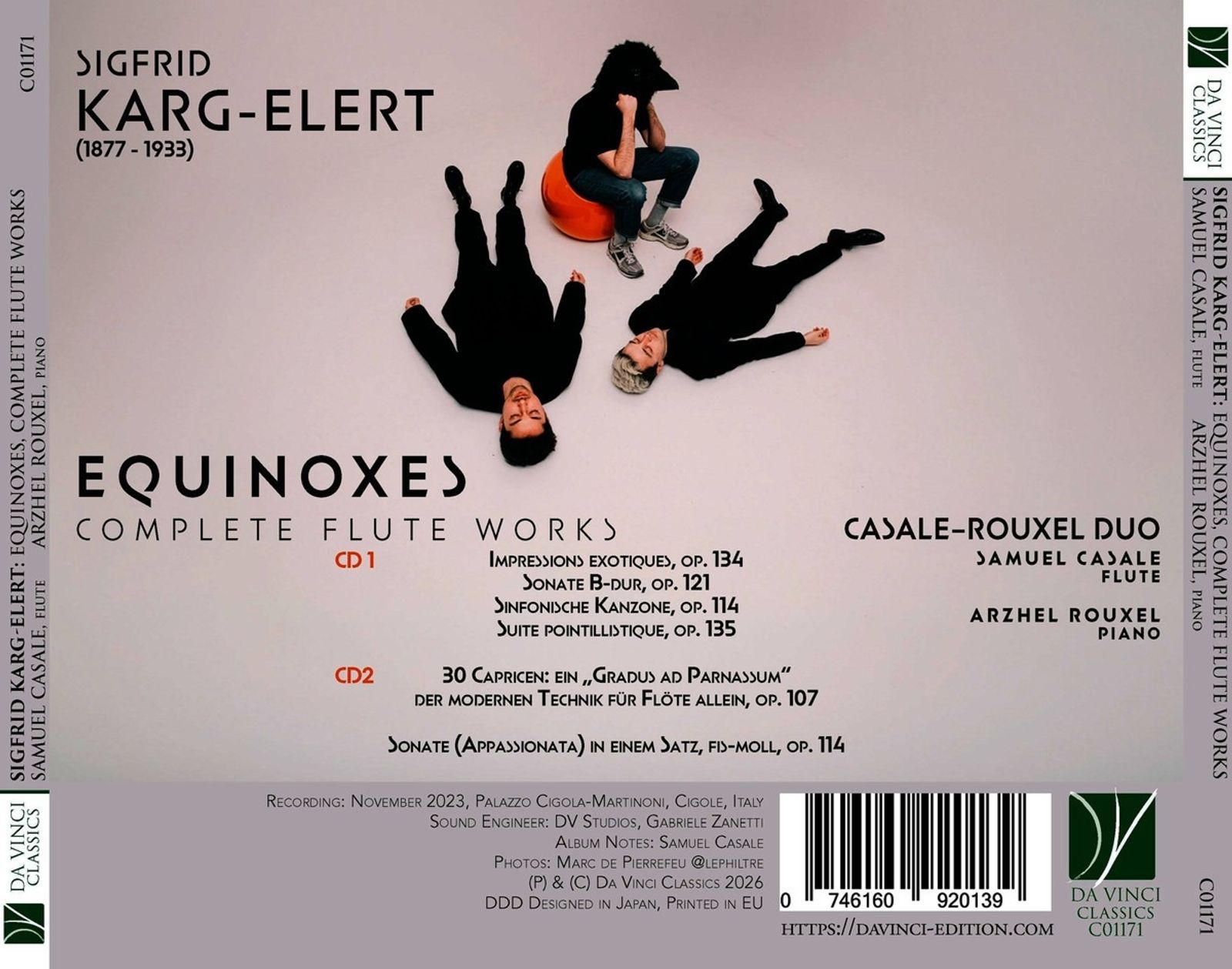
Some composers survive in the collective memory chiefly through pedagogical channels, while their real artistic significance gets lost along the way. Sigfrid Karg-Elert (1877-1933) is a textbook case. Every flute student will grapple with the 30 Caprices, perform the Sinfonic Canzone as a required exam piece, or tackle the Sonata Appassionata. But how often are these works actually heard as fully-fledged concert music? It is precisely this gap between pedagogical ubiquity and artistic marginalization that forms the starting point for this new release from Da Vinci Classics, on which the Casale-Rouxel Duo – flutist Samuel Casale and pianist Arzhel Rouxel – brings together Karg-Elert's complete flute oeuvre.
To properly assess this undertaking, one must first understand how isolated Karg-Elert's position actually was within the German fin de siècle. Born in Oberndorf am Neckar, a contemporary of Richard Strauss, Max Reger, and Franz Schreker, trained as a pianist – yet never truly fitting into any school or movement. His idiom, influenced by France, was moreover a sore point in the German musical climate of his time, which had little patience for such international orientation; outside Germany, especially in the United Kingdom, his work actually gained recognition. After World War II, he faded into the background for a time, until a revival beginning in the late 1970s brought him back into focus – though that remained largely confined to his organ works. Where Richard Strauss unfolds his musical narratives slowly, Karg-Elert seems constantly to surprise the listener with fresh perspectives. His music moves restlessly, full of unexpected turns and sudden bursts of color. Because of this, he opts less for monumental architecture than for a continuous stream of new ideas, which lends his music a striking vitality. Those who know Karg-Elert only from teaching materials will moreover be surprised by how much lyrical warmth, colorful harmonies, and refined tonal shadings lurk behind these scores. What sounded idiosyncratic a century ago sounds remarkably fresh today.An intriguing thread in Casale's accompanying essay is the kinship he draws with Nietzsche's cultural critique. His call for French clarity against Wilhelmine heaviness would, according to Casale, also be musically recognizable in Karg-Elert's desire to break free from academic conventions. Whether that parallel holds up entirely from a musicological standpoint is hard to prove, but as an interpretive key it works surprisingly convincingly. It helps us understand this music as an art of perpetual change, in which contrast is not an interruption of form, but its essential motor. The essay moreover testifies to a thorough knowledge of Karg-Elert's oeuvre and to a strikingly critical, thoughtful approach to interpretation. At the same time, it offers a fascinating glimpse into the duo's working methods and gives the choices made during this recording extra relief. Not by chance does the album bear the title
Equinoxes
: the moment when light and darkness hold each other in balance. That metaphor neatly sums up what this music and this interpretation revolve around: a perpetual play of opposites that do not cancel each other out, but rather strengthen each other. This vision also determines the Casale-Rouxel Duo's interpretation. According to the booklet, Karg-Elert's many character markings – blühend, duftend, bleich – are not understood as mere atmospheric suggestions, but as the starting point for musical imagination. Tempo flows from character, not the other way around; tone color emerges from a shared dramaturgy between the two musicians. It is an approach that aligns well with their experience with contemporary music, where abrupt transitions and an elastic sense of time are more the rule than the exception.Fortunately, that vision remains far from purely theoretical. This is evident from the very opening of Impressions exotiques, which sets the tone immediately on the first CD. Before the listener has fully grasped Karg-Elert's idiosyncratic musical language, this music already sweeps him into a colorful sonic universe that sparks curiosity about everything to follow. Samuel Casale possesses a full, flexible tone that effortlessly shifts between lyrical warmth and sharp definition. From one work to the next, his tone color shifts almost imperceptibly, always completely at the service of Karg-Elert's widely divergent musical worlds. Even in the technically most demanding passages – the sharp register jumps from the
The vision also determines the interpretation of the Casale-Rouxel Duo. According to the booklet, Karg-Elert's many character markings — blooming, fragrant, pale — are not understood as mere atmospheric suggestions, but as the starting point of musical imagination. Tempo flows from character, not the other way around; tone color emerges from a shared dramaturgy between both musicians. It's an approach that aligns well with their experience in contemporary music, where abrupt transitions and an elastic sense of time are more the rule than the exception.
Fortunately, this vision is not confined to theory. This becomes apparent right from the opening measures of Exotic Impressions, with which the first CD immediately sets the tone. Before the listener fully grasps Karg-Elert's idiosyncratic musical language, the music sweeps them along into a colorful sonic universe that piques curiosity about everything that follows. Samuel Casale possesses a full, flexible tone that effortlessly switches between lyrical warmth and sharp definition. From one work to the next, his tone color shifts almost imperceptibly, always entirely in service of Karg-Elert's widely divergent musical worlds. Even in the technically most demanding passages — the sharp register leaps from the Caprices, the hurried little runs in the Sinfonic Canzone – his vocal line remains intact, as if technical mastery were never an end in itself for him, but a self-evident means to let the music speak freely.
Arzhel Rouxel meanwhile proves himself to be an equal partner. His piano playing possesses refined musicality and great sensitivity for color and balance. Although he continuously supports the flute, he remains far more than merely an accompanist. He gives the piano part its own voice without ever disturbing the careful equilibrium within the duo. His playing lends structure to Karg-Elert's sometimes capricious musical thinking and ensures that the many harmonic colors never dissolve into diffuse masses of sound. Especially in the quieter moments, the duo demonstrates how naturally lyricism and tension can coexist here. The recording quality also deserves praise: transparent, spacious, and with enough detail to allow the often complex textures to speak clearly. This makes the comprehensive release engaging from beginning to end: each work reveals a new color, a new character, and a new facet of a composer who proves far more versatile than his reputation suggests.
This becomes particularly clear in the integrally recorded 30 Caprices. Where this cycle is usually regarded as a collection of technical studies, Casale treats each caprice as an independent character piece. Register changes, articulation challenges, and virtuosic runs recede into the background in favor of musical profile. This creates a surprisingly varied cycle in which each miniature acquires its own psychological color. As a result, you are no longer listening to thirty technical studies, but to thirty character pieces, each with its own voice.
The same balance between mastery and expression characterizes the Sonata Appassionata. The composer constantly balances here on the border between passion and formal control, a tension field that the performers carefully maintain without falling into sentimentality or detached restraint. The programmatic works, such as Exotic Impressions and Pointillist Suite, are nowhere reduced to musical illustrations. Behind the exotic titles unfolds a continuously transforming soundscape in which color is at least as important as melody.
The question remains whether this integral recording will definitively rehabilitate Karg-Elert. A successful CD alone is not enough to restore a composer to a permanent place on concert stages. For that, his musical language may well remain too idiosyncratic and too difficult to fit into familiar historical categories. But that is precisely why this release is so valuable. It invites us to listen again to a composer who proves to be far more than the author of a handful of mandatory exam pieces. Not every rediscovery rewrites music history, but some do correct our listening memory. This integral recording undoubtedly belongs to that latter category.