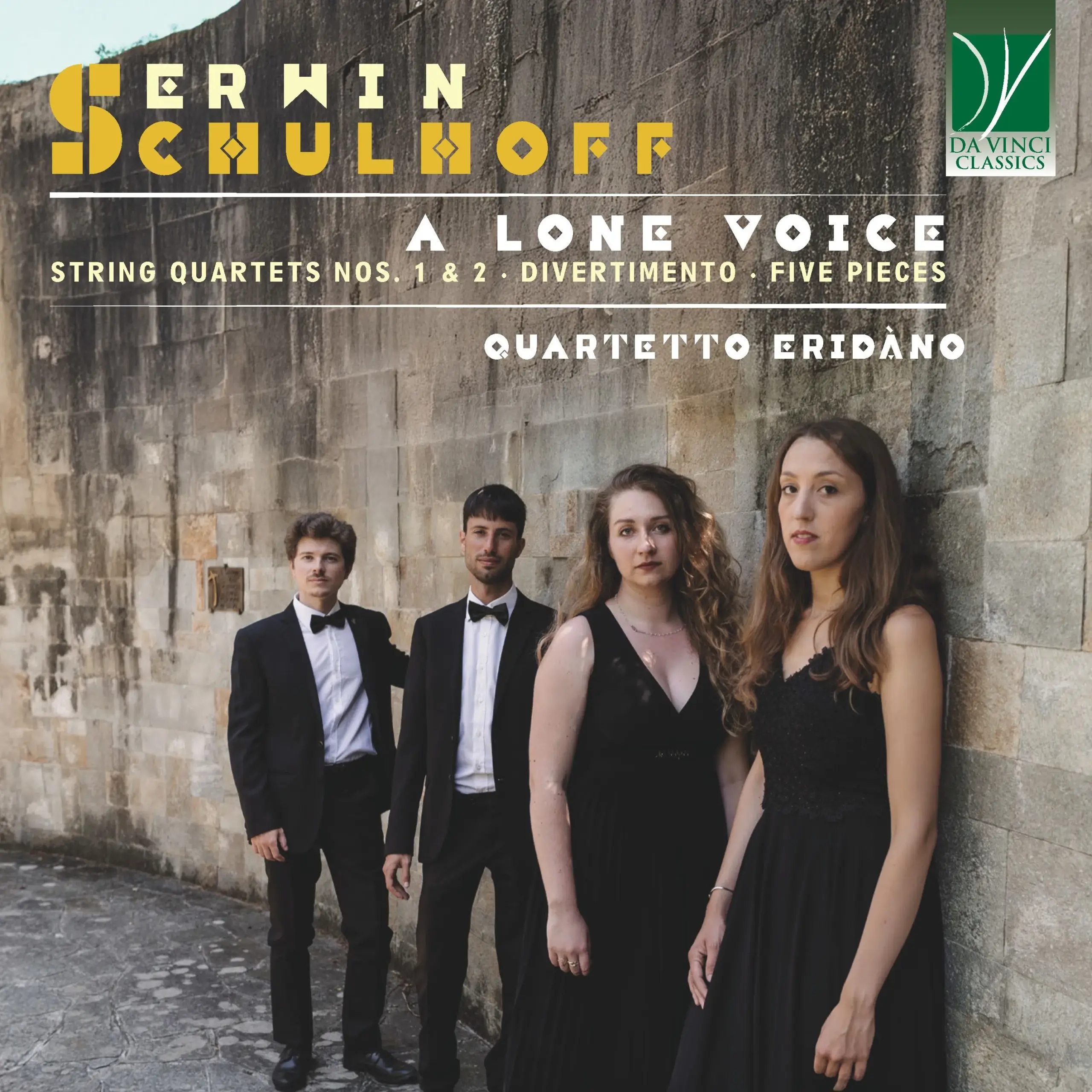
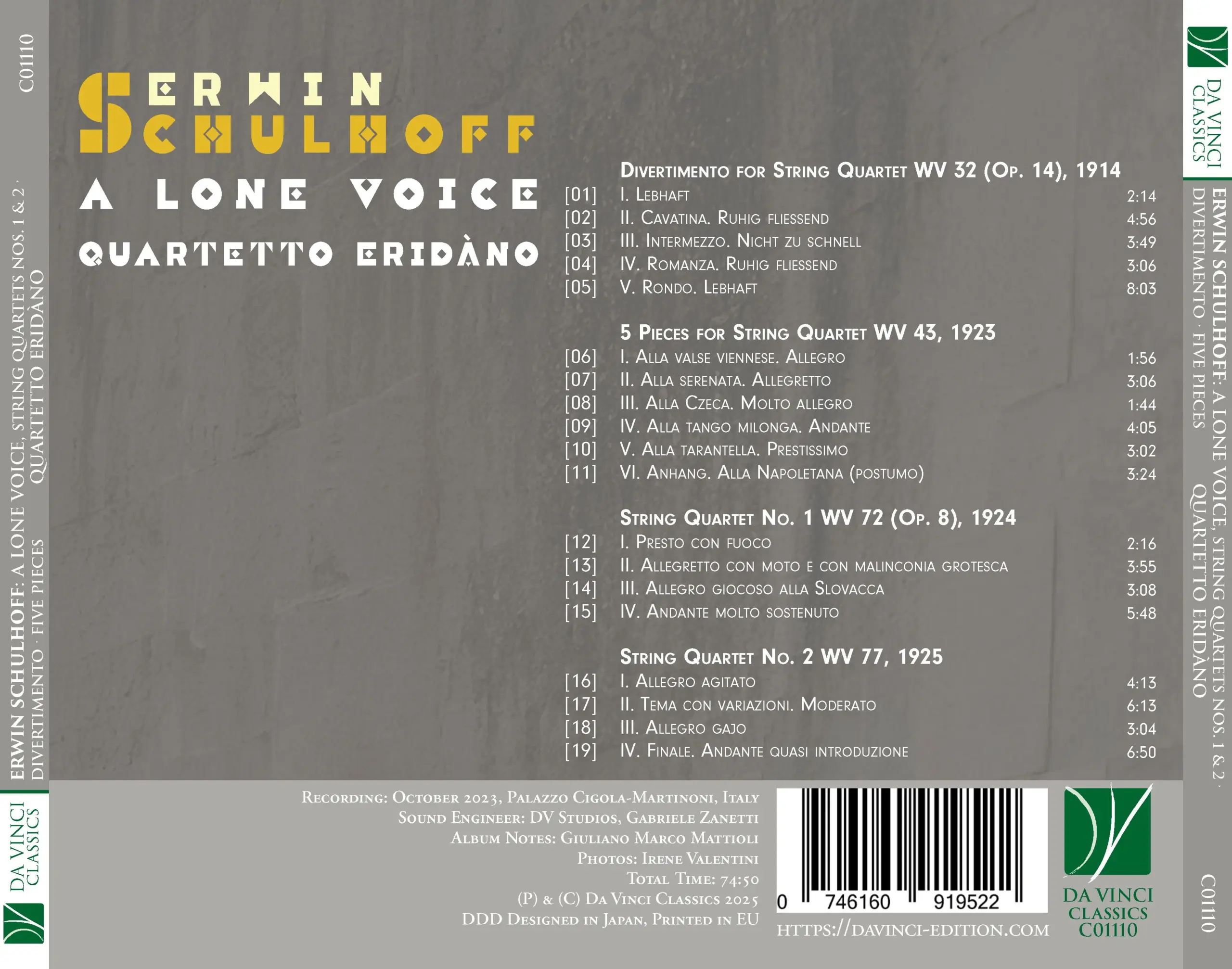
There are composers whose life story you can scarcely separate from their music. Erwin Schulhoff (1894-1942) is one of them. When you put on this new recording by the Quartetto Eridano, you hear not just notes, but an entire era: the twilight of the Austro-Hungarian Empire, the shockwaves of the Great War, the vibrant cultural melting pot of 1920s Prague—and, inevitably, the shadow that would later fall over it all. That the young Italian Quartetto Eridano takes on this repertoire deserves every praise: Schulhoff's music demands not only technical refinement but also the ability to constantly shift between styles, moods, and registers.
The program opens, significantly, not with the most familiar pages. The Entertainment op. 14 from 1914 still breathes the spirit of Haydn and Mozart, with its gallant dance rhythms and horn-like gestures, but in the Short Aria and the Romance a subtle unease already begins to emerge. The Quartetto Eridano resists the temptation to approach this work merely as elegant or decorative; the musicians let the lyricism breathe freely and give the underlying melancholy full space, without overdoing it.
With the Five Pieces WV 68 (1923), the atmosphere shifts. This is Schulhoff the stylistic omnivore: a swaying Viennese waltz with an ironic undertone, a sly serenade, a Bohemian folk dance, a sultry tango, and an exuberant tarantella. The four musicians play these miniatures with audible delight. Their articulation remains sharp, the rhythmic flexibility is infectious, and the many character shifts flow naturally, without the music ever falling apart into disconnected style exercises.
The heart of the CD is formed by the two string quartets. The First Quartet (1924) opens with a Fast with Fire that is genuinely tense: nervous, sharply profiled, and full of energy. Striking is how the Quartetto Eridano carefully weighs irony and melancholy against each other in the second movement. In the rustic scherzo, the Slavic influences take on an earthy directness, while the finale stands out through its restrained concentration. The musicians dare to thin the music here to an almost weightless transparency, making the solitary lines of the first violin all the more poignant.
The Second Quartet (1925) is more compact and direct. The opening movement possesses an almost mechanical motor quality, while the variation series constantly shifts in color: folk warmth is unexpectedly intersected by a playful foxtrot, a quintessentially Schulhoffian interplay of disparate musical worlds. This blending in Schulhoff is never merely ironic: it reflects a time in which folk music, jazz, dance, and classical tradition did not stand opposed to each other but continuously influenced one another. The Quartetto Eridano knows how to make such transitions sound organic while always maintaining a clear overview of the form. The finale grows from its contemplative beginning toward a convincing apotheosis, without losing sight of the underlying ambiguity.
What ultimately makes this recording so convincing is the combination of clarity and commitment. The Quartetto Eridano—Davide Torrente and Sofia Gimelli (violin), Carlo Bonicelli (viola), and Chiara Piazza (cello)—lets the four voices sound exemplarily balanced, so that Schulhoff's often layered writing never gets muddied. The recording quality also helps with this: the sound is transparent and direct, with enough warmth to give the lyrical moments their full impact. The Quartetto Eridano presents Schulhoff not as a historical curiosity but as a composer who effortlessly connects different musical worlds and developed a completely unique voice in doing so.
That Schulhoff died in the internment camp Würzburg in 1942 makes his music, in hindsight, inevitably also a testament to a lost world. His music survived him, fortunately. This release lets us hear why: not only because of its inventiveness and stylistic richness, but also because the Quartetto Eridano brings it to life with intelligence, conviction, and a fine sense for contrasts. The result is a recording that has much to offer both new listeners and those familiar with Schulhoff's oeuvre.