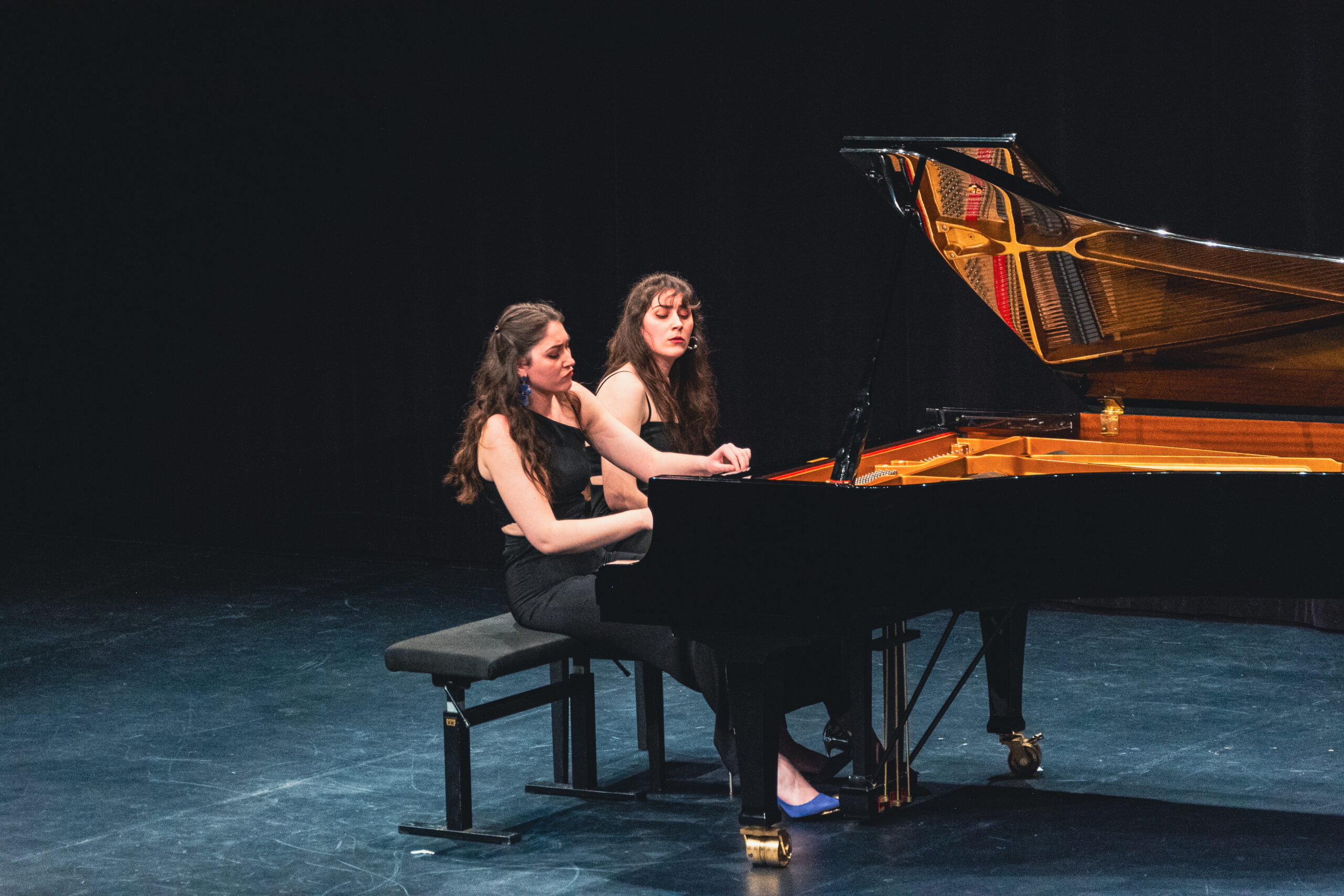
There are piano duos that play side by side, and there are piano duos that play into each other. The Brussels-based sisters Fiona and Chiara Alaimo clearly belong to the latter category. With Echoes, they release a debut album that spotlights two living composers: Sharad Goulam and Gabriel Field. Two friends, two worlds, one piano. Or rather: two pianos, four hands, and a conversation that began long before the first note. The result is a recording in which silence is as important as sound, where dissonance doesn't ask for resolution but is treated as color, and where contemporary music is presented not as an intellectual exercise, but as something living, tangible, and deeply human. For Klassiek Centraal, Werner De Smet spoke with both sisters Alaimo.
Music as a creeping story
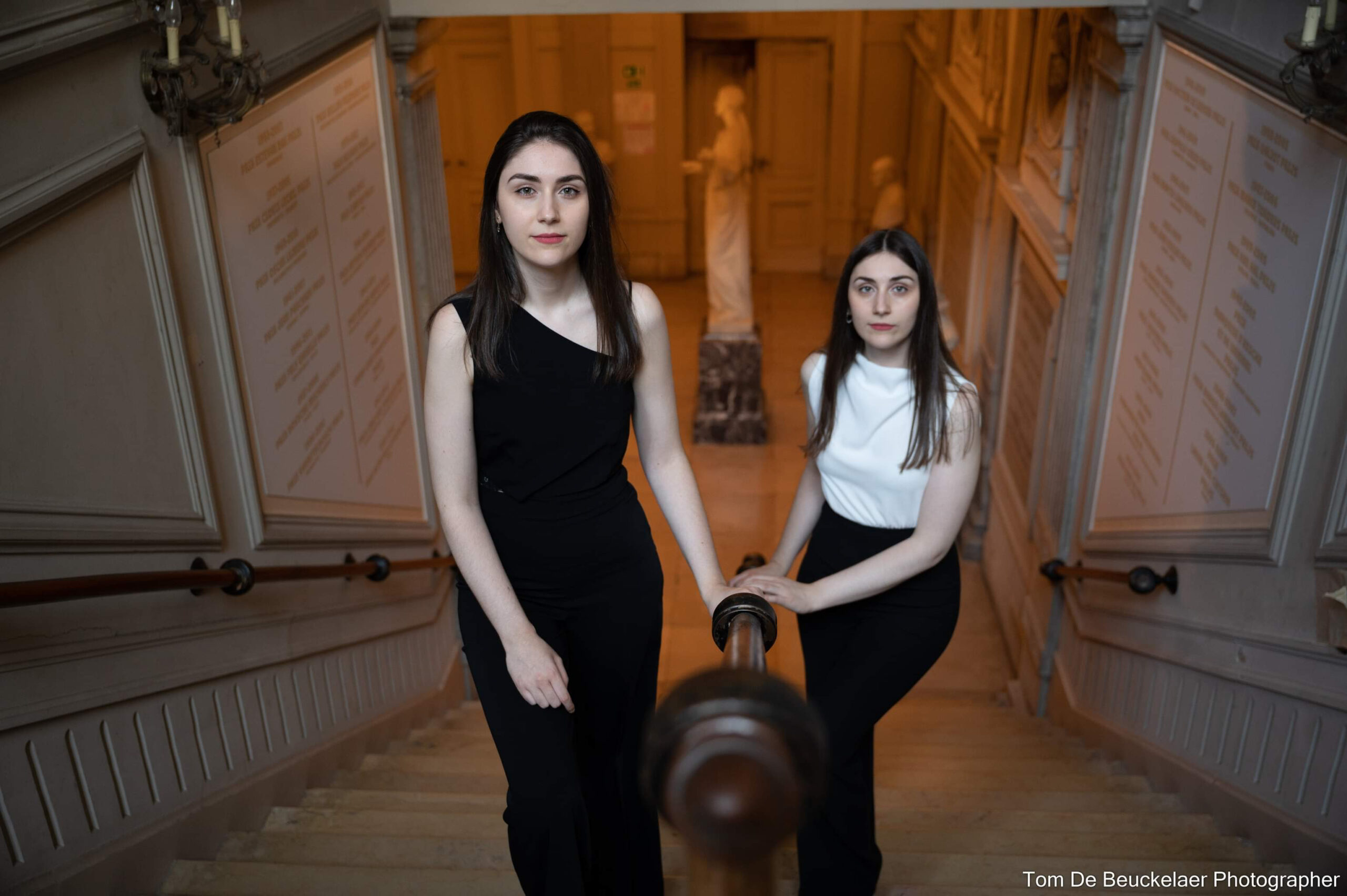 When I meet the sisters, what strikes me immediately is how they shy away from grand theatrical gestures. Music didn't come to them as a sudden revelation, not a conscious life choice announced with fanfare. "Rather, it quietly crept into our lives, carried by the many projects we participated in along the way," they explain. "Like a love story that begins in friendship and deepens imperceptibly into something greater. Perhaps because our fascination always lay more in the intimacy and beauty of playing itself than in standing in the spotlight." You believe them right away. No dramatic turning point, no moment of revelation – rather an attention that quietly takes root.
This intimacy was nourished by a remarkably layered youth. Alongside a deep affection for the emotional architecture of Chopin and Rachmaninov, their teenage room also echoed with the raw, rhythmic energy of Linkin Park and System of a Down. For the sisters, there is no strict division between genres: music is first and foremost a world of feeling. The concerts they attended as children together with their parents also shaped and deepened that love. This open perspective was later channeled at the Brussels Royal Conservatory by Aleksandar Madžear. He worked with them for six years – not as a rigid pedagogue, but with rare warmth and generosity. "We still grab coffee together now and then," they say. "His humor, his humanity, and his way of looking at music remain a source of inspiration." A sentence that sounds like a genuine bow, not a polite phrase. Both sisters also pursued individual solo careers alongside their duo work – at among others the KCB and the École Normale de Musique de Paris – allowing each to develop their own musical identity within the same pedagogical foundation.
The fact that they now consciously distance themselves from music is something the sisters only learned to practice in recent years. Earlier, music consumed their entire lives, from early morning to late at night. Gradually, they realized that silence and distance are also necessary – reading, exercising, playing chess, singing, spending time with family and friends – to return to the piano each time with fresh ears.
Two people, one voice
Although they are biologically and mentally closely interwoven, the artistic gain lies in the nuances of their contrasting characters. Fiona is the conceptual driver, the one who activates the score with unexpected – sometimes slightly absurd-seeming – ideas, and covers her sheet music with annotations and markings. Chiara is the pragmatic architect who sets these ideas in motion, prefers the blankness of an untouched score, and breaks the silence of rehearsal by continuing to search and experiment. It is precisely this productive tension that protects their playing from the trap of sterility.
They have indeed developed one artistic voice, they say, but they try not just to form one sound, but at the same time to remain consciously audible as two separate musical identities within that same sonic space. "So that listeners also feel that we are two different people who complement each other and enrich each other's interpretations." That conversation nourishes them outside of music too. They quote their father: "There's always more in two heads than in one." And they cite the Duffer Brothers – the twin brothers behind Stranger Things – as an example of how a shared artistic vision can become greater than the sum of its parts. It's a striking reference in a classical music conversation, but precisely for that reason it resonates: the Alaimos think in analogies that extend far beyond the concert stage.
The quartet on the cover
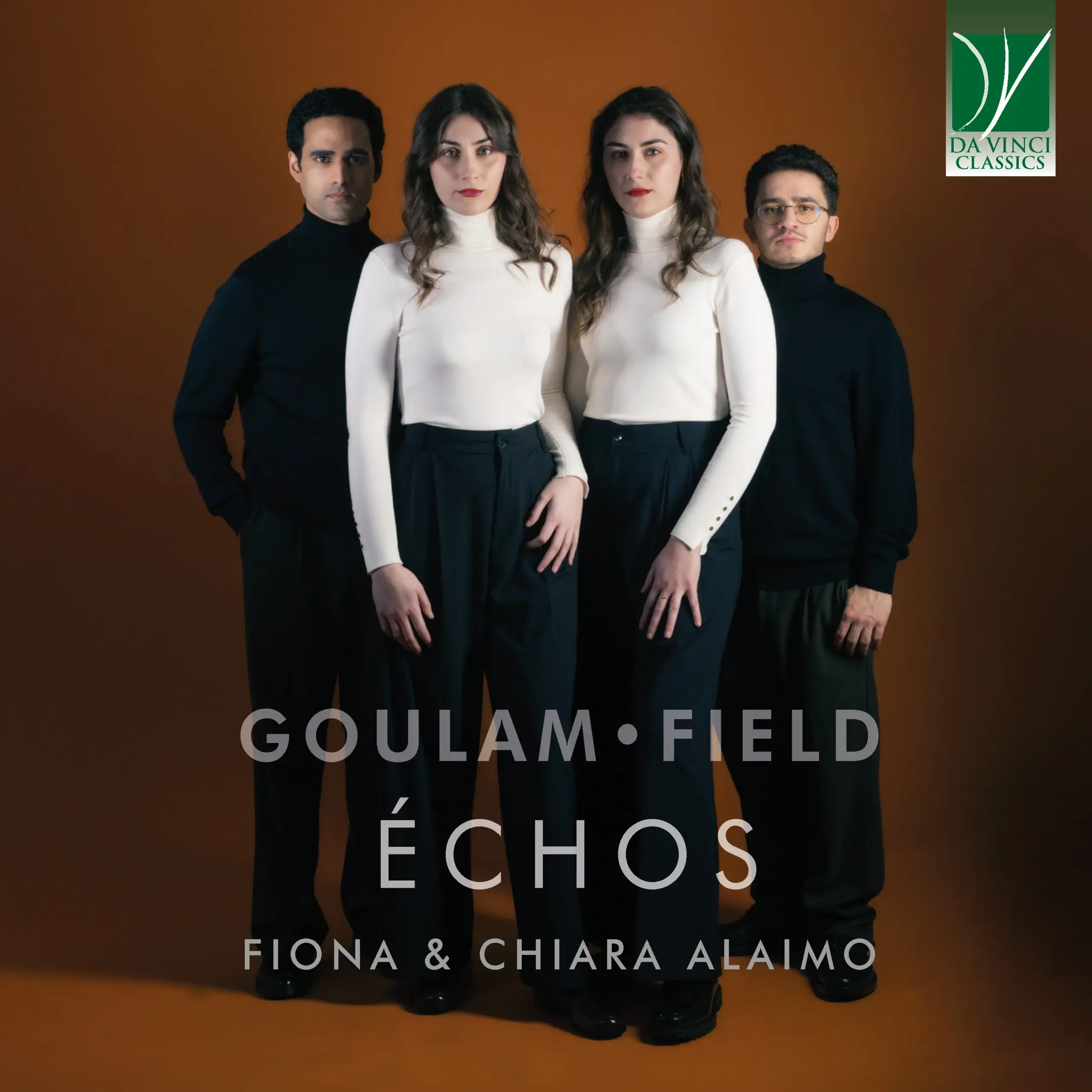 The works on Echoes are divided between two composers whose friendship dates back to their shared student days at the Cortot School in Paris, the same school where the Alaimos came to know them. That the album has its roots there is for the sisters no coincidence but a conscious act of gratitude. "We wanted to bring our French roots to life," they say. "The countless opportunities we received at the Cortot School were for us a way to honor and spotlight French culture and music." Echoes is thus also a portrait of a city, a school, and a friendship.
Sharad Goulam contributes a Toccata, a Prelude V, and a Marche. Gabriel Field contributes eight Chorals and the triptych Pièces Joyeuses. The cover shows a quartet, but those who look closer see two pianists and two composers. An aesthetic alliance that is already announced in the image.
The division of tasks between the sisters usually flows naturally, but with Goulam's Toccata, democracy broke down briefly. They both wanted to play it. Lots had to decide. Fiona drew the short straw. "Since then, that Toccata officially belongs a little bit more to her," they say, with the dry precision of people who know that a good anecdote needs no exclamation mark.
"Their personalities seem almost like each other's opposites," the sisters describe their composers. "Goulam starts from a decidedly dramatic, almost physically sculpted sound world. Field, on the other hand, employs a minimalist, almost ethereal language – as if the trace of an already vanished thought." What connects them, however, lies not in the obvious. Not the style, not the tempo, not the idiom. Rather their approach to dissonance: for both, not tension that must be resolved, but a color in itself. A way to deepen the sound palette. The Alaimos recognize this approach as the quiet bridge between two apparently opposite worlds.
Analyze, let go, rediscover
What stands out in their working method is the combination of intellectual analysis and conscious intuitive ripening. New scores are first dissected almost scientifically: every detail is examined until a clear picture emerges of how the composer thought and felt the music. Then comes a surprising step: stepping back. The music must be allowed to settle outside the piano, outside the rehearsal room. Only months later do they return to the same work, now with their own experiences and emotions as an additional layer. From that individual processing, a shared interpretation gradually grows. That process became even richer with Echoes because they could speak directly with the composers and also engage in discussion when a passage they were playing turned out to be intended differently interpretively. "That interaction is precisely what's most fascinating," they say. At the same time, they refuse to ever consider their readings as definitive. "Interpretations become sharper and more deeply anchored over time, but at the same time there's always room for change. Maybe that's the most beautiful thing about music."
The paradox of irony and silence
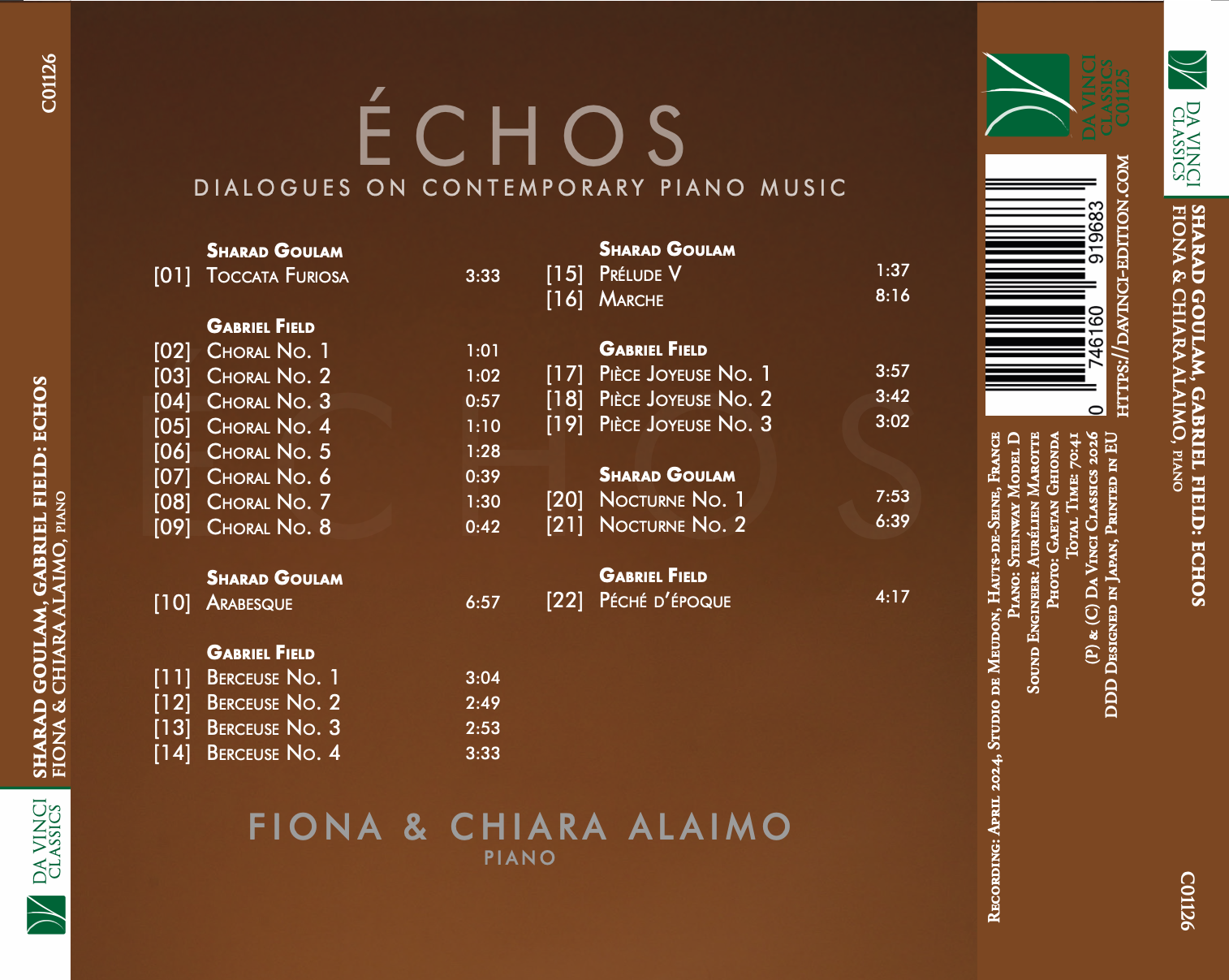 In Goulam's Prelude V and Marche, the sisters are forced into an extremely precise polyphonic discipline, where every voice must be able to move completely independently without tearing the larger fabric. A composer who places the pianist in complex technical situations and treats polyphony as architecture.
With Field, the difficulty lies paradoxically in the very restraint. His eight Chorals are seemingly distilled miniatures at first glance, but the sisters refuse this reading: "They are actually far more complex than they appear." The tension lies in the voice-leading, in the way individual lines move without merging. Each Choral is its own world. They form no continuous chain; they exist side by side, like people in a waiting room each lost in their own thoughts.
Their sharpest observation concerns the Pièces Joyeuses: three pieces that hide a dark, almost macabre world beneath their ironic title. "Hope flickers for just a moment, but is swallowed again and again by something ineffably somber." As performers, they say, they have "surprisingly little to do," which probably means they do everything they can to add as little as possible. One must resist the temptation to clutter it with clichés.
It is in these pieces that silence transforms into essential building material. The sisters approach rests not as mere absence of sound, but as charged space: "Silence is also music. The tension one can create through silence is undoubtedly one of the most beautiful tools a musician can use to bring a piece to life and let it breathe." They state this not as philosophical observation, but as professional assessment. Two pianists learning to be silent together—that is an art in itself.
From laboratory to stage
Échos was recorded in Studio de Meudon on a Steinway Model D, with microphones close to the pianos and dry acoustics. "A kind of laboratory work," they call it themselves—clear, transparent, every color and echo mercilessly visible. That unforgiving clarity was unexpectedly prepared by their collaboration on the film The Chapel, where they learned how to repeat the same passage multiple times in succession with identical intensity—a process that surprisingly mirrors studio work. On stage, everything is different: the hall weighs in, the audience, the energy of the moment. The interpretation is strongly influenced by it—and that is not a drawback, but a gift.
This live environment also gives them the chance to break down the supposed barrier of contemporary music. For instance, Fiona took the microphone during a solo concert in Sainte-Savine to guide the audience through specific motifs from the score—highlighting melodies like a guide explaining a painting without explaining it. There is a deep sense of artistic responsibility in this project. The duo refuses to wait until history has filtered these scores: "Waiting a hundred years for this music to be adopted into the standard repertoire seems unnecessary to us nowadays." A small but clear statement of purpose: contemporary music deserves an audience now, not a future archive.
Two words as echo
At the end of our conversation, I ask the sisters to describe each other musically in one word. They laugh and then decline the task. One word is not enough. Because there are two of them, they prefer to propose two words instead: joy and generosity.
These are also the words that best describe this album: music that gives something to the listener, that leaves room for personal memories, images, even scents. Échos does not seek the easy, immediate impact of virtuosic effect, but nestles itself slowly, compellingly, and with serene layering into memory. It is not an album that gives up its meaning immediately. It is one that echoes on, as an echo should.
Joy and generosity—rarely was an album summed up more accurately.