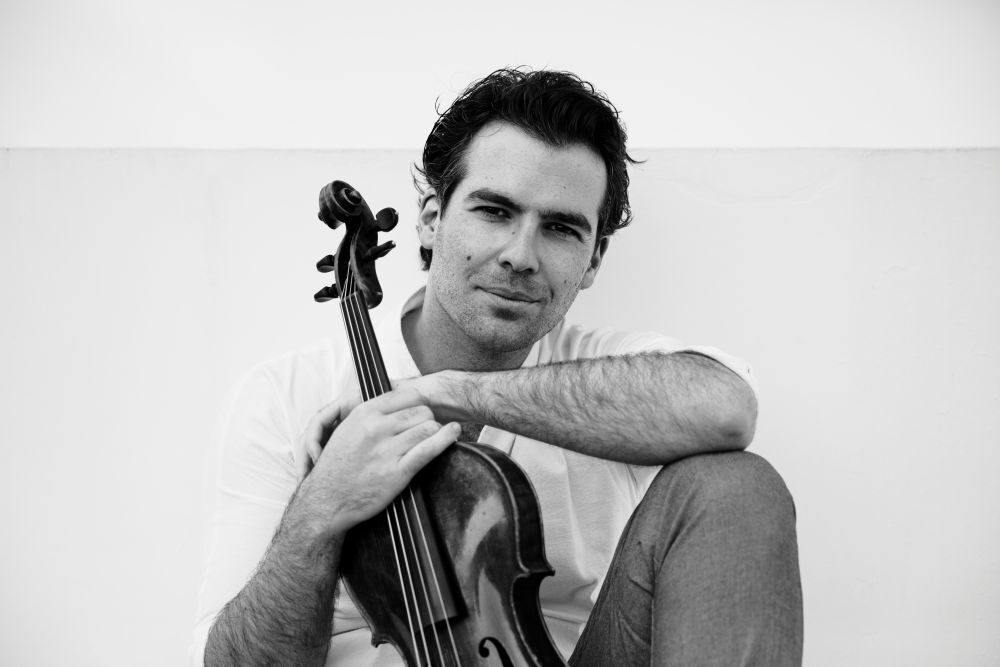

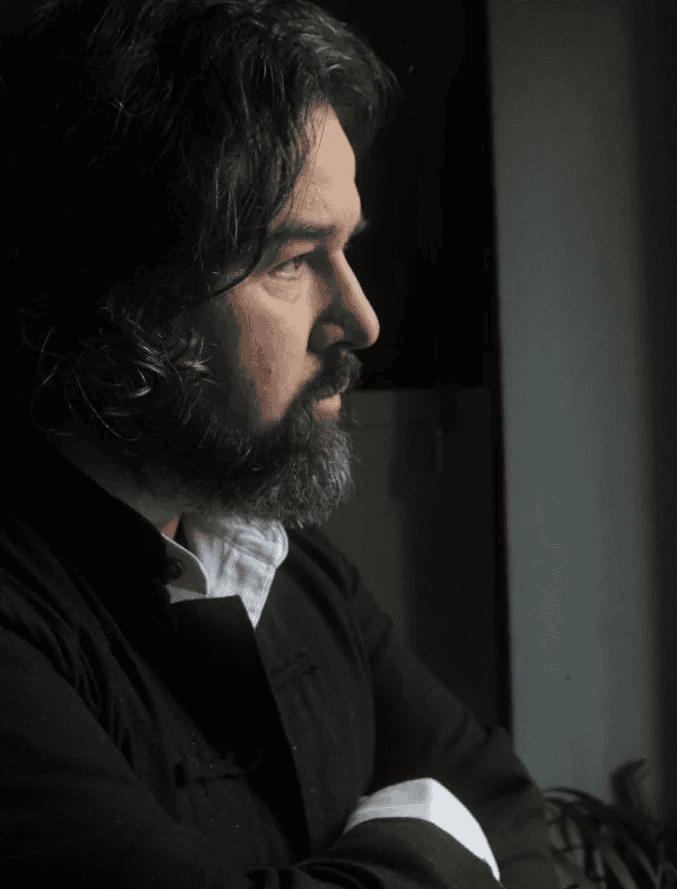
Johann Sebastian Bach, who doesn't know him? But who knows Dimitri Arnauts-Kolokolov? Somewhere in the green surroundings of Kampenhout, the municipality where the Van Beethoven family had and still has its roots, an unknown composer sits in an attic room, almost constantly stringing notes together.
Through a 'like' on some social media post, I saw 'composer' listed next to a name I didn't know. Never heard of them before—there was an Arnauts in my elementary school class, but that wasn't them. So what do you do? I poked around the world wide web where I found a website and music. The music on it breathes Bach from front to back, from back to front, and from every angle. That's refreshing these days, isn't it? A composer who reaches back to that earlier time and makes no bones about it. A quick email, a phone call, an appointment. Coffee and cake. It had to be good!
It's hard to believe, but the nearly 50-year-old composer has never really received serious attention anywhere. He makes do with fairly limited means to squeeze out one work after another from his head and immortalize them on sheet music. As luck would have it, just before I contacted him, he made the German press with—yet again—an unpublished work. He owes this to a composition he dedicated to Pope Emeritus Benedict XVI. He managed to get this work 'In honorem Benedicti XVI' to the right address, though the Pope never heard it. Two days after delivering the musical tribute, Benedict XVI died. It got the romantic with a Baroque flair into the newspapers, and who knows, perhaps he'll finally be performed as it should be: not digitally via computer, but by an orchestra, live in the concert hall or church.
A church might actually be the ideal place because 90% of the deeply devout Christian Dimitri Arnauts' works are religiously inspired. In Bach's time, the most normal thing in the world; today, pretty much the exception to the exception. Who writes music for a church that's practically empty these days? Well, you could plant a tree over that issue because not all religious music is written to be performed during a church service. One doesn't have to be a convinced Christian to be moved by religious music, and not only for the melody, but also for the text.
Arnauts is driven and talks enthusiastically about everything. During our conversation, many subjects come up, not just musical ones. The composer has an interest in architecture, for example, and he passionately tells how he sees things, just as in visual art, literature, and life. He has a very dominant sense of beauty, a drive toward harmony, balance, melody, logical streamlines, natural colors, simplicity, and the richness that all of this gives. The (overly) abstract is foreign to him, especially in his music. Yet he's not stuck or obsessively fixated on Bach or Beethoven, his other musical idol.
However much Bach is present in almost all of his works in some way or another, Arnauts is at the same time sometimes strikingly contemporary—not in terms of modern compositional techniques, but in putting forth something new that carries the traces of many centuries of European music composition within it and makes it clear that there's still room for something new.
© mt
On Spotify, YouTube, and on Arnauts' own websites, you can listen to his works—soon to be 300!—from his hand. It's a shame that he has to make do with electronics. A real orchestra, and it could just as well be a large symphonic one conducted the way Karl Richter did it in the mid-20th century, is his dream. Bach today, Richter-style? That can't happen anymore; it has to be purist with limited instrumentation because Bach had nothing else at his disposal than a handful of musicians and singers. Arnauts, however, loves those full Romantic orchestrations, especially the way Karl Richter performed Bach with them. Some won't find this acceptable as it goes against historical performance practice. Others might still enjoy it, even if not slouching in an armchair. Is listening to a broad, flowing, rich Bach not allowed? Arnauts thinks it is, especially since he's convinced that Bach would have worked with a much larger ensemble of instrumentalists and singers had he had access to them. Prove him wrong!
As for performance practice and interpretations of Bach's works, ultimately this isn't about Bach, but about Dimitri Arnauts-Kolokolov's works, and they belong to this time. A time when music is composed for all kinds of instruments, including 'historical' ones. That's the luxury we enjoy now. When you listen to Arnauts' compositions, you hear that they ask for more than a small ensemble, which Bach was forced to work with. A large organ—say, a great Bach organ like the one now shining in the Sint-Michielskerk in Leuven—and certainly an orchestra, that's what much of Arnauts' music demands.
Who dares to program one or preferably several of Dimitri Arnauts' compositions? The audience will judge too, and I wouldn't be surprised if they asked for more. Give this inspired creator a chance!
Simon van Rompay Dmitri Arnauts – Kolokolov
YouTube channel: https://www.youtube.com/@dimitriarnauts3352
Prophone 10352825 https://open.spotify.com/artist/5PpEZI5Eljz6FChB8xLCZq