

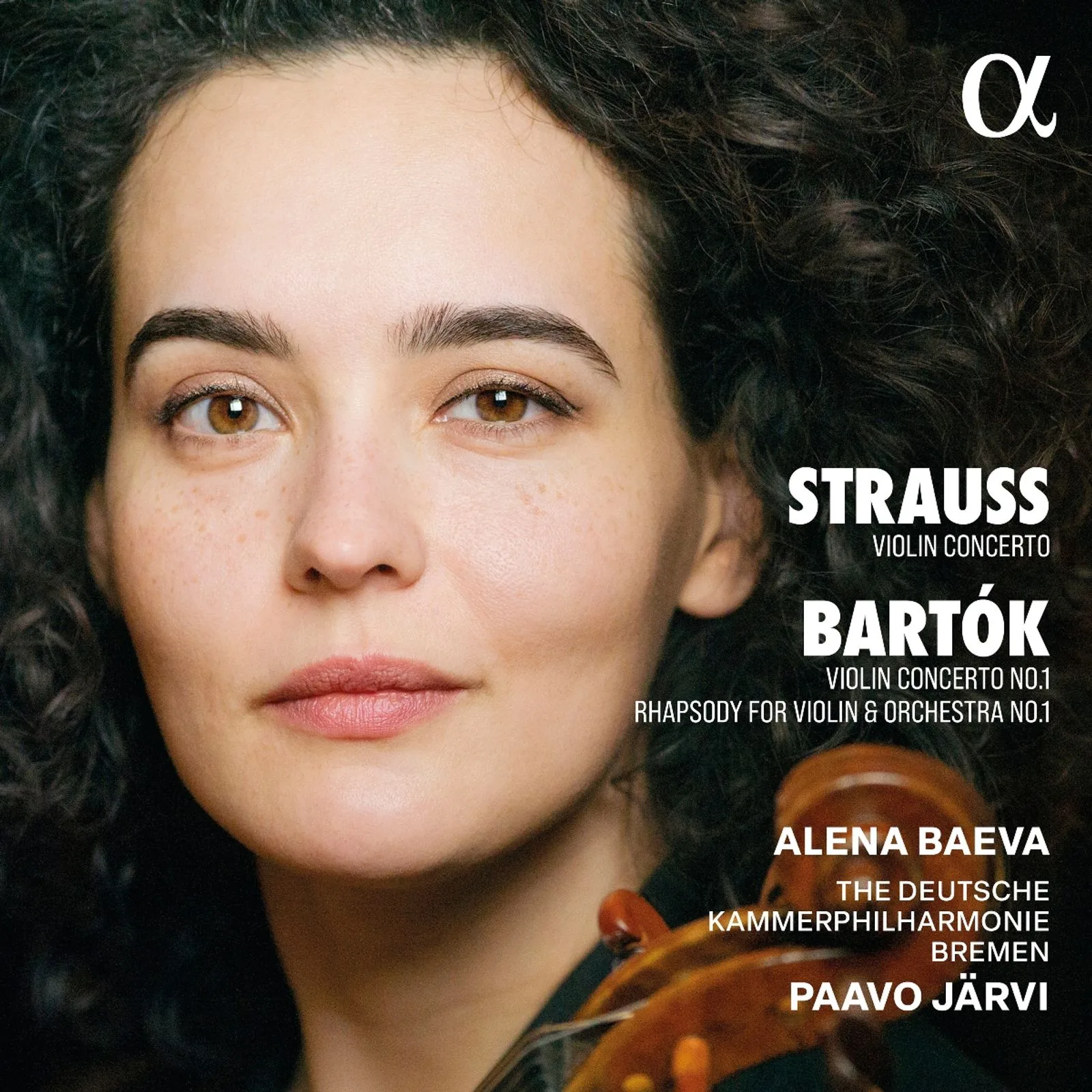
A youthful violin concerto by Richard Strauss (1864-1949) alongside two works by Béla Bartók (1881-1945) from very different phases of his development: the combination yields a fascinating programme that not only illuminates the evolution of both composers, but also brings together diverse facets of the violin repertoire. Alena Baeva deserves praise for her choice of repertoire that does not immediately belong to the core canon. The three works moreover call for a different approach: from the romantic lyricism of Strauss to the searching, personal language of the young Bartók and the folk-music energy of his later Rhapsody.
Between playfulness and stillness
Richard Strauss was barely eighteen when he composed his Violin Concerto. It is not a masterpiece that can simply be measured against the great romantic violin concertos, but it possesses sufficient individuality to hold the attention. At times the kinship with Mendelssohn shines through, while here and there something of the later Strauss already glimmers. The charm lies above all in the combination of a still distinctly romantic lyricism with playful passages and moments in which the soloist can display his virtuosity. And especially in this performance one wonders why this concerto is heard so rarely in the concert hall.
The orchestral introduction receives sufficient space and character under Järvi. Baeva takes up the challenge with conviction and treats the concerto as though it belonged to the standard repertoire. She brings fire where needed, but also leaves room for stillness. In the first movement, what stands out is how naturally she lets the virtuoso passages connect with the lighter, playful moments. The pointed accents in the strings give the whole momentum, while the woodwinds provide refinement.
The second movement opens beautifully with the woodwinds, after which Baeva sounds almost pleading, without the lyricism becoming sentimental. She gives the melodic lines all the space to unfold while keeping the dreamy atmosphere intact. In the third movement the music initially shifts to a faster tempo, but here too the singing side of the work receives sufficient weight. The alternation between lyrical slowings and virtuoso passages proceeds naturally. Soloist, conductor and orchestra find one another in a performance that brings Strauss's youthful work to life with conviction.
A personal musical document
With Bartók's First Violin Concerto the sonic landscape changes entirely. The work was composed in 1907–1908 and was dedicated to the violinist Stefi Geyer, with whom the composer was in love. She did not perform the concerto; the manuscript only came back to light after her death. That personal background gives the music an additional dimension, but even without that knowledge, the cautious, almost hesitant tone of the violin immediately speaks to the listener.
Baeva initially lets the violin search tentatively for its way. Her full, warm tone gives this passage something very personal. The strings respond beautifully, after which the woodwinds further open up the sonic picture. When the orchestra swells and the music becomes more intense, the violin continues to follow its own path. It is precisely in this interplay between soloist and orchestra that the strength of this performance lies: the solo part retains its own character, even as the orchestra gains in power. The music thereby acquires something vulnerable, as though the solo part only gradually exposes itself.
The second movement brings a clear turn. The rhythmic element receives more emphasis, both in the solo part and in the orchestra, and Baeva reveals a more direct, sometimes sharper side of her playing. Yet the music continues to sing, with a slightly unruly undertone that gives it its character. Towards the end the woodwinds add a piercing colour. Then the orchestra erupts forcefully, only to make room for the violin, which re-enters almost unperturbed. The lyricism returns, now with a particularly beautiful harp accompaniment. Baeva lets that transition breathe calmly and thus brings the work's various moods together naturally. It is precisely the contrast between the orchestral outburst and the composed return of the violin that makes this moment especially striking.
Folk-music energy
The First Rhapsody, written more than twenty years later, reveals a different Bartók. The music is based on Hungarian and Transylvanian folk melodies that the composer collected and arranged. The two movements, Lassú and Friss, move from a freer, sustained atmosphere to an increasingly exuberant and lively character.
Baeva and the orchestra give the Rhapsody a strong pulse, without reducing its restlessness to mere effect. In the sustained first movement the violin is given full scope to shape the melodic lines supply; in the livelier second movement the emphasis shifts to rhythmic momentum and virtuoso exuberance. The violin responds flexibly to the changing orchestral colours and retains a distinctly personal sound even in the most exuberant passages. This alternation between expressive freedom and rhythmic sharpness gives the performance its convincing force.
The recording also contributes to the listening pleasure. The violin is well balanced with the orchestra, while details in the accompaniment, such as the harp and the individual orchestral colours, remain clearly audible even in the full tutti.
More than an unusual combination
With this CD, Alena Baeva shows that less frequently performed works need not be approached as curiosities. Strauss is given room to shine without being made larger than he is; in Bartók, both the personal lyricism of the early violin concerto and the folk-music energy of the later Rhapsody are convincingly brought to light. The greatest merit of this recording is that Baeva does not blur the differences between the three works, but gives each one a different sound and expression. In this way, a less obvious programme grows into a convincing plea for repertoire that deserves to be heard more often.
