

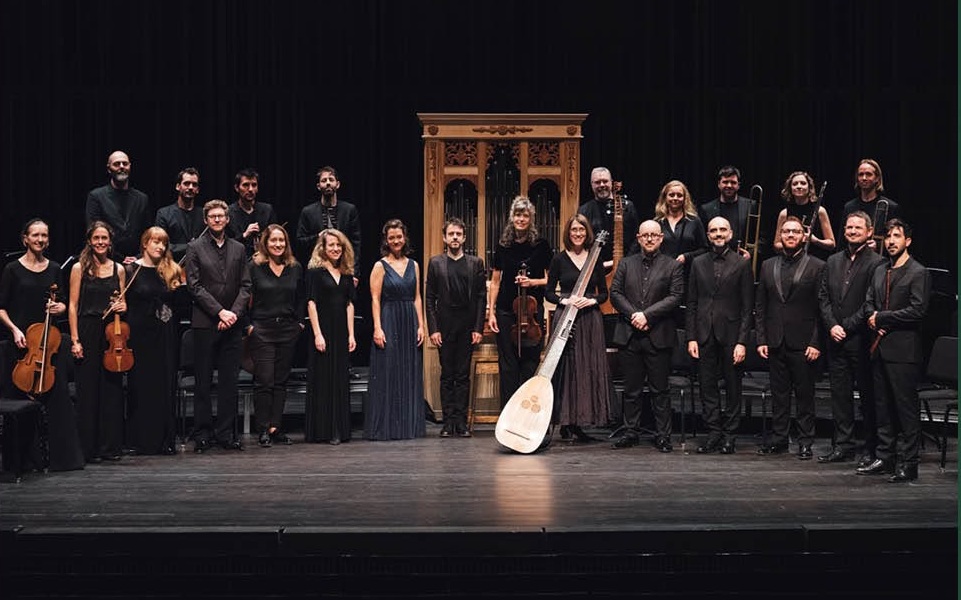
The concert was structured around the theme of love and death. More specifically, it referenced the love stories marked by the death of Karel V and Isabella van Portugal, and the death of Caterina Martinelli, one of the favorite singers of Vincenzo I Gonzaga, the Duke of Mantua.
The seventy years between both events gave musical leader and cornet player Lambert Colson the opportunity to draw from a particularly extensive repertoire, with everything between Josquin and Monteverdi. Moreover, a mix was presented of secular and religious repertoire. Plenty of possibilities, then. But in my opinion, this also contains a pitfall.
The concert opened at the back with a playful La Spagna by Josquin. This well-known bassa danza immediately set a high qualitative tone for the concert: high! Very high! And always in a natural manner. The overwhelming start was immediately followed by what could almost be considered a piece of chamber music: soprano Alice Foccroulle brought her message to a knight in a very intimate vocal manner, set to music by Gombert.
Immediately after came what was for me the first highlight of the evening: the lamentation on the death of Isabella by Nicolas Payen, until then a relatively unknown Franco-Flemish composer to me. With four lines of text, he wrote a poignant motet, centered around Cur requiris? Why do you ask about that? Vivit, non obiit. She is not dead! She lives. This thought would ultimately become the red thread throughout the entire concert.
The motet Mort m'a privé (on text by Karel V?) by the well-known Thomas Crécquillon paved the way for his mass, composed on the same theme and with numerous references to longing, death, and so on. A work that in itself deserves a place as a centerpiece.
And here lies, in my opinion, a programmatic weakness. By choosing a particular theme, one can, especially with early music, take the contemporary listener through recognizable situations into a repertoire that might otherwise be difficult to access. As mentioned: from Josquin to Monteverdi. But if there is also a mix between secular and liturgical repertoire, it becomes quite complex. Because with a mass, you immediately enter the core of something that is no longer secular.
In theory, the same could be said of songs about love and longing, but mass sections carry a different connotation, I think.
In all honesty, I remained somewhat hungry with Crécquillon's mass. I initially didn't know why. It was performed more than competently. The lines expressing longing and depth were rendered excellently, among other things by the full bass voice of Jimmy Holiday. Could it have been related to the fact that all mass sections were 'accompanied'? That also sounded beautiful and could well have sounded that way. Yet I had the feeling that the whole remained somewhat flat and was sung with little inspiration.
That approach was unfortunately continued in the well-known motet Todos los bienes by Encina. There are so many recordings of it: slow, fast, with Northern restraint, with Southern passion. I missed a clear direction here. Why this was fortunately soon became clear.
After a brief and sympathetic intermezzo in which Lambert Colson provided some context, he performed Vergine bella by Cipriano de Rore as soloist, accompanied by lutenist Johannes Ötzbrugger and continuo player Joseph Rassam. These two created, incidentally, throughout the entire concert an essential 'foundation'.
This was a masterstroke.
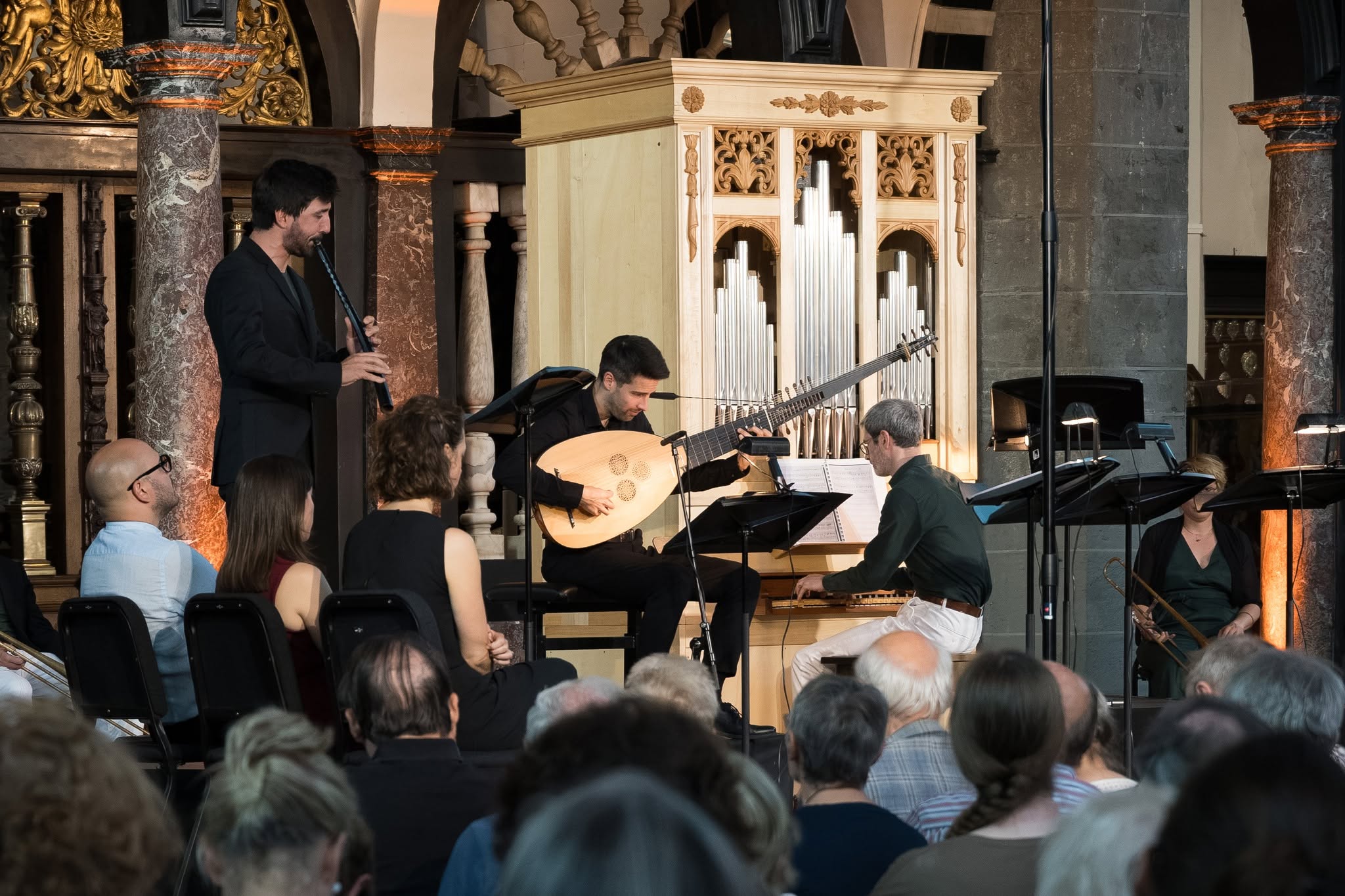 I sensed that Colson at that moment made the bridge between the heavenly and the worldly. His extremely virtuosic interpretation of the motet was exactly that. Although Petrarca's text can be considered rather secular, the motet is clearly also a heavenly hymn of praise. I think De Rore intended it that way too.
And then, from that moment on, the concert enters a different tempo. Just like the artists.
All color palettes of voice and instruments were opened up in a heavenly Incenerite, spoglie by Monteverdi.
What text interpretation and expression! You saw the tomba, you felt the ira and you could only mourn along with the pianto.
Really!
Here the concert got underway and transcended the proverbial review description of 'competently performed'. If I were Colson – however appropriate his academic approach may be – I would trade the mass sections for, if it really must be religious, motets that likewise express love, death, and longing. The choice is vast!
Perhaps Colson felt exactly what I wrote above, because In die tribulationes, a strong motet by Guami, was interpreted solely by instruments. A justified choice, in which the fantastic trombonists Defendi, Hanssen, Van Passen, and Vrooman were able to convincingly do their thing. They again demonstrated how they manage to present each polyphonic line clearly and distinctly.
What a feast for the ear… even though it's about 'days of tribulation'.
In the following madrigal by Monteverdi, Dunque, amate, reliqui un mar di pianto, I was especially struck by the high tenor Andres Montilla. What text interpretation, with correct vocal placement at the right moment! Together with Benedict Hymas and Ricardo Pisani, these 'three tenors' formed a wealth to listen to, each with their own palette.
There was also room for a solo piece with organ and lute alone. Beautiful and soothing. Often you have the feeling that the lute disappears into the whole. That was not the case here. It gave – literally – that 'key strike' to make everything just a bit more lively. Well done.
As I said: after Vergine bella the concert took an emotional and musical dive, with numerous highlights. The well-known Lasciate mi morire was one of them.
Colson clearly opted for a more restrained interpretation. Where it is often sung theatrically and with Southern passion about 'let me die', the singers here chose a performance that was much more introspective. The questioning ending, however, always remains intact!
Special mention also for mezzo-soprano Maria Dalia Albertini, who, like Foccroulle in her solo, brings the necessary calm and conviction.
The concert ended with the strophic song Questa vita mortale by Cavalieri.
At the beginning I wrote: Vivit, non obiit. She is not dead! That thought forms the common thread. Here it is confirmed: on the one hand by the awareness that heaven gives life and the wind blows it away again, but on the other hand also by the hope and desire of those left behind that they will find each other again one day, surely and certainly, in a safe haven.
And so the concert navigated between heaven and earth, between passionate rapture and religious seriousness.
A daring programmatic choice, which found its strength especially in the second half. InAlto proved once again, and extremely successfully, its idiosyncratic approach. That was appreciated by the large audience. Probably not only in the church, but also at home, because the concert was broadcast live and can therefore perhaps still be heard again.
Do it, I would say. This is the kind of concert that is 'riper' the second time than the first.
MAfestival InAlto photos: MAfestival / Laia Van den Borre concert: Friday 7 August 2026, Sint-Jacobskerk, Brugge