


Imagine yourself an open violin case on the floor. A fiddler is playing for the passers-by. There are a few coins and banknotes lying around. Imprinted on these black and white currencies are the faces of three composers: Claude Debussy (1862-1918), Maurice Ravel (1875-1937) and George Enescu (1881-1955). The image is less far-fetched than one might think and, most of all, breathes just the kind of nostalgic atmosphere that Philippe Graffin wants to convey with his latest recording project called À la Valse. Klassiek Centraal put on its dancing shoes together with the acclaimed French violinist and the Belgian pianist Tim Mulleman, who made the arrangement for strings of Ravel's iconic poème chorégraphique.
December 12, 2020. It has been exactly one hundred years since the première of La Valse, Maurice Ravel's stunning apotheosis of a genre that dominated much of the 19th century and became a hallmark of the by then defunct Austro-Hungarian Empire. The end of the First World War also marked the end of the waltz, of which Ravel so vigorously wrote its obituary. Strangely enough, the daring composer did so by creating yet another waltz, be it a very atypical one. "Un tournoiement fantastique et fatal", he called it, celebrating a bygone grandeur brought to a halt by the decline and ultimately the destruction of what the Austrian novelist Stefan Zweig (1881-1942) in his autobiography described as "the Golden Age of Security". On this occasion, and to celebrate his compatriot's audacity, the French violinist Philippe Graffin (Romilly-sur-Seine, °1964) finally wanted to appropriate La Valse too. He therefore commissioned a brand new version of the piece for string nonet with the Belgian composer, arranger and pianist Tim Mulleman (Turnhout, °1993), whose name could well ring a bell. Earlier this month Klara, the Belgian classical radio station, put the spotlight on Mulleman and his piano duo Mimese as part of its series De Twintigers ("The Twenty-somethings"), encouraging promising and often versatile musical talent.
"I know Philippe via the Karski Quartet and more specifically their viola player Diede Verpoest", Mulleman remembers when the three of us meet in Brussels in the middle of January. "We played together as part of Tmesis, a quintet of flute, clarinet, cello, violin and piano, in which Diede plays the violin. The repertoire for this particular combination is not very extensive, so we decided we needed some new music. I arranged Debussy's Prélude à l'après-midi d'un faune, which was actually the way I got into this practice. With Tmesis we played some pieces for Philippe, like the arrangement by Webern of Schönbergs Kammersymphonie. Now, a few years later, he asked me to have a look at Ravel's La Valse."
"I heard about Tim as an arranger already from different musicians and ensembles. I was looking for somebody young from Belgium who knew the piece and actually Tim already performed the version for piano four-hands for quite some time. I was sure he would do something creative and at the same time remain respectful to the piece. I was also looking for someone with whom I could collaborate and share my ideas about the creation of certain details, colours and effects that I already had in my head. Because in my opinion, La Valse is a work that is destined to play a role in a string players' life. To date, so many versions for piano were made that we felt a bit excluded, whereas the original conception of the traditional waltz is very familiar to us string players."
To reinforce his point, Graffin concocted a programme with the waltz as its leitmotiv. First comes the Octet for Strings in C major (opus 7) by George Enescu. Written just after the turn of the 19th century, this vast work culminates into a highly spirited Mouvement de Valse bien rythmé. The twisting and twirling then continues with La Valse, before the acclaimed violinist lives up to his reputation of treasure hunter with Debussy's La plus que lente (Slower than slow): another waltz, originally written for solo piano in 1910, but presented here in a different combination for solo violin, string quartet, double bass, flute, clarinet, piano and … cimbalom.
Philippe Graffin: My whole being is set on the idea that the repertoire is not fixed, but on the contrary is something still to be constructed. Every piece has a life of its own, so to speak. In fact, you can dive into the past and collaborate with composers in finishing their works or uncovering them in a different guise. That's why I spent a good deal of my professional life as a musician searching for and unearthing unknown music. I discovered for example a work by the famous violin composer Ernest Chausson (1855-1899), a friend of Eugène Ysaÿe and student of César Franck, who died young after an unfortunate bicycle incident. He wrote a beautiful concerto-like piece for violin and orchestra called Poème (opus 25). In the middle of the 1990s, I found a version of this music for string quartet, violin and piano that nobody knew about at a bookseller in Paris, near the river Seine. I helped in finding out what it was and in playing it for the first time. In South Africa, I also recorded for the first time the romantic violin concerto (opus 80) by the black composer Samuel Coleridge-Taylor (1875-1912) and I found a version of the last movement of the third violin concerto in B minor (opus 61) by Camille Saint-Saëns (1835-1921) that was actually written fourteen years before but which is conceived as a totally different piece for violin and piano (the Caprice Brilliant, Ed.).
Imagine you would discover yet another unknown masterpiece, which composer would delight you the most, and why?
Graffin: If there was one piece that I would have loved to discover, it would be the Trois Nocturnes that Claude Debussy originally wrote for violin and orchestra. He threw the parts away and made it into the version for orchestra that we know today. There is a letter that Debussy wrote to Ysaÿe where he says that the three movements are like tonal colour pictures – what a study in grey would be in painting – with the first one including violin and strings only, the second violin, wind and brass and the third one a mixture of the different instruments. Because afterwards both gentlemen got into a fight, Debussy changed the music into the nocturnes as we know them. I would have loved to find on the shelve in some old lady's house the original version of these three pieces (laughter). But people say they probably don't exist anymore. I even went to François Lesure (1923-2001), one of the most eminent Debussy scholars, who thought that in his letter Debussy is lying. He just hoped that Ysaÿe could help him perform his opera Pelléas et Mélisande in Brussels.
If neither money nor time was an issue, which project would you immediately like to embark upon?
Tim Mulleman: I'm actually very happy with what's coming on my path. I would never have thought to make an arrangement for strings from Ravel's La Valse for example. Some of the commissions just find their way and give you the opportunity to challenge yourself. I just like to let things happen to me. I don't have a clear idea that in a few years' time I want to write a symphony or some other work. So in that way, I prefer to leave this question open.
As a composer both Leoš Janáček (1854-1928) and Alban Berg (1885-1935) interest me immensely. Therefore, I wouldn't mind to come across a mysterious piece by one of them. Or by Dvořák or Enescu, who worked more or less in the same style. But there is still a lot of repertoire to be written by living composers that also deserves a discovery.
From which version (orchestral, piano, …) of La Valse did you start when making the arrangement for string nonet?
[caption id="attachment_21865" align="alignleft" width="300"]
 Tim Mulleman: "The flexibility of La Valse is actually one of its biggest assets."[/caption]
Mulleman: From every possible version that's available. First of all, I listen carefully to all versions and in many different interpretations. Because I played the quatre-mains version so much, I had the structure of the piece already firmly in my head. Subsequently, it does not work by only redistributing the parts. The really fun part begins when you start dismantling the music and you take the pieces of the puzzle to make another monumental composition but on a different scale. In the end, you don't think about the different existing versions anymore. It has to become a version on its own, totally idiomatic, otherwise the new piece is nothing more than a reduction of the original orchestral version which is of course not what we want to hear. Because there is so much information in the original piece, there is always some reduction involved. But the trick is not to make this noticeable by creating a kind of balance and relief. In my opinion, although I try to keep everyone engaged and give everyone its fair share, a very sober way of arranging could work very well. For instance, we decided to add a double bass to the nonet, but this instrument only becomes noticeable when it does not have to play all the time. As Philippe said, he also had some suggestions. For example, there is a very interesting part where the harp plays some glissandi and long scales. These create a totally different effect on the violin but most of all are terribly difficult to execute. Being the wonderful musician that he is, Philippe showed me how it could be performed.
Graffin: In La Valse we have to be different instruments all the time, so you take on the role of the harp, woodwind or piccolo. We also have to imitate percussion very frequently, with all kinds of plucking and stuff like that, because these instruments play an important part in the original piece. What remains unsaid, is actually the most important in order to evoke an unexpected scale of sounds ranging from very soft and sweet to harsh and dynamic.
Did your re-arranging process of La Valse change the perception of the original piece, and if so: in what sense?
Mulleman: The very goal of making an arrangement is precisely to shed new light on the music. That's the essence, basically. Otherwise, it wouldn't make any sense. Additionally of course, it gives these wonderful musicians the ability to also play this piece and for the audience to hear new and different things. Even for Ravel there was no original version of La Valse. Around this time, an arrangement became more or less the equivalent of the original piece. In Vienna you had this Verein für musikalische Privataufführungen, set up in 1918 by Arnold Schönberg (1874-1951), where it became an art to re-arrange modern pieces in order to make them more transparent. This susceptibility to transparency revealed the mastery of a work. It really became an art in itself to create new versions of already existing works that were on the same level as the initial pieces and got played multiple times for a select group of musicians and listeners.
When a composition is being appropriated in different combinations – orchestra, piano duo and now also chamber ensemble – this means there must be something special about it. Apart from the fact that this ballet music was premiered 100 years ago, what is so intriguing about Ravel's La Valse?
Mulleman: La Valse has a crazy energy that drives you from the first minute till the very last. There is this remarkable tension that you experience from start to ending, with this incredible dance macabre. You can try to analyse the score of course, but it's probably the difficulty to precisely grasp this tsunami of tenseness which makes it a masterpiece. It's truly difficult to perform, also and perhaps especially on one and the same piano.
Graffin: I have the feeling this piece also has a reputation because a lot of the great musicians are pianists. It asks so much virtuosity in whatever version you play it, that it has this kind of aura of a small holy grail within the piano repertoire.
Mulleman: Lucien Garban (1877-1959) made a lot of transcriptions of Ravel's music, among others. Until the end of his life, he also served as the musical director of the well-known publishing house Durand. So he was a very important figure that stimulated this arrangement practice and he did so not only for practical or financial reasons. The version for two pianos of La Valse that Ravel made himself was first of all meant to show the piece to Sergei Diaghilev (1872-1929), who commissioned the ballet. The striking thing is that Diaghilev considered it a masterpiece … but not a ballet. He saw it more like a picture or a portrayal and thus rejected it. Because of this the two got into a big fight. However, in later years, a lot of companies successfully proved that you can turn this music into a ballet. The flexibility of La Valse is actually one of its biggest assets.
In one of his musical essays entitled Viennese sentiment and the good taste, the Dutch writer Simon Vestdijk asks himself the following question: "Already through its multiple interpretability, La Valse is infinitely more interesting than the Bolero; for what is this: ballet music, waltzes that can be danced to 'just like that', a 'poème choréographique'? It is all of this at the same time; but one can accentuate the one or the other, and therefore the leader of the orchestra will do well to determine beforehand which way he wants to go [...]." What way did the ensemble take in this recording?
Graffin: In truth, when we play this piece there is a nostalgia the whole way through. We see in front of us an imaginary couple waltzing and being part of a harmonious world, a world for which we care about but that belongs to the past. This music is particularly fitting for this specific feeling. The text Ravel put at the beginning of the orchestral version of La Valse also expresses something in this sense. It sets the scene of the film, so to speak: "La scène s'éclaire progressivement. La lumière des lustres éclate au fortissimo. Une Cour impériale, vers 1855." When we play we long for this lost time that we want to return to. The piece tells this story, but in the end it turns into chaos because we are so upset that we cannot go back to this somehow romanticized past.
Mulleman: The murmuring start of La Valse is also quite special. You don't know what is happening exactly. Then the basic melody pops up, but only relatively late into the piece. Ravel saw this as the birth of the waltz genre and subsequently likes to jump from one period to the other, making a sort of collage of different styles out of it.
Graffin: To a large extent, you could indeed consider La Valse as a kind of pastiche, but it's not a caricature. Because what Ravel does is never without irony. It's actually a soft and refined form of colonialism, with the composer twisting and turning a cornerstone of Austrian culture, the waltz, into something French. Luckily, it's less harmful to colonize the past than the future (laughter).
Dit is niet de eerste keer dat je Debussy, Ravel en Enescu op één en dezelfde cd combineert, Philippe. Ik doel natuurlijk op In the shade of forests en Fiddler's blues, twee opnamen voor het Britse onafhankelijke muziekabel AVIE Records. Hoe komt het dat deze drie componisten zo gemakkelijk met elkaar verweven raken?
Graffin: Dat is een interessante vraag. Alle drie kenden elkaar natuurlijk, hoewel Debussy schijnbaar een moeilijk persoon was om te benaderen. Dus noch Ravel noch Enescu waren bijzonder dicht bij hem. Maar Ravel en Enescu waren dicht bij elkaar, omdat ze beiden tegelijkertijd en in dezelfde klas van Gabriel Fauré (1845-1924), onder anderen, aan het conservatorium in Parijs studeerden. Ze speelden ook samen. Er is een verhaal van de jonge Yehudi Menuhin (1916-1999) dat hij les kreeg van Enescu en dat Ravel kwam langs vragen aan zijn vriend om zijn nieuwe (tweede) vioolsonate prima vista te lezen en door te spelen voordat hij hem naar de uitgever zou sturen. Dit werk heeft een berucht moeilijk laatste gedeelte (de Perpetuum mobile, Red.). Toch speelde hij het na slechts één keer lezen al uit het hoofd. Ongelooflijk en tegelijkertijd bizarre!
Hoe dan ook, er is een nauwe relatie tussen Ravel en Enescu. In 1924 schreef Ravel zijn Tzigane, een beroemd vioolstuk, als eerbetoon aan zigeunermuziek. Dat was ook het hart van Enescu's inspiratie, komend uit zijn thuisland Roemenië. Op een dag ging Debussy naar Boedapest waar hij een zigeunerviolist in een brasserie hoorde spelen. Daarna schreef hij een van de meest aangrijpende brieven, gebruikmakend van dit poëtische beeld dat de titel van het album In the shade of forests werd. Deze musicus, schreef hij, houdt meer van muziek dan de meesten van ons. Wanneer je naar hem luistert, bevind je jezelf in de schaduw van het bos, verwijzend naar een diep gevoel van eenzaamheid en zelfs existentiële angst: een zeer diep en aanlokkelijk gevoel dat kan worden geïnspireerd door zigeunermuziek. Dit is waarom we in al deze projecten het gevoel hebben dat we teruggrijpen naar de essentie van muziek.
Er is ook een derde Valse op de opname die raakt aan deze essentie. De transcriptie van het solo-pianostuk La Plus que Lente van Debussy is naar ons weten een wereldpremière. Kun je wat meer vertellen over dit bijzondere stuk?
[caption id="attachment_21892" align="alignleft" width="300"]
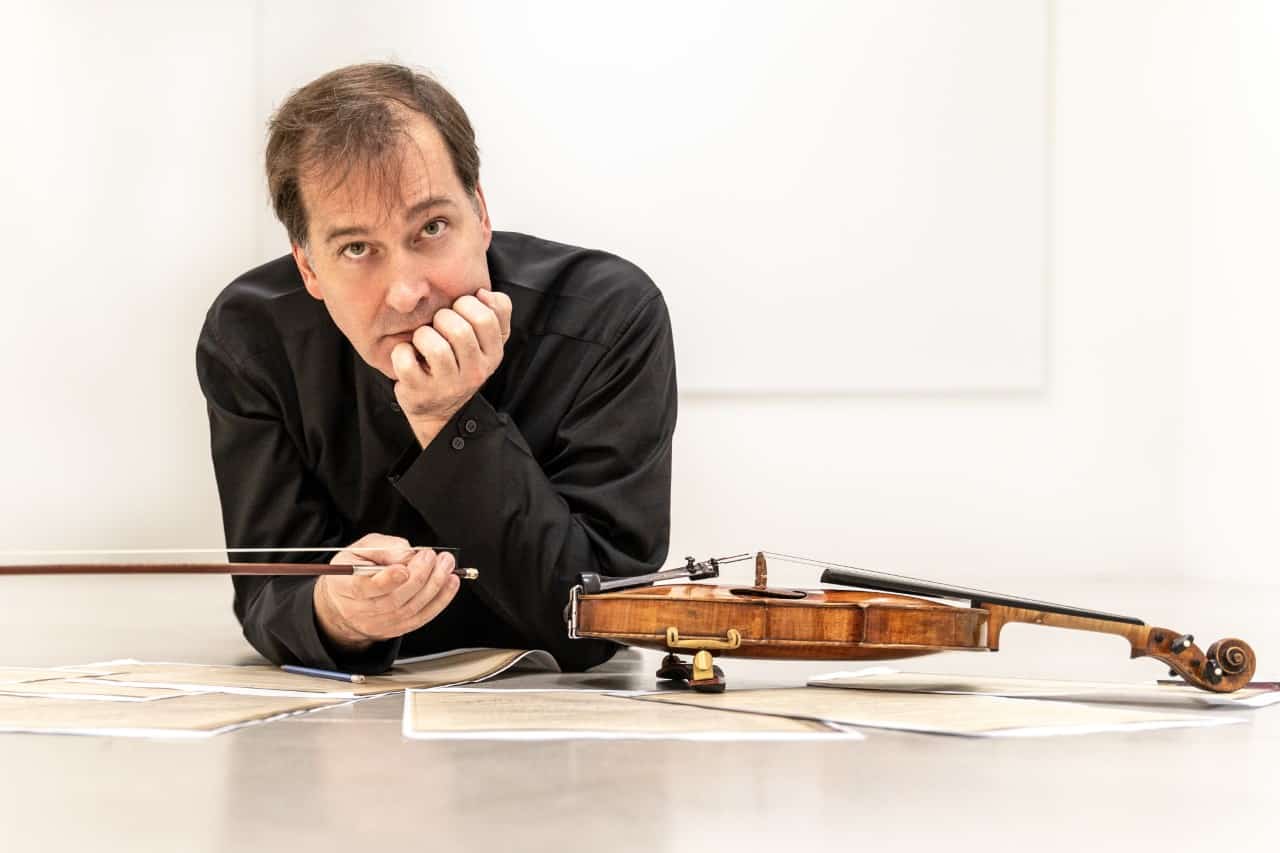 Philippe Graffin: "My whole being is set on the idea that the repertoire is not fixed, but on the contrary is something still to be constructed."[/caption]
Graffin: Ik kwam hierover te weten uit een boek geschreven door de Amerikaanse violist Arthur Hartmann (1881-1956), die een vriend van Debussy was. Hartmann beschreef hoe Debussy hem en zijn vrouw meewas te eten nemen naar Hôtel Ritz in Parijs, waar een zigeuneroband in residence was. Debussy hield ervan naar hen te luisteren. Op een avond, nadat zij naar huis waren gegaan, zette Debussy zich aan de piano en begon La Plus que Lente te spelen, dat hij zojuist had gecomponeerd. Zijn vrouw zei dat hij de hele zomer van 1910 aan het schrijven van deze muziek doorbracht in een poging om iets erg populairs te componeren en hem dus goed geld zou opleveren. Nadat hij het een tweede keer speelde, begon Debussy te beschrijven welke instrumentatie hij voor dit stuk zou willen, verwijzend naar de zigeuneroband en hun cimbalom die zij eerder hoorden. Hartmann vertelde hem dat hij er een thuis had. Slechts twintig jaar later ontdekte hij dat Debussy een transcriptie van zijn muziek voor orkest en cimbalom had gemaakt. We nemen dit stuk op als een soort toegift in een zeer zeldzame versie voor solo-viool, strijkkwartet, contrabas, fluit, klarinet, piano en cimbalom.
Samen met Ravels La Valse, is het Strijkocttet van Enescu het andere grote werk op de opname. Het is een erg lang, complex en uitdagend stuk dat zowel de uithoudingsvermogen als de analytische capaciteiten van de musici test. In welke mate ben je tot de kern van dit stuk doorgedrongen?
Graffin: Het octet is een formatie waarvoor je meer mensen nodig hebt dan bij een strijkkwartet of pianotrio, die eigenlijk elke dag kunnen repeteren. Maar om acht mensen dagelijks toe te zeggen is bijna onmogelijk. Dus je kunt deze stukken alleen af en toe spelen en dus onder aanzienlijke tijdsdruk. Anderzijds is de muziek van Enescu ongelooflijk complex en was lange tijd ook erg impopulair. Veel musici kennen zijn Octet niet, wat betekent dat wanneer ze het op een festival moeten spelen, ze werkelijk moeite hebben om het vol te houden. Daarom is het idee om tot de kern van dit stuk door te dringen utopisch. Maar daarmee bedoelde ik de tijd te nemen om elke zin te verkennen en echt het karakter dat ik in deze muziek zie eruit te halen en met het publiek te delen. Natuurlijk kom je in muziek nooit tot de kern van iets. Omdat het vluchtig is. Maar wat we deden was proberen het Octet enkele dagen vast te houden en het zeer dicht tegen ons aan te nemen.
Welke gevoelens roept dit Octet op, wat is het karakter van dit stuk?
Graffin: Because of its length, it has very different moods. But what I'm most impressed by is that this complex work is written by a very young person. Enescu was only nineteen years old when he wrote his Octet. Moreover, the construction is without fault. The composer takes you by the hand from the first theme all the way till the very last note. You hear something particular and at the same time very honest in this music, which also has something exotic and unhinged. At some point, in the main theme of the slow movement (Lentement), I even hear a quote of Guillaume Lekeu (1870-1894). Enescu was probably touched by the untimely death of the Belgian composer and was influenced by the second movement of his violin sonata (Très lent). Both movements have a similar character, namely of a popular folkloristic song.
In January 2019, the first edition of TRACES Festival which was founded by you took place in Brussels and is a project aiming at the promotion of unjustly neglected chamber music repertoire, as well as helping young talented artists perform. Will the second edition in 2021 be able to take place, and what are the musical paths you want to uncover with the new programme?
Graffin: It should have happened in January, but unfortunately in current times it's impossible to perform live concerts with an audience or to plan anything. For now, we have a film of us playing Enescu, Ravel and Debussy which we will use a kind of calling card for the festival. I would like to do another project next year with a composer called Karl Weigl (1881-1949). His work is wonderful. He wrote among others a beautiful String Sextet and several works for voice and chamber ensemble. I would like to find a little bit of funding to make this initiative come about. The idea of TRACES is actually to play in every concert a piece from a composer whose life was affected by the Holocaust. Some of them died in a concentration camp, while others fled overseas. In the case of the Austrian-born Karl Weigl, he and his wife Vally Weigl (1894-1928), who was also an accomplished composer, ended up in the United States. The reason we don't know his music was exactly because of the political oppression of Jewish artists which occurred in the 20th century.
Maybe the following short but particularly touching piece by the South-Korean composer Jo Yeong-wook is worth an arrangement. For when the audience at the festival is crying out for an encore … In any case, the final song featuring the soundtrack of the movie Old Boy (2003), aptly called The Last Waltz, seems an appropriate way to conclude our conversation. Thanks a lot gentlemen!
- WHAT: Interview about the À la Valse project
- WHO: Philippe Graffin (violin) & Tim Mulleman (piano, arranger)
- WHERE & WHEN: Brussels, January 16th 2021
- PHOTO'S: © Marije van den Berg & Hiu-Man Chan
- TRANSLATION INTO DUTCH: click here